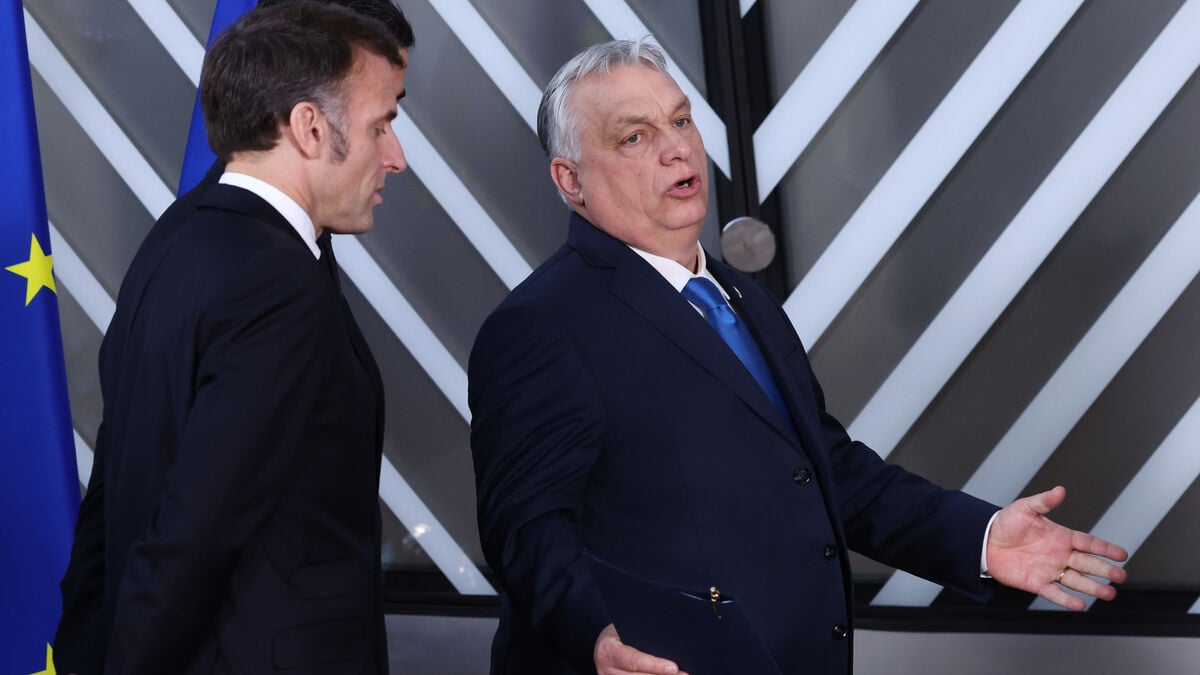
Prime Minister Orbán stubbornly refuses to give the go-ahead for an emergency multi-billion-dollar loan to Ukraine, despite Hungary not having to help finance it and despite having said yes at a previous summit.
Legally, Hungary still has the power to stop the money if it says no when the loan decision itself is formally made at a ministerial meeting.
The situation highlights one of the EU's major weaknesses: the inability to act against a member state that stands in the way.
To court?
The European Commission can initiate infringement procedures against countries that do not follow EU decisions. But it is a long process, with letters sent back and forth before a case possibly reaches the EU Court, which also takes a long time to decide.
One idea put forward for the Ukraine loan is to do the opposite: deliberately circumvent the rules, declare the loan approved, and then have Hungary take the EU to court.
However, the consequences could be severe once the court gets involved.
Support from Slovakia
The EU has no clauses that allow a country to be expelled from the union. The closest thing is the so-called Article 7 procedure, where a country that violates fundamental rules and values can lose its voting rights.
However, making such a decision requires total unanimity. This means Orbán can sit quietly, as long as he has a like-minded ally in power in another EU country. Previously, he was backed by the former Polish government. Now it is Slovakia, with flanking support from the Czech Republic and perhaps even Italy.
Changing the rules would require a change to the EU's founding treaties. Almost all member states view this with horror, as it could spark a host of other discussions and paralyze EU cooperation for a long time.
Emergency clause
Instead, other avenues are being explored. New budget rules were introduced last year that allow funds to be withheld from member states if there are risks or concerns about misuse of EU funds.
In December, they also pushed through a measure to freeze Russian state assets indefinitely, rather than just six months at a time, by referring to a special paragraph on a state of emergency.
Allowing more decisions to be made by majority rather than unanimity is another option. But consensus is first required to change the rules.
Article 7 of the EU's Lisbon Treaty states that a majority of the European Commission, the European Parliament or the member states can initiate a special procedure when a member state is considered to be violating fundamental EU values such as "respect for human dignity, freedom, democracy, equality, the rule of law and respect for human rights, including the rights of persons belonging to minorities".
The process takes place in several stages, with hearings and recommendations mixed with formal decisions. If it reaches the point where it is decided that an EU country is truly violating the values, all other EU countries must vote in favour. Any sanctions that can then be imposed - such as temporarily suspending the country’s voting rights in the EU - must also be decided unanimously.
So far, Article 7 proceedings have only been initiated against Poland (2017-24) and Hungary (since 2018). However, neither process has even reached a vote on whether there is a clear risk of a breach of values.
Here are some leaders who have expressed support for Hungarian Prime Minister Viktor Orbán:
* US President Donald Trump - said "I hope he wins big" in a video message this weekend ahead of the election in Hungary.
* Russian President Vladimir Putin - thanked Orbán in a phone call in early March for Hungary's "principled" and "independent" Ukraine policy.
* Slovak Prime Minister Robert Fico - blocks sanctions along with Orbán and, like him, refuses to sign the EU's latest Ukraine statements.
* Czech Prime Minister Andrej Babis - whose party is part of the same party group in the EU Parliament as Orbán's Fidesz and also the French National Rally, the Danish People's Party and the Belgian Vlaams Belang.