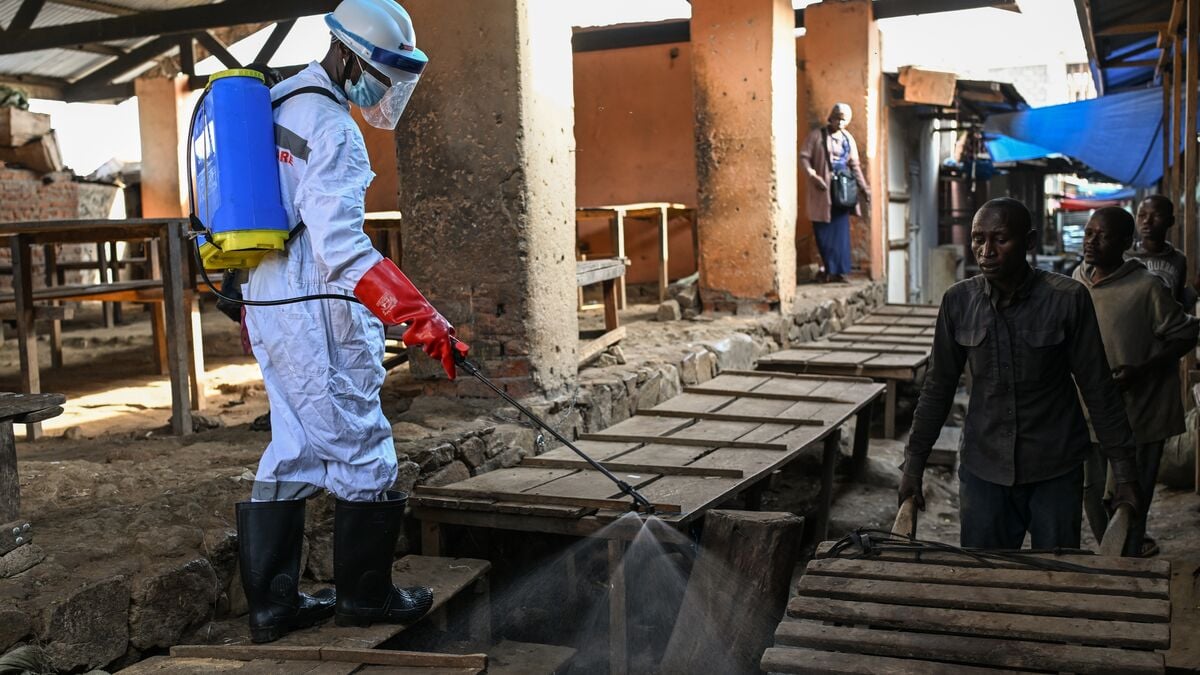
Esther Sterk is a doctor specializing in tropical medicine and has worked on previous Ebola outbreaks. Since Friday, she has been on site in Bunia, the capital of Ituri province in northeastern Congo-Kinshasa.
It was there that the first known case in the ongoing epidemic was confirmed, this time in the form of the Bundibugyo variant for which there is neither a vaccine nor specific treatments.
Just over a week later, there are nearly 900 suspected cases and just over 200 deaths. This is probably an underestimate.
The outbreak was most likely already underway before April, and it was discovered quite late because there was no good surveillance system in place, says Esther Sterk.
Mobility
Because the outbreak has gone undetected, cases have been able to spread in different directions, she says. Northeastern Congo-Kinshasa is an area where the population moves a lot for various reasons.
It is a province where the mining industry is big - many people go there to work and then return home. There is also an armed conflict going on and people are fleeing the area.
Some also travel to the larger cities for better healthcare.
With all this mobility, the outbreak has been able to spread, and there is a risk that it will spread further, says Esther Sterk.
Isolation and tracking
Cases linked to the outbreak have already been reported in neighboring Uganda, and the African Union's public health agency Africa CDC on Saturday identified ten more African countries that are at risk of being affected.
"To control this outbreak, we need to isolate all suspected Bundibugyo patients. And we need to trace all people who have been in contact with the patients, so that if they also develop symptoms, they can be immediately isolated to avoid further spread," says Esther Sterk.
More protective equipment and better diagnostic capacity are also needed. Another challenge is to be able to carry out safe burials, as bodies remain highly contagious.
Esther Sterk emphasizes that it is an already very poor part of Congo-Kinshasa that has been affected by the outbreak. Therefore, Doctors Without Borders will also try to increase access to non-Ebola-related care. This includes continuing to vaccinate against measles and treating malaria and pneumonia.
We must ensure access to care for Ebola, but we must also ensure that access to care for other diseases continues and improves.
Ebola virus is an RNA virus that causes hemorrhagic fever. There are six variants of Ebola virus - four of which cause disease in humans.
The Bundibugyo virus variant is behind the current outbreak in Congo-Kinshasa. There are no vaccines or specific treatments for it, making the situation particularly challenging.
Ebola virus is transmitted between people through bodily fluids. Sexual transmission also occurs.
The illness develops rapidly with flu-like symptoms such as high fever, headache, sore throat, stomach and intestinal symptoms and muscle pain. At the end of the course of the disease, bleeding may occur on the skin and in internal organs.
The mortality rate is estimated to be 50–90 percent in outbreaks in affected African countries. With access to adequate intensive care, the mortality rate is likely to be significantly lower.
Source: Public Health Agency of Sweden, CDC