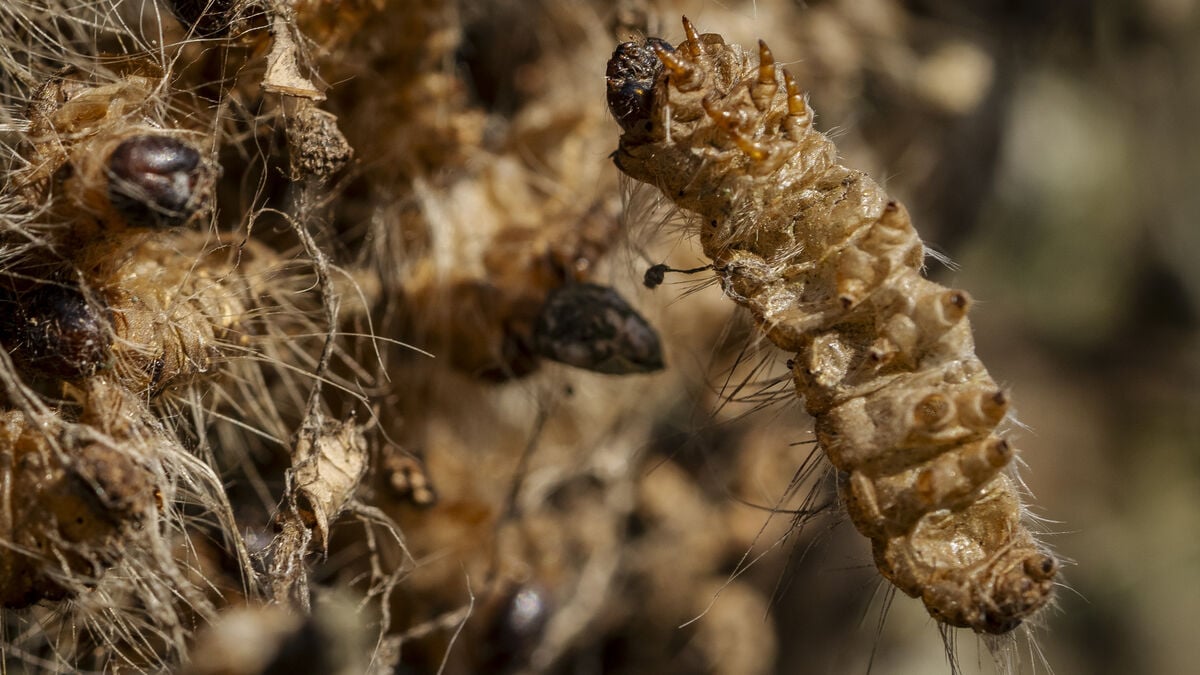
The larvae will likely also appear in Sweden, according to Didrik Vanhoenacker, a biologist at the Swedish Museum of Natural History.
If the climate gets warmer and the larvae establish themselves in Denmark, they will most likely spread gradually to the Copenhagen area and then appear in Sweden, he says.
The oak processionary moth gets its name from the fact that it lives on the leaves of oak trees and the larvae move in a procession as they search for a new host tree.
The oak processionary moth has been present in Central Europe for a long time, but now it has spread northward in Europe. It is also found as far south as the Mediterranean. It is a relative of the pine processionary moth, which eats pine and is already found in Sweden, especially on southern Gotland, Didrik Vanhoenacker continues.
Leather
The larvae build communal nests in the oak trees. Before they pupate to become butterflies, the larvae shed their skins several times. The skins with the poisonous hairs end up in the nests, and the hairs can then be spread by the wind. People standing under a tree with a nest can get the larvae's hairs on them.
According to Danmarks Radio, the Ørbækparken preschool in Odense on Funen has been forced to temporarily close after several children suffered itching and a rash from the caterpillar's hairs.
The first living populations of oak processionary moth larvae in Denmark were discovered in Odense in the fall of 2024. Since then, the species has also been found in Nyborg on Funen and Horsens on Jutland, according to Danmarks Radio.
Small eggs
Didrik Vanhoenacker believes that the oak processionary moth may have come to Denmark with purchased oaks from nurseries in Germany and the Netherlands.
Sweden also buys trees from other countries, and it is not possible to know for sure whether the oak processionary moth eggs can then accompany the trees. The moth eggs are only a few millimeters in size, so you have to look carefully to spot them. They often sit on trunks and thin twigs, and often on older oaks where they overwinter, he says.
Residents of Odense are dissatisfied with how the authorities have so far handled the problem with the larvae. A concerted effort against the larvae is needed, according to Denmark's Minister for Nature and Animal Welfare Christian Rabjerg Madsen, who has initiated a coordinated effort with the relevant authorities and the country's municipalities, reports Danmarks Radio.