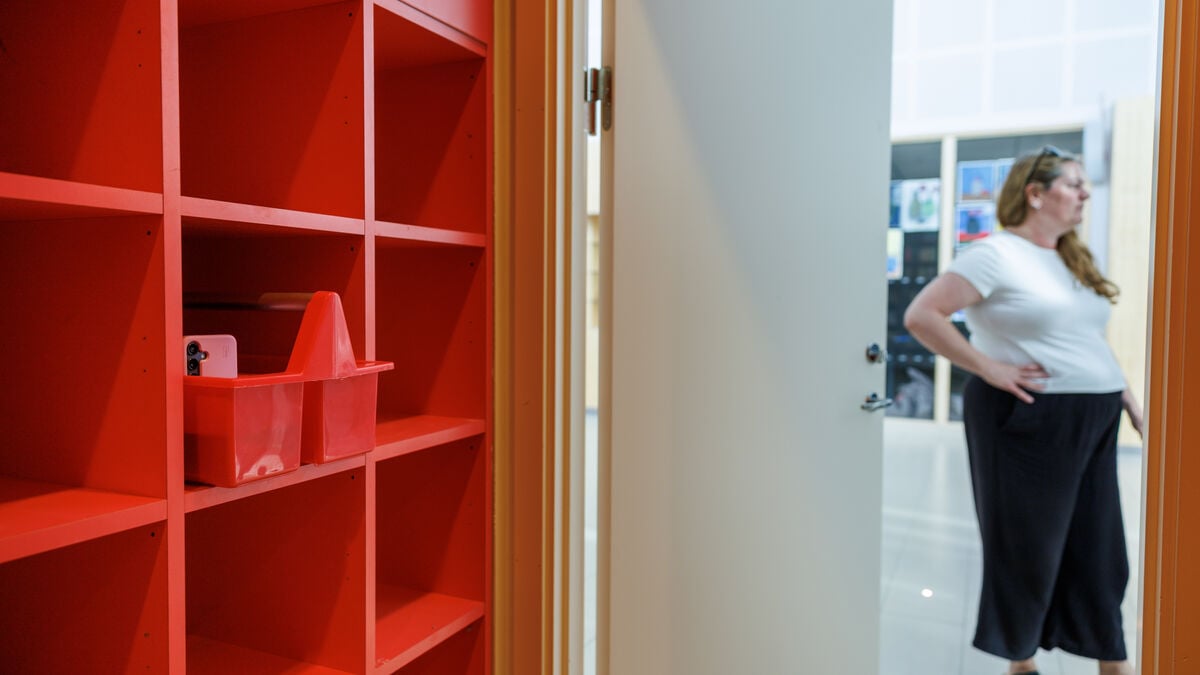
Preparations for the autumn semester are in full swing at Nyboda School in Tyresö outside Stockholm. The old lockers at the entrance have been converted into mobile phone storage, and more clocks have been purchased so that students can keep track of time. More balls and pool cues will make it easier to find things to do during breaks.
We need to give students good conditions to succeed, says the school's principal Magnus Prior.
Students circumvented previous bans
The school tested mobile-free school days back in 2023, but many students got around the ban, for example by hiding their mobile phones in their clothes. During breaks, the students didn't know what to do, says Magnus Prior.
The principal believes that the ban is now in the Education Act and will make a big difference.
It's clearer and without discussion now. It's completely crap to be controlled by social media algorithms. We hope for better school results.
The mobile phone ban was introduced by Education Minister Simona Mohamsson (L) at the beginning of the year. Approximately 80 percent of primary schools already had some form of mobile phone ban, but now it is legally in effect throughout the day. For 2026, the government is allocating SEK 95 million for lockers and administration, and SEK 100 million annually thereafter.
"School must be a sanctuary so that you can focus on your lessons and socialise during breaks. All research shows the positive effects on concentration," Simona Mohamsson tells TT.
Concerns about teacher workload
The Swedish Association of Local Authorities and Regions (SKR) has previously raised practical challenges with an all-day ban.
Schools need to organise storage and who will collect the phones. There has been concern about more administration for teachers. Many schools already have a mobile phone ban, but we hear that some would have liked more flexibility in how to solve it, says Monica Sonde, head of SKR's education department.
Simona Mohamsson says that she rather believes that the ban will reduce chaos in the classroom when the submissions are done together in the morning. At the same time, SKR points to future challenges with smart watches and other wearable technology that are constantly developing.
There is a risk that people will try to get around the rules. Ultimately, it is about students and schools seeing value in the reform, says Monica Sonde, who hopes that the law will lead to a healthier balance between digital and analogue tools in schools.
The national mobile phone ban will apply from the autumn semester of 2026 and means that all students will hand in their mobile phones at the start of the school day and get them back at the end of the day.
The ban applies to all compulsory school types and also to after-school centres.
The goal is increased study calm and concentration as well as more togetherness during breaks.
The government will allocate SEK 95 million in 2026 to enable schools to purchase mobile lockers and for administrative costs for delivery and collection. From 2027, SEK 100 million will be allocated annually.
Exceptions may be made for special needs or specific teaching.
Guidance will be available in early 2027 on how schools should act when students try to violate the mobile phone ban.
Source: Government, Swedish National Agency for Education, SKR.