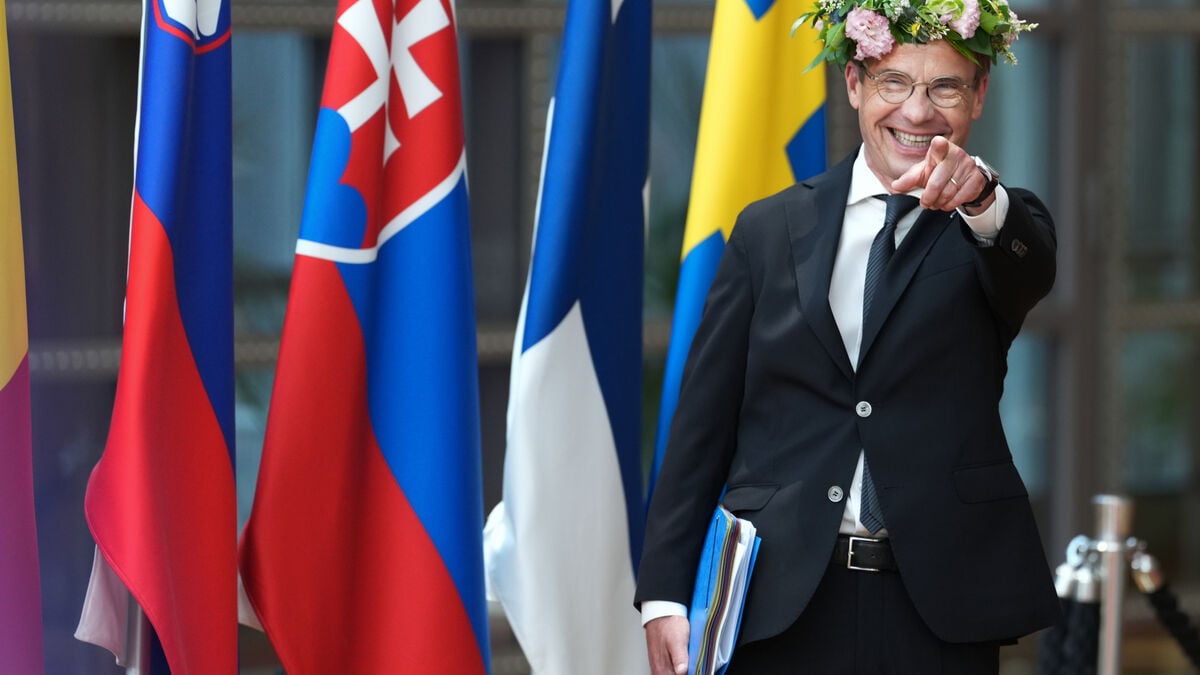
Sweden remains on what its opponents call the “stingy” side in the budget battle. Together with countries such as the Netherlands, Austria, Germany, Finland and Denmark, it is working to keep down the joint expenses that the EU will have to manage during the years 2028–2034.
The compromise offer recently presented by the spring presidency country, Cyprus, is not well received.
"I have said directly to Cyprus that this is not even the start of talks. This means a sharp increase in the size of the budget. We need a better budget - not a bigger one," says Kristersson on site at the ongoing summit of EU countries in Brussels.
Fight against Spain
On the other side are a significantly larger group of countries, including major economies such as Italy, Spain and Poland. They support the new investments that the European Commission wants to make in defence and competitiveness, but also want to maintain large and strong support for agriculture and regional policy.
No solution is yet in sight. The discussion at Friday's EU summit was mostly another sparring session where both sides presented their arguments.
"We got nowhere at all," Kristersson notes afterwards.
Instead, the fight continues at the civil service and EU ministerial level with negotiations that will lead to another compromise offer, this time from Ireland, the autumn presidency, sometime in October.
"At some point we will agree and if it can happen sometime before 2027 . . . then that is an advantage. But for me the content of the budget and Swedish taxpayers' money will be much more important than exactly when," says Kristersson, who does not feel there is any rush to reach an agreement.
Sweden definitely has patience. Whoever is in a hurry now is the one who loses.
Conversation about China
Friday's meeting followed a long session on Thursday evening and into the wee hours, when the heads of state and government mainly discussed Ukraine and the complicated trade relationship with China.
European companies cannot operate competitively in a situation that is increasingly unfair, says Kristersson.
Afterwards, the European Commission was tasked with “developing and gradually completing the toolbox for trade defence and industrial policy”.
In practice, this means coming up with proposals for new, sharper measures no earlier than this autumn.
There are two clear factions in the discussions about the EU's next long-term budget.
On one side are mainly Sweden, Austria, the Netherlands and even Germany, who want a tighter budget.
On the other side are Poland, Spain, Greece and the Baltic countries, among others, who like the larger investments contained in the European Commission's original proposal.
The long-term budget will apply for the years 2028–2034. The basic proposal is EUR 1,763 billion, corresponding to 1.26 percent of the EU's total gross national income, GNI. A first compromise proposal is now being discussed, in which the amount has been reduced to EUR 1,730 billion.