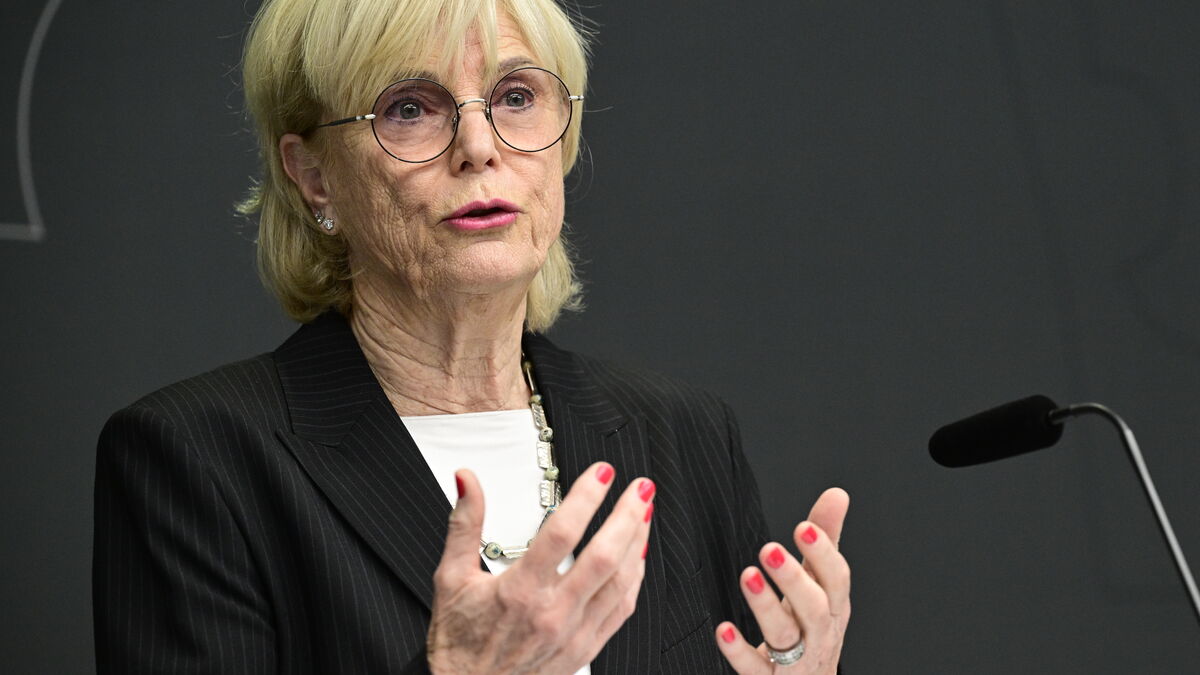
More private money for culture has been a mantra for Minister of Culture Parisa Liljestrand (M), who on Monday received the report "An investment program for culture" to broaden cultural funding.
A lingering 1970s policy has created a vulnerability that is completely unnecessary, Liljestrand says at a press conference where she emphasizes that the government has initiated "a paradigm shift."
A new billion
A new billion in the culture budget could bring in another four billion, according to the investigation, which also calls for a shift in perspective.
Resources for culture must be seen as "investments" to a greater extent than today, according to investigator Karin Forseke, former CEO of the investment bank Carnegie. To achieve this, changes in the law are needed, but also that the value of culture is highlighted at the political level more generally, according to Forseke.
I think politicians should do more to emphasize the importance of culture; they do that in other countries, she says.
The signal values are very large, especially when I have spoken to donors.
According to the investigation, Sweden is currently "in principle" the only country in Europe without the possibility of making tax deductions for cultural gifts - this is proposed to change from July 1, 2027.
It is, of course, an ideological choice, but it is also a choice about Sweden ending up in line with other countries, the Minister of Culture says.
Matching cultural initiatives
The new cultural billion, divided over four years, will go to a special "investment program" where private cultural initiatives are matched with public ones. It is proposed that the current government present a bill with fundraising campaigns for projects of national interest.
This is a way for the political sector to set the agenda and for the private sector to build capital, says Karin Forseke.
Private grassroots fundraising and temporary campaigns should also be able to be matched with public funds.
However, private sources of funding for the cultural sector are not a pretext for reducing public funding, according to the Minister of Culture. At the same time, other parts of the state budget have grown significantly more than culture. Isn't there a risk that only private money will be responsible for future increases?
"I think this will work in a good and balanced way. We also see that when we look at the countries around us that have had it this way for over 100 years. I don't understand why Sweden would be an exception," says Liljestrand.




What do you think?