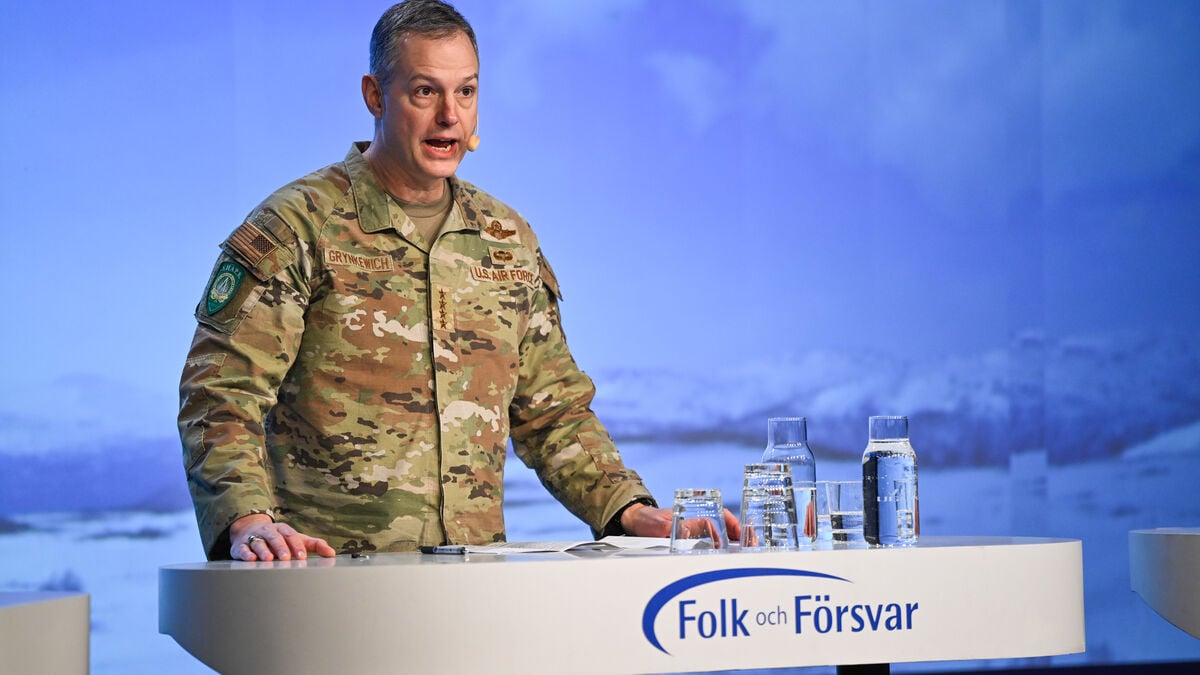
"Military cooperation in this region has never been stronger," says Alexus Grynkewich at Folk och Försvar.
NATO is working on several fronts to strengthen its presence in the North, including better surveillance, infrastructure and logistics, but also through adapted forces.
"Many of them are here in Sweden," says Grynkewich.
He describes, among other things, how Russian and Chinese ships have become more active in the Arctic. But he sees no immediate threat to NATO territory.
"No, I don't think there is an immediate threat right now, partly because Russia is so busy in Ukraine," he says.
He welcomes the fact that NATO countries decided at the recent summit in The Hague to increase their defense spending to 5 percent of GDP, of which 3.5 percent is on military spending. For the first time, money is not a problem for the alliance, he says.
"But money in itself is no deterrent; it is necessary for defense equipment, weapons and ammunition to arrive. That is a big challenge," he says.
However, Grynkewich, who is NATO's top military commander in Europe, dodges questions about the new US national security strategy and President Donald Trump's threats against Greenland. He does not want to get involved in politics.