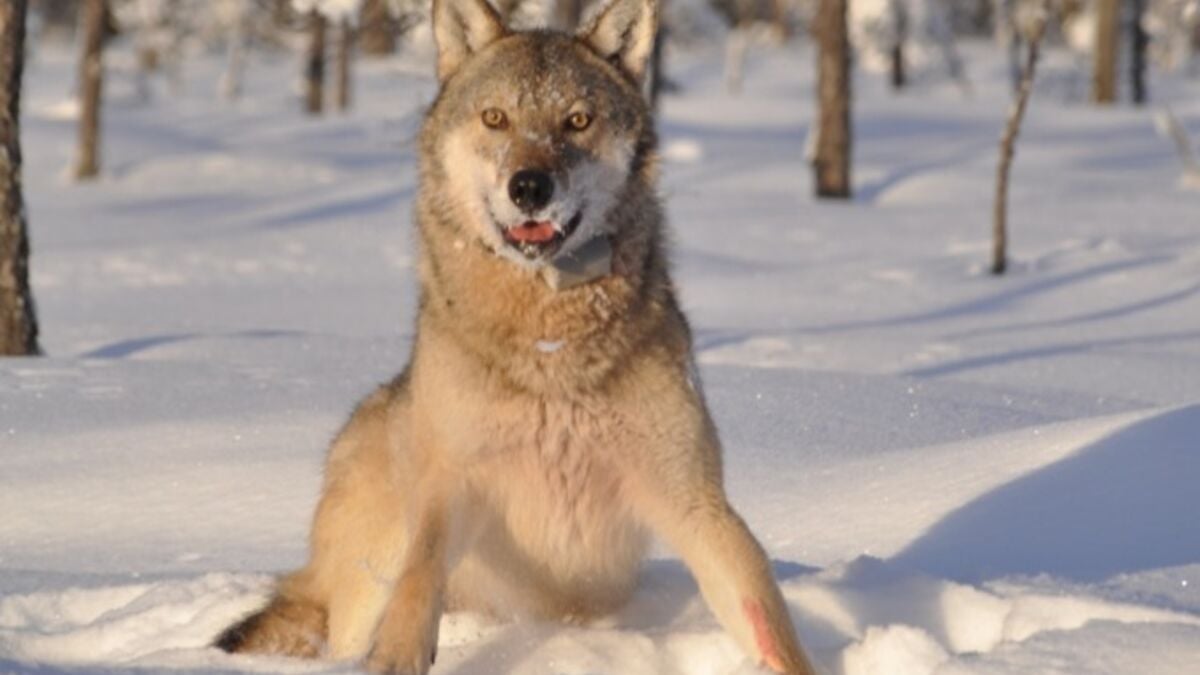
The wolf research project Skandulv has been running for 25 years and has given researchers a nearly complete family tree of the wolf lineage.
Since 2010, 44 wolves have migrated to Sweden from Finland and Russia, a much-needed addition to the Scandinavian wolf population, which has a high degree of inbreeding.
But only eleven of the migrating wolves reached areas where they could form their own territories and have pups. Thirteen were killed during protective hunting in the reindeer herding area.
There may be many who try to establish themselves on the way down, i.e. in Norrland, and that is not a good strategy. There, most of them are removed legally in a protective hunt by the authorities, says Håkan Sand, project manager and associate professor at the Swedish University of Agricultural Sciences (SLU).
Natural causes
He sees several different reasons why wolves are disappearing along the way - legal hunting and illegal killing, but also natural causes.
It is usually young individuals who are on the move and some have not learned how to hunt and survive. Some will probably die from malnutrition, disease or being kicked to death by moose.
The wolf population in Sweden and Norway originates from three wolves that immigrated from the east in the 1980s and 1990s.
So every new individual that comes down and manages to reproduce contributes to increasing the limited genetic variation. Then the immigrant wolves must not only succeed in reproducing themselves, but also have offspring that in turn reproduce. There are several steps that must be successful.
Own offspring
Of the eleven that reached the breeding area, one was killed in traffic, one was killed illegally and the fate of two is unknown. However, seven have had offspring of their own, and the offspring of four of them have in turn had pups.
To prevent wolves from disappearing along the way, attempts have been made to tranquillise them in northern Sweden and move them further south. The results have been mixed.
It's a fairly complicated process. It's been successful a few times, but it's also failed a number of times when the relocated wolf has wandered north again. They have the ability to have a will of their own.
There are around 390 wolves in Sweden and Norway, of which approximately 355 are in Sweden.
When the wolf research project Skandulv started in 1998, there were between 62 and 78 wolves in Sweden and Norway.
Today's Scandinavian wolf population is descended from three wolves that immigrated from Finland and Russia in the 1980s and 1990s. However, there are wolves in zoos that are genetically more similar to the historical population.
So-called hybridization, when wolves and dogs produce puppies, is rare in Scandinavia. There are only two known cases.
Source: Swedish Environmental Protection Agency