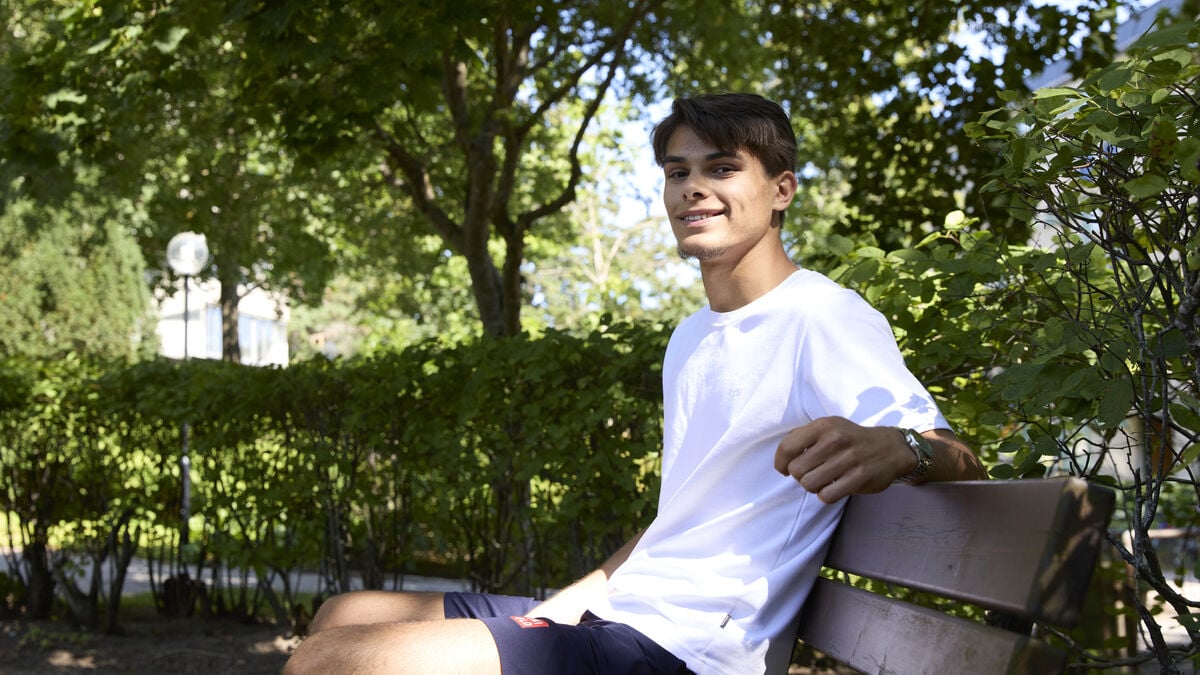
In September, Maya Stenmark in Uppsala will vote for the first time in a parliamentary election. If you don't, she says, you can't complain about how society is.
I'm not very happy with our current government, and I feel that as a Swedish citizen I must be able to change it.
She has no doubt that her voice counts.
I believe that an ordinary Svensson can do a lot for this country.
It hasn't been entirely clear which party she will vote for. However, she knows which issues are important.
I am very committed to taking care of our earth and the environment.
This year, first-time voters make up 6.5 percent of all eligible voters in Sweden. In 2022, the corresponding figure was 5.7 percent. Compared with the average voter, first-time voters tend to vote more for the Left Party and the Green Party and less for the Social Democrats. In the last election, the Moderates had the upper hand.
They may not be as different from the population as a whole as one might think. In many ways they are similar, that is the first thing to say. But there are some differences, says Oskar Hultin Bäckersten, postdoctoral fellow in political science at Mälardalen University.
Once you have voted once, it is easier to continue - and vice versa. This should make the group especially interesting for the parties, according to Hultin Bäckersten.
If you don't vote your first choice, you are much less likely to vote your second choice. It becomes harder and harder to change that habit. This also applies to some extent to which parties you vote for.
"Ask me how honest they are"
For 18-year-old Anton Rasmusson in Täby, unemployment is an important issue. This fall he will start his third year of high school and after that the job market will be very relevant. Functional healthcare is also important.
I've heard about how stressful it is, and it's very important for us in society that healthcare works, and it doesn't really feel like it does now, he says.
He sees voting as his responsibility. Despite that, he is skeptical about how much of a difference he, or one vote out of ten million as he says, can make.
But I also understand that if everyone thought that, society wouldn't function.
To make sense of what he should vote for, he makes election compasses, tries to follow debates and read analyses - because he coldly assumes that politicians will not tell the whole truth.
Every time I hear a politician speak, I am very critical of the source, in the back of my mind I ask myself how honest they are.
In recent years, men and women have increasingly voted differently. The differences between the sexes, both in terms of opinions and which political parties people vote for, have become particularly large in the 18- to 25-year-old voter group over the past ten years, according to research from the SOM Institute at the University of Gothenburg. Even within the young group, the very youngest, first-time voters, stand out.
It is a gender-polarized group, says Jakob Ahlbom, a doctoral student in political science at Stockholm University.
It's a pattern we're seeing now that we've never seen before, where women and men vote more differently than they ever have before and the young group really stands out.
Why the difference is so large is not fully understood, but research shows that social media plays a role, according to Jakob Ahlbom.
The differences started to increase around the time social media became more prevalent in the youngest group, and we see that young women and men are consuming very different types of content. Research also shows that political differences are greatest among those who use social media the most, he says.
Oskar Hultin Bäckersten believes that we need to understand the differences from a broader societal perspective.
The causal relationship is not at all clear to me. It could just as well go the other way, that one's attitudes affect what content one wants on social media. We see a certain gender polarization in the younger group in several different directions.
Tiktok on the rise
First-time voters are exposed to political content in both more traditional media, such as radio and television, and via social media, according to a report from the Internet Foundation. They stand out when it comes to TikTok; 48 percent have seen political content on the platform in the past year, compared with 10 percent in the 26-35 age group. The proportion has also more than doubled since the last election, when the corresponding figure was 23 percent.
In Maya Stenmark's feed, the parties' youth associations dominate. She, who grew up in Kiruna, thinks that more politicians need to be more visible - throughout the country.
The Prime Minister and other party leaders have visited schools and such, but they have never come up here.
Anton Rasmusson, on the other hand, thinks that politicians are good at showing off - but worse at being clear about what they actually stand for.
If someone were to ask me to put my finger on exactly what they are running for, I would probably say that they are doing a worse job there, he says and continues:
They try more to refute the other parties and say what they are doing wrong. You can find out more about a party's agenda by what the opposing party says about them.
Where everyone agrees
He thinks the parties should do more than just try to follow trends on social media.
They say words they think young people will like, instead of getting them to vote for them through their policies. They should instead say what they want to do.
After the election, he wants to see a Sweden that stands strong in a troubled world. Where everyone thrives and gets along.
There are things I would have liked to change about how we are right now, but I still look positively to the future.
First-time voters make up 6.5 percent of those eligible to vote in this year's election, according to statistics from Statistics Sweden. This represents an increase compared with the last election.
The largest proportion of first-time voters is found in municipalities near Stockholm, Gothenburg and Malmö. Danderyd tops the list with 9.2 percent. The lowest proportion is in Överkalix with 3.8 percent.
Voter turnout among first-time voters decreased slightly, from 86 to 84 percent, between the 2018 and 2022 parliamentary elections.
Statistics from Statistics Sweden show that first-time voters tend to vote if at least one of their parents does.
The proportion of young people (18-24 years old) elected to parliament, regional and municipal councils has decreased, from four percent in 2014 to 2.5 percent in 2022.
Tiktok and Instagram are where most first-time voters access political content daily.
Source: Statistics Sweden, Internet Foundation (Swedes and the Internet 2026: Election Special), Agency for Youth and Civil Society Affairs.