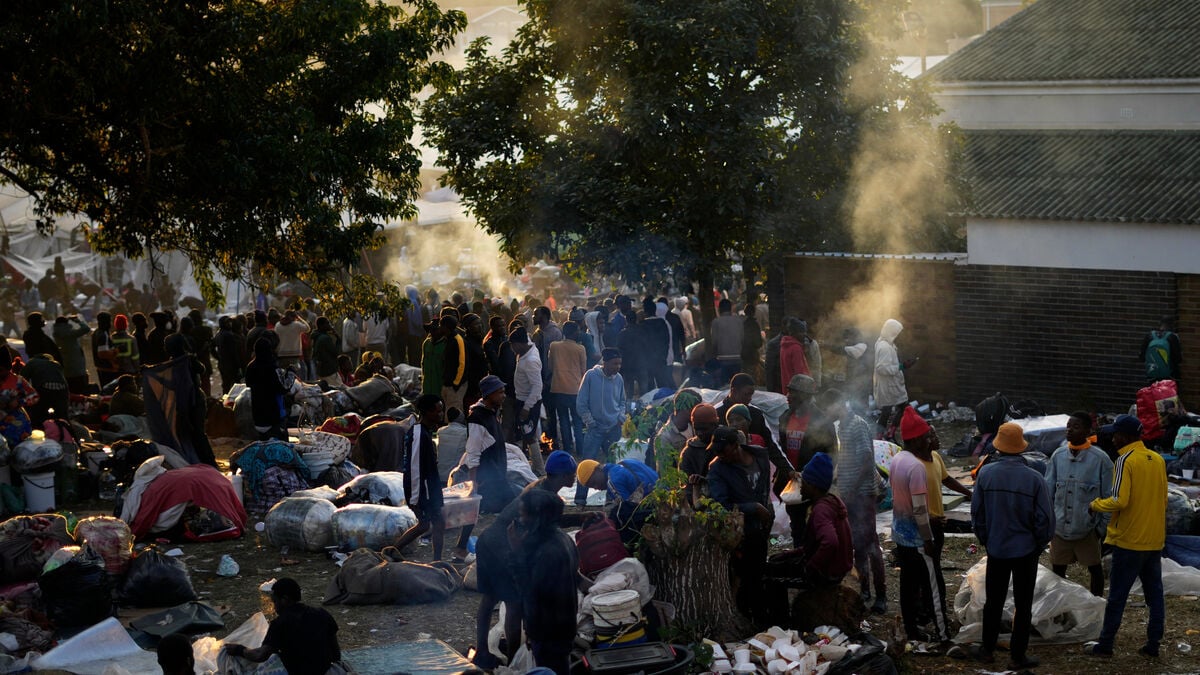
When the angry mob arrived at Baloyi's informal settlement in Gansbaai, he fled into the mountains. The fact that he had the legal right to be in South Africa did not matter to the citizen guard that went door to door.
They said: "You are a foreigner, you don't belong in South Africa, you are going out," the 32-year-old tells the AFP news agency.
In Kleinmond, an hour to the west, Michael Markson from Malawi also fled into the mountains.
"They had machetes... dangerous tools to hunt someone," he told AFP.
Similar violence has erupted in several parts of South Africa in recent weeks, as xenophobic, more or less loosely organized vigilantes have taken the law into their own hands. They have taken it upon themselves to enforce a deadline set by the anti-immigrant organization March and March: undocumented immigrants must leave the country by June 30. In the run-up to the deadline, crowds have armed themselves with sticks, whips and knives to make migrants obey the call.
“Traumatized”
And many have listened – or at least been intimidated into obedience. On June 14, South Africa's Home Affairs Minister stated that nearly 2,800 migrants had been repatriated to countries including Nigeria and Ghana in the course of a week.
Thousands more – many of them from Malawi and Mozambique – are waiting to leave.
"I am scared and traumatized," Malawian Esnat Joseph, mother of one-year-old triplets, told the BBC in Durban.
March and March wants the country's limited resources to benefit poor South Africans, according to founder Jacinta Ngobese-Zuma.
"All countries prioritize their own citizens. Why shouldn't South Africa do that?" she told media company IOL in early June.
“The legacy of apartheid”
Several smaller groups have joined in. The common denominator is that they blame South Africa's socio-economic difficulties – with an unemployment rate of almost 33 percent – on migrants.
“The citizen guards feed on societal frustration and the lack of socio-economic rights, on unemployment and the inequality gaps we have as a country,” says human rights activist Mpho Makhubela in a press release from Human Rights Watch.
“The truth is the country is still struggling with the enormous task of dealing with the legacy of apartheid.”
Days before hundreds of people were displaced from Gansbaai and Kleinmond , more than 50 shacks were burned down in Mossel Bay further east. Five Mozambicans were killed, according to the Mozambican government. South African police, who do not want to link the deaths to violence against migrants, claim that “only” two were killed.
President Cyril Ramaphosa has condemned the violence, but at the same time promised tougher action against illegal migrants in the country.
South Africa, at the southernmost tip of Africa, is with its 64 million inhabitants (2024) Africa's largest economy.
Years of economic growth and relative political stability have created a prosperous middle class. At the same time, unemployment is high and poverty, crime and corruption are widespread. The growing inequalities, as well as large immigration from neighboring countries, are leading to increasing tensions in society.
Between 1948 and 1994, apartheid was a policy of racial segregation in the country. Apartheid was the separation of blacks and whites under a racist regime that, among other things, prohibited blacks from moving freely in "white" areas. Blacks and whites were also kept separate in restaurants, hospitals and public transport, and marriages between people of different skin colors were prohibited.
In April 1994, the first general elections were held in which everyone was allowed to participate, regardless of skin color. The African National Congress (ANC), led by Nelson Mandela, won a landslide victory. Since then, the party, which was a resistance movement during the apartheid era, has dominated politics.
However, support has gradually declined, and after the 2024 elections, the ANC was forced to form a coalition government in order to continue governing.
Source: Country Guide/UI