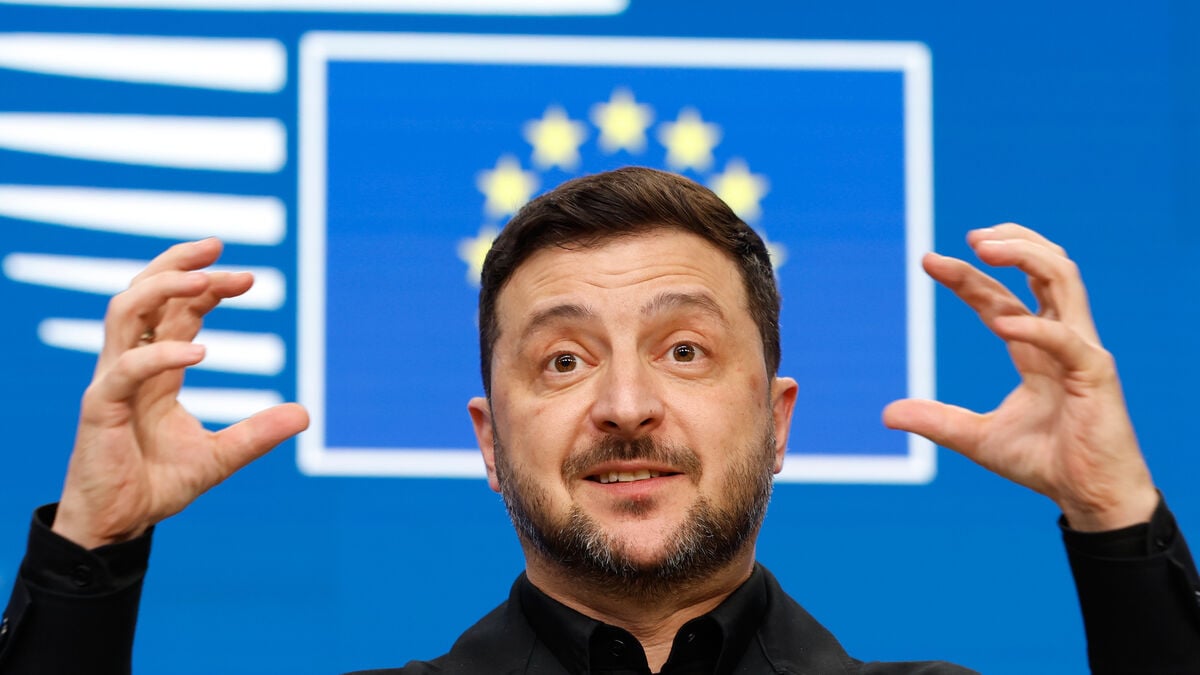
At 3 a.m. on Friday, after 16 hours of negotiations, the news came that an agreement had been reached. The EU will provide Ukraine with 90 billion euros in aid over the next two years, announced Council President António Costa.
Costa describes it as the Union delivering on its commitments. But the ambition to use Russia's frozen assets in Europe to help Ukraine did not hold up and the member states reached a different compromise solution.
Ukrainian President Volodymyr Zelensky expresses gratitude and writes on social media that the support will strengthen Ukraine's ability to resist Russia's invasion.
Kristersson: Sorry.
For Sweden, Germany and other countries that had fought for the frozen Russian assets to be used, the outcome of the meeting was partly disappointing.
The good news is that we have secured funding for Ukraine's needs in 2026–2027, says Prime Minister Ulf Kristersson (M) at a press conference.
The bad news is that there was not enough support at all to use the frozen Russian assets. It was nowhere near that, and I regret that.
Belgian Prime Minister Bart De Wever has maintained throughout the meeting his opposition to using the frozen Russian assets. The money is physically located in Belgium and De Wever fears future Russian claims for damages.
Now the 90 billion will instead be lent jointly by the EU countries to Ukraine, with the EU budget as collateral. To avoid a veto, Hungary, the Czech Republic and Slovakia have been promised that they will not have to participate.
Get the money quickly
The decision means that Ukraine can quickly access the money. Without EU support, the country would have risked essentially running out of money at the beginning of next year.
"This sends a clear signal from Europe to Putin: This war will not be worth it," German Chancellor Friedrich Merz said on X.
The proposal to use the frozen Russian assets is not completely off the table, even if they will not be used right now. The EU Commission is tasked with working further on developing a proposal, but the pressure on the issue has decreased, admits Ulf Kristersson.
Russia's negotiator Kirill Dmitriyev writes on social media that the EU has failed and that Commission President Ursula von der Leyen and Germany's Merz may as well resign.
According to the European Commission's calculations, there are a total of 210 billion euros in frozen Russian state assets in the EU.
The majority – 185 billion – is held by the securities institution Euroclear in Belgium. The other 25 billion is held by other institutions in the country, but also in France, among others. There is also a smaller amount in Sweden – but only around 120,000 kronor.
Of the assets, the European Commission wanted to earmark 45 billion euros for repayment of previous loans that Ukraine received through a deal within the G7 last year.