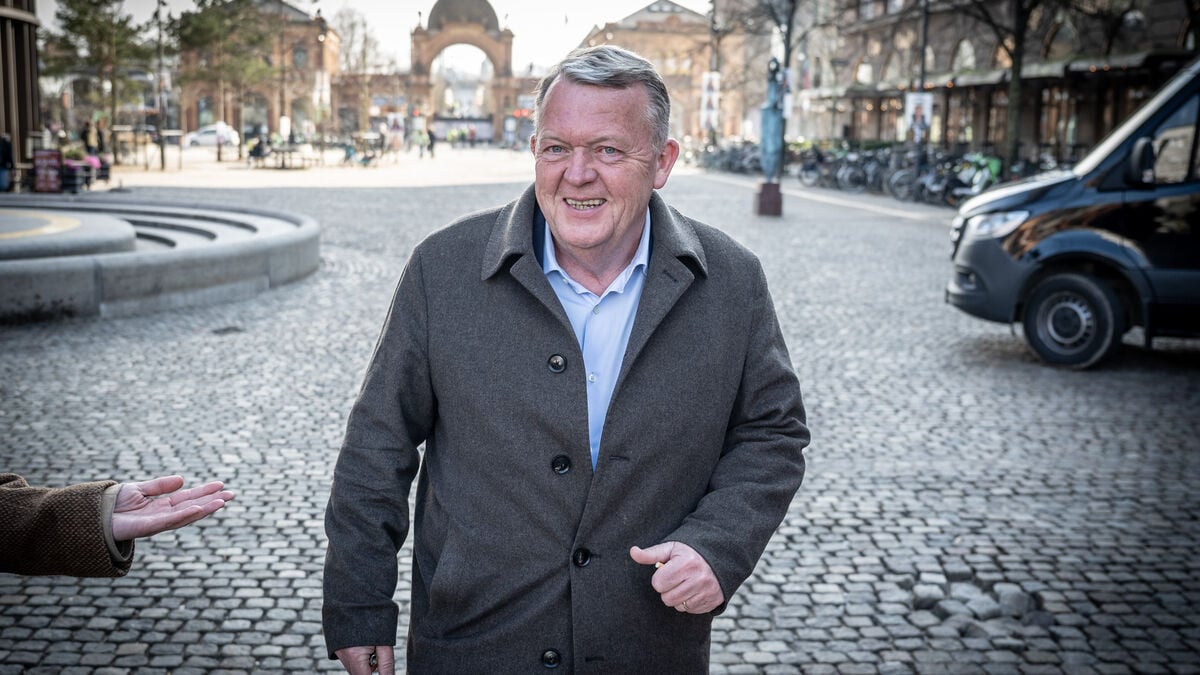
If you walk around Copenhagen, you will see his face on every other lamppost.
When TT meets Lars Løkke Rasmussen during a campaign walk around a lake in Hillerød north of the Danish capital, he jokingly suggests that the electorate should split up, go in different directions and meet in the middle.
The message has not yet hit home with voters who appear to be punishing the centrist government that has been in power since 2022.
“Diplomatic hero”
Løkke, however, takes it in stride. The sun is shining, he lights a cigarette, takes a deep drag and reminds himself that the election campaign is not over.
I hope it leads to reflection: Who should answer the phone if Trump calls?
Løkke became internationally known as the smoking Dane after the historic meeting about Greenland at the White House at the beginning of the year.
According to the Danish Foreign Minister, it was a combination of things that “made Trump climb down from his tree, at least for a while.”
The US Senate couldn't stand the idea of annexing an ally, forget it. The market reacted, Europe stepped up and NATO said they were taking responsibility for the Arctic.
Immediately after the meeting in the White House, his party, the Moderates, surged in public opinion and Løkke was described as a diplomatic hero. Now the party once again has voter support at around six percent.
Can become a kingmaker
Despite leading a smaller party, he looks set to find himself in a unique position as a kingmaker after the election. If he gets the role, he has a clear goal:
If the parties that stand in the middle and think holistically gain influence, and not those who believe that everything can be solved by throwing out immigrants or taxing the rich, I believe it is in the country's interest.
He also believes that a center-right government can better work for a stronger EU, which Løkke believes is needed more than ever, partly due to Trump's dissatisfaction with NATO during the ongoing Iran war and trade threats directed at Spain.
One question left hanging, he says, is that Europe was never "seriously stress tested" on the Greenland issue.
We are grateful for the solidarity that was there. Fortunately, we did not get to a point where it had to be delivered.
Therefore, this is a question that remains unanswered. If there had been a trade war, where would Europe have stood?
The current center-right government, consisting of the Social Democrats (S), the Liberals (V) and the Moderates (M), has taken a beating in public opinion and has lost approximately 13 percentage points since the 2022 election.
During the ongoing election campaign, both the Social Democrats and the Liberal Party have claimed the post of prime minister.
According to opinion polls, it appears to be a dead heat between the red bloc and the blue bloc (with the Moderates included in the parliamentary base).
If the red bloc becomes the largest, current Prime Minister Mette Frederiksen (S) has a good chance of remaining prime minister and can choose whether to form a red government or a new centrist government.
If the blue bloc becomes the largest, it is primarily an advantage for Lars Løkke Rasmussen, as he could once again become the kingmaker. Løkke has ruled out collaborating with the Danish People's Party and has instead advocated a new center-right government in which he could position himself as prime minister.
The most likely government after the election is, according to Danske Spil, a center-right coalition consisting of the Social Democrats (S), the Moderates (M), the Radical Left (RV) and the Socialist People's Party (SF).
Sources: Danmarks Radio, Ritzau, Danske Spil and Rune Stubager, professor of political science at Aarhus University.