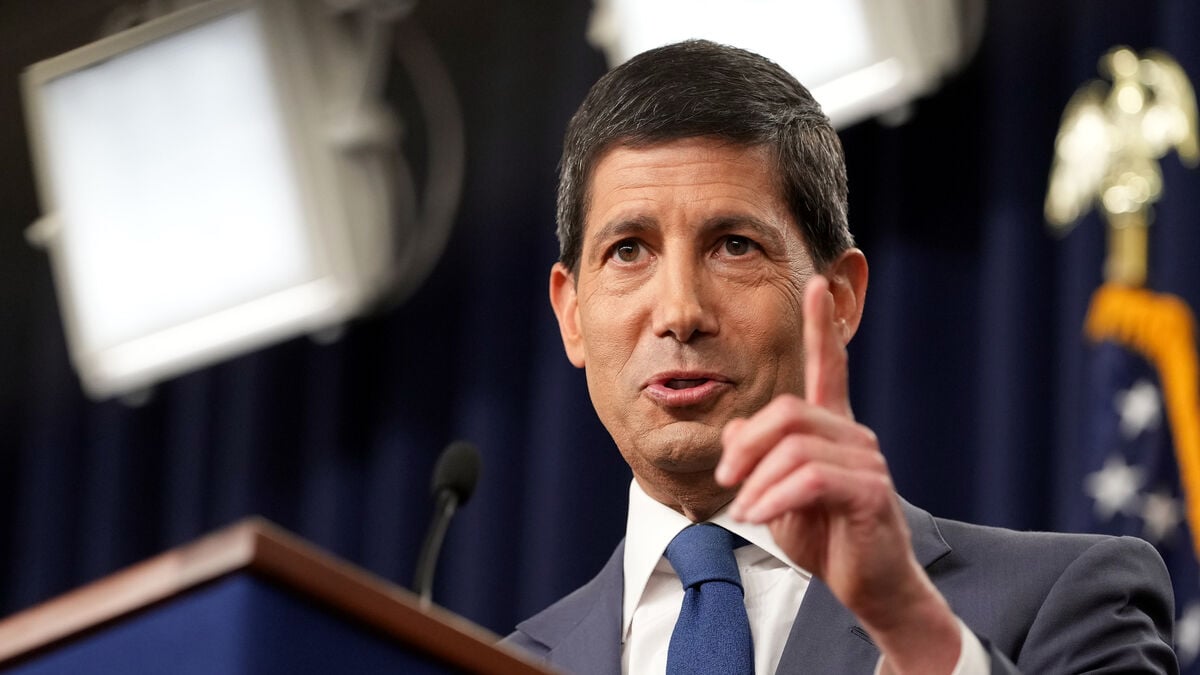
On Friday, US Federal Reserve Chairman Kevin Warsh will give his first major speech when he appears in Jackson Hole. Among economists and investors, every word will be dissected, especially since Warsh has made it a point not to say too much.
He's probably under a lot of pressure for that speech. In the press conferences he's had so far, he hasn't really worked well with the press or analysts. People are wondering what he really means and whether it's going to be this unclear going forward," says Jens Magnusson, chief economist at SEB.
Appointed by Trump
Warsh, 56, was appointed by President Donald Trump and took office in May of this year. The start has also been tough for several reasons, including what economists believe is a reluctance to provide a clear assessment of the state of the US economy.
In a recently published survey of economists conducted by the University of Chicago Booth School of Business, criticism was raised, among other things, against Warsh's lack of communication.
"His view is that we should help the market much less. We should not give any forward-looking guidance and it is better for the market to draw its own conclusions than to interpret the Fed," says Magnusson.
It may sound reasonable, but history has shown that it is a questionable strategy.
Taken in
That's why his performance on Friday will be so interesting. Will Kevin Warsh continue on his path or has he accepted the criticism?
Something that is being demanded from the market is at least some form of information about the five special working groups that Warsh has established, Jens Magnusson points out. This is in an attempt to modernize and review the Federal Reserve.
They are supposed to report towards the end of the year, but there are probably still some who hope that he will at least say something.
Two other topics where the market is demanding answers are his views on the US national debt, which recently reached a record $40 trillion while interest rates on the country's long-term government bonds reached their highest level in almost 20 years.
This is something that can have an impact on the global economy and that needs to be addressed, says Jens Magnusson, although not in the way that has so far been done by the Ministry of Finance through the repurchase of government bonds.
I am critical of it and think it is a sign of a certain desperation, albeit understandable. If you pay over $1,000 billion a year just in interest on the national debt – then you have problems.