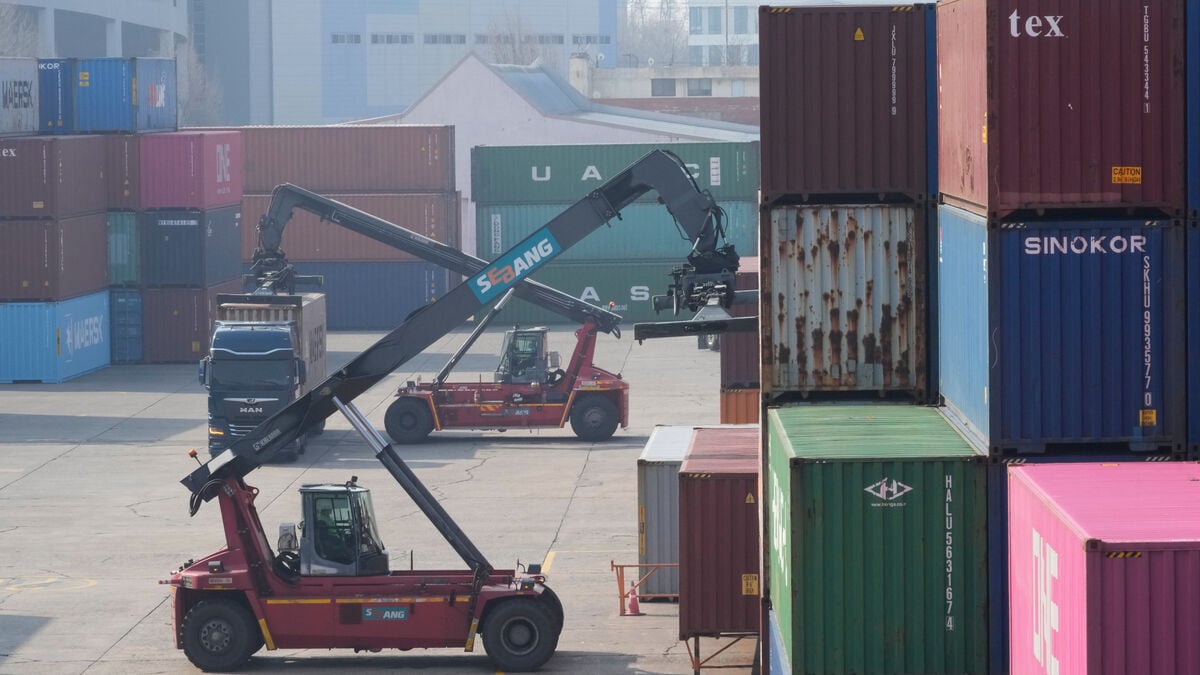
"At the moment it's the wild west," David Ozard, CEO of the moving company John Mason International, tells the Financial Times.
He says shipping companies are dumping container loads en route to the Persian Gulf in India or at the wrong port in the Middle East. This has meant that customers have to pay new costs, such as port fees, import duties, warehousing costs and even extra costs for long land transport.
Sources in the container industry confirm to TT that some cargo has been unloaded in other ports due to the security situation, after which the shipping company is trying to arrange new routes in consultation with customers.
Plate of spaghetti
A certain element of logistics chaos cannot be avoided when such an important shipping lane is closed, according to Erik Hånell, CEO of tanker shipping company Stena Bulk.
"I usually explain it like a plate of spaghetti being thrown up in the air. Then it usually falls back down in a pretty good way, maybe 3 - 4 months after an event like this," he says.
There were approximately 3,200 ships in the Persian Gulf when the US and Israel launched a bombing campaign against Iran on February 28. This corresponds to 4 percent of the global merchant fleet, but the figures also include ships that normally never leave the region.
"The last figure I saw was around 2,300 - 2,400 ships in the Persian Gulf. But that doesn't leave that many ships, I'm absolutely sure. So I think ships are turning off their AIS transmitters to simply stay out of the way or try to get through the strait," says Hånell.
A trickle
Over the weekend, President Donald Trump threatened Iran with attacks on energy infrastructure if the country does not open the Strait of Hormuz within two days.
Stena Bulk has also had "a handful" of tankers trapped in the Persian Gulf since February 28 and is losing perhaps 15 percent of its total freight business as long as the Strait of Hormuz is closed, according to Hånell.
"The Chinese, Iranians and Russians have been passing through the strait pretty much the whole time. But it's just a trickle in the river, so to speak," says Hånell.
Iran has also allowed a few ships from other countries to pass through the Strait of Hormuz, including the Liberian-flagged Shenlong, owned by Greek Dynacom Tankers.
Facts: Thousands of ships stuck in the Persian Gulf
When the US and Israel launched a bombing campaign against Iran on February 28, there were about 3,200 ships in the Persian Gulf, according to websites that show ships with their automatic identification systems (AIS) turned on. Most were various types of tankers and bulk carriers, but there were also a few container ships and six cruise ships.
At the same time, an estimated 500 ships were en route to the Persian Gulf when Iranian attacks and threats to civilian shipping halted the ability to safely pass through the Strait of Hormuz.
According to S&P Global Market Intelligence, only 21 ships in total have passed the strait since February 28, compared with the usual more than 100 ships per day.
Source: Clarksons Shipbrokers, S&P Global Market Intelligence