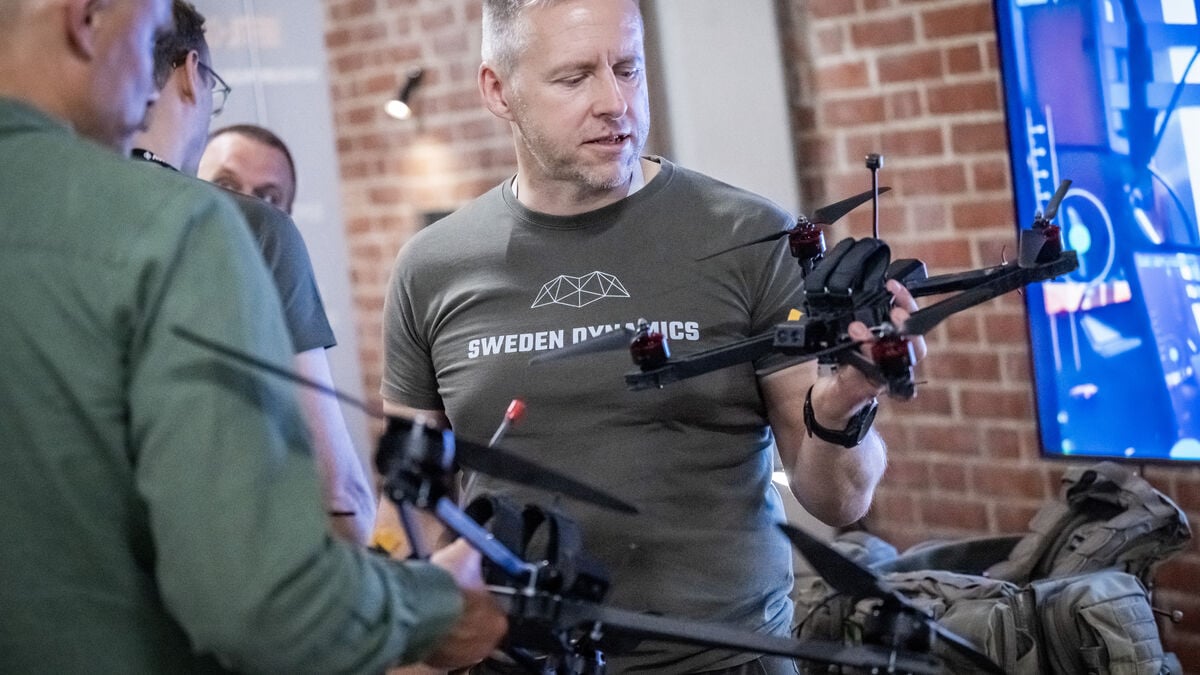
In Malmö, they want to develop "China-free" drones for total defence that are easy to control and high-performance.
A basic requirement is that they are designed and developed in Sweden. We source components from other NATO countries, not from China, preferably from countries as close as possible, says Sebastian Merlöv, CEO of Sweden Dynamics, which was founded last autumn.
The hardware components are purchased and the software is developed in-house.
Relying solely on foreign actors, whether in the EU or NATO, is not sustainable in the long term, says co-founder Oscar Karlflo.
Together with the third co-founder, Martin Helmersson, they have spent a lot of time in the field, as they are occasionally employed in the intelligence battalion in Karlsborg.
“Shit, no”
Oscar Karlflo describes how, as a platoon commander, he was forced to say no over and over again when his subordinate Sebastian Merlöv insisted that they must be allowed to use drones.
During an exercise in 2024, when they spent over a hundred hours together in a small shed outside Oskarshamn, they decided.
"Then we said, 'Now we don't care about this.' We have to build up our own capabilities," says Oscar Karlflo.
At the same time, he understands the no, since it is not possible to have individual soldiers bringing their own drones and flying them over live defence targets. Two years ago, drones were not used during military exercises - a lot has happened in the defence sector since then.
Sweden Dynamics has developed tactical drones in three different size classes with an eye on potential customers such as police and emergency services. The company also hopes to get the Swedish Armed Forces as a customer, but in that case the armed forces will have to modify the drones to suit their needs.
Later on, we will be able to deliver purely military equipment, but we do not have those permits yet, says Oscar Karlflo.
A fresh product
The fact that development is happening so quickly means that from a preparedness perspective, drones can be compared to food - they are a perishable commodity.
You can't buy 100,000 and put them in a mobilization stockpile, because in a year they will be completely obsolete, says Oscar Karlflo.
Instead, it's about having an updated recipe and planning to be able to push the button when large-scale production is required, he explains.
The company currently builds smaller series in its own facilities. For larger orders, it will seek help.
"We develop the recipe and then we let an experienced factory, a box builder as it is called, build them. There are a number of such companies," says Martin Helmersson.
“Free as a bird”
Oscar Nilsson, a former junior world champion in drone flying, is one of those recruited to the company. His interest in drones was sparked when he was 16 years old, when he saw a YouTube video of a drone flying in an abandoned building.
I felt like that was being free as a bird.
He specializes in developing carbon fibre for drones, which will make them exceptionally durable.
It's about optimizing the carbon fibre for this design and the design for the carbon fibre - marrying the two worlds, he says.
The company's second generation of drones is ready to be certified, which is a prerequisite for them to be sold to, for example, emergency services. But each certificate costs 200,000 kronor and takes two to three months to obtain.
Sebastian Merlöv believes that Swedish drone development risks being paralysed by a rigid regulatory framework. If a certified drone model is modified and, for example, fitted with a different type of engine, new certification is required.
Then it will be difficult to launch new models every quarter, he notes.
“Hinders rapid development”
This simply prevents rapid development, says Sebastian Merlöv.
So far, their drones have only been used for pilot tests by the police task force, the fire service and military personnel from P7, but the company has agreements in the works and will start selling in the autumn.
Carl-Oskar Bohlin (M), Minister of Civil Defence, emphasizes that he has appointed an inquiry to review the regulations.
It is very promising to see that this capability is now emerging in Sweden, that we have control over our own drone production and that we can be at the technological forefront, he says.
Facts: The Swedish Defence Forces' drone initiatives
In January, the government announced that four billion kronor would be invested in unmanned systems for the Swedish Armed Forces.
This includes so-called kamikaze drones, also called patrol robots, that is, drones that contain some form of weapon that can combat a target.
It also involves reconnaissance drones, airborne remote-controlled telewar capabilities and naval drones.
Together with Saab, the Swedish Armed Forces have had a one-year project to develop a new type of drone swarms.
The Armed Forces today have access to a range of systems for knocking out drones, both those that can be carried by individual soldiers and those that are mounted on vehicles, ships or in fixed installations.
Sources: The Armed Forces, the government and Officers' Journal.