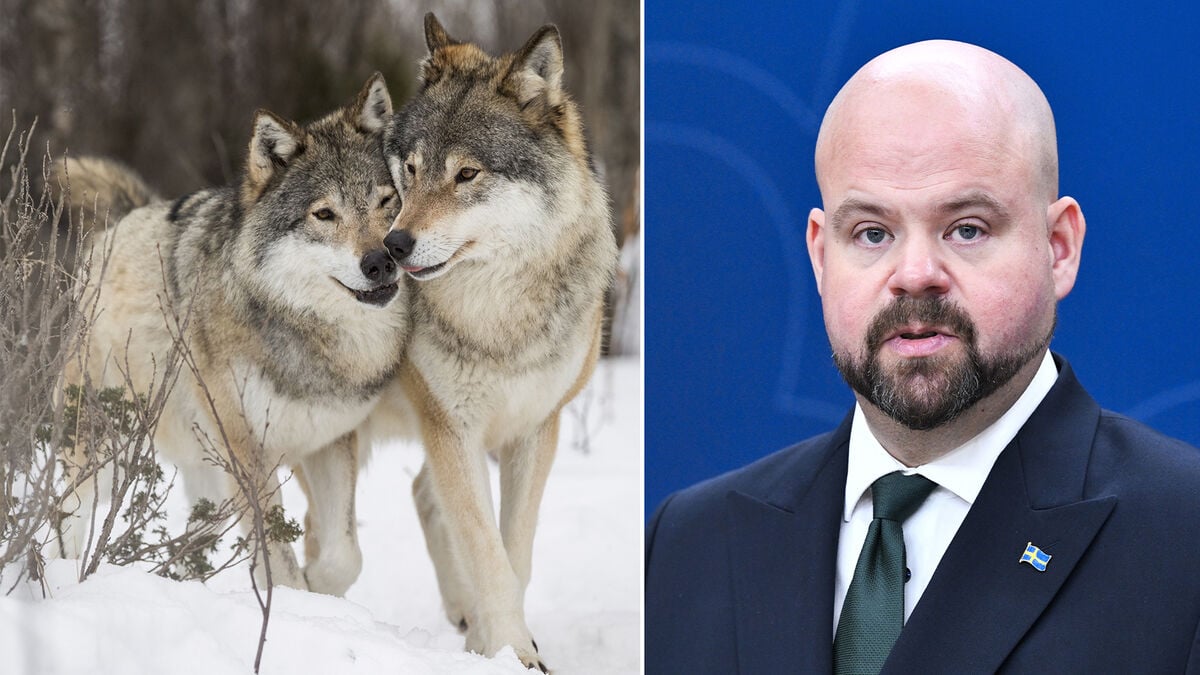
At the beginning of the year, 48 wolves were to be shot in Sweden following a decision by the county administrative boards. But the decision was appealed by, among others, the Swedish Society for Nature Conservation, which prevailed first in the administrative court and later in the court of appeal.
According to the courts, the hunt, intended to result in a population of just over 270 wolves by the fall of 2026, risked reducing the population so much that it would not be sufficient to maintain so-called favorable conservation status.
The government's clear ambition was that we would get down to 270 wolves after this year's wolf hunt. You can see that it looks dark now, says Peter Kullgren.
The hunt was intended as a first step in bringing the population down to even lower levels.
New reference value
On behalf of the government, the Swedish Environmental Protection Agency reported a new reference value of 170 for the wolf population in Sweden to the EU Commission this summer, a sharp reduction from the previous value of 300.
It received harsh criticism from the Commission, partly because the new value had been set by the government even before the Swedish Environmental Protection Agency had produced scientific evidence for it, and because the level appeared to lack sufficient research support.
The Swedish Environmental Protection Agency also wrote that such a low population "would entail a significant biological risk in the form of significantly reduced genetic variation."
The Commission has given Sweden the opportunity to revise the reference value and submit an updated report, but according to Peter Kullgren, it will not be changed.
Instead, we will try to explain more about our thinking and on what basis we believe we can have a reference value at that level.
Strengthened management
The Swedish Environmental Protection Agency has reported on the management measures required to maintain favourable conservation status if the population declines, and Kullgren emphasizes that the government is now investing heavily in introducing them.
In total, we are spending over 300 million on strengthened wolf management, he says.
How the government will proceed with its plans after the setback in the courts is still unclear, but Peter Kullgren emphasizes that there are parliamentary decisions to reduce the wolf population to the level the government is trying to reach. He does not see court decisions as putting an end to the policy's goals in the long term.
We simply have to keep working. The first step is to analyze these judgments and, based on that, try to take it further.
The wolf is protected and may only be hunted under strictly controlled conditions.
The Swedish Environmental Protection Agency has delegated the right to decide on licensed wolf hunting to the county administrative boards in the central and southern predator management areas. Wolves are hunted from January 2nd to February 15th or until a decided number of wolves are killed.
The county administrative boards can also decide on protective hunting when necessary. Protective hunting can be permitted to prevent serious injuries to reindeer, domestic cattle and dogs and to stop incidents related to unwanted behavior.
According to the latest inventory period, 2024/2025, there are approximately 400 wolves in Scandinavia, of which approximately 355 are in Sweden.
Source: Swedish Environmental Protection Agency