Actor Val Kilmer only managed to film one scene in As Deep as the Grave before his death. However, with the help of generative AI, a digital copy of Kilmer has been created that appears in the film.
Kilmer is one of a growing number of people who are living on through AI.
Back in 2017, long before the AI boom, Microsoft applied for a patent for a method to create a chatbot based on "social data" such as images, social media posts, voice data and letters. However, the company said it had no plans to develop the technology.
But since the patent was granted, services that recreate the deceased have gone from being new and unusual to something people use every day. In December last year, Meta was granted a patent for technology that would make it possible to publish posts on social media regardless of whether the user has taken a break or died.
Three categories
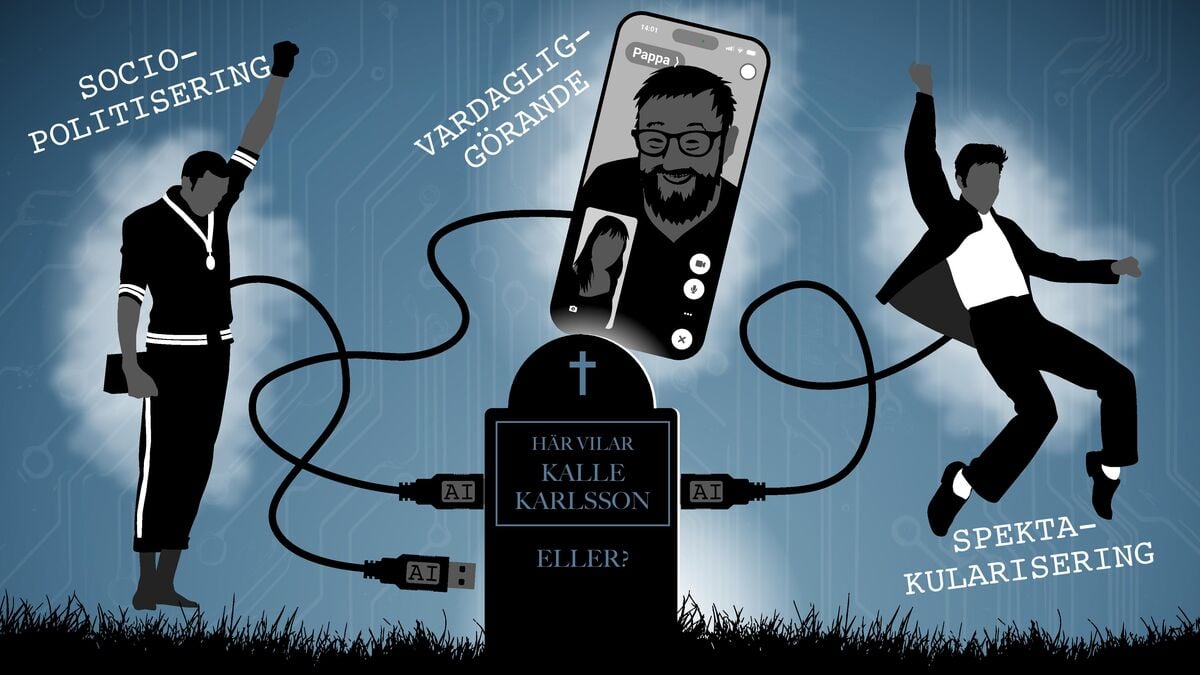
In a study by the Hebrew University of Jerusalem and the University of Leipzig, researchers have identified three categories in which people are recreated using AI after their death.
Spectacularization, where famous people are brought to life with AI to entertain.
Sociopoliticization, when victims of violence or injustice are brought back to life in remembrance of something, or for political purposes. AI-generated images can testify, protest, or tell their own stories after death.
Everyday life, which the study says is the fastest-growing way to let AI cheat death, keeping relationships with deceased loved ones alive through, for example, chatbots that allow people to continue "talking" to them.
The researchers believe that with the help of AI, we are now not only remembering the dead but also letting them work, and point to the importance of sorting out the legal and ethical aspects before it is too late.
Sold bodies
Per Bauhn, professor of practical philosophy at Linnaeus University, sees parallels far back in time to 19th-century British grave robbers who sold dead bodies to hospitals for research. According to the law at the time, you owned your own body, and when the owner was dead, there was no owner.
Another comparison is biographies.
Then the same question arises - who has the right to the life of a dead person? It would mean the end of the entire biography genre if one were not allowed, for example, to make a critical portrayal of a person who lived.
But even though we have free access to write about people, their relatives may have opinions.
You can imagine something similar here. The dead person cannot speak for themselves, but relatives might resent it if someone created an AI-generated copy that might also do things that are completely foreign to the original person.
The issue of what content can be used to recreate a person is something Lars Lindblom highlights. He is an assistant professor of philosophy and applied ethics at Linköping University and has an interest in AI and ethical issues.
What one could reasonably use is, for example, social media posts. But it would be unbearable, I think, for my family to talk to my Facebook persona after my death.
Mixing up
Lars Lindblom's model would need to be tweaked so that it makes fewer puns and is supplemented with training data from the large language models, he reasons.
That means they mix me up with all the other people. That's part of this generative AI - yes, we can generate people, but it's with the help of everyone else's information and behavior as well. So it becomes a kind of stretched version of us.
He finds it worrying that services are starting to appear that recreate the deceased.
That industry has a history of just grabbing information that may not be theirs. I imagine it would be, maybe not on a philosophical level, but on a policy level, be very good if companies were not allowed to do that.
The new technology is something the funeral industry already has to deal with, says Ulf Lernéus, director of the Swedish Authorized Funeral Directors. The discussions that have taken place have tended to avoid doing anything the deceased themselves would not have wanted. It is not always easy to know; different family members may have different opinions.
It's not a simple question, but the basis must be that it is the co-owners of the estate who jointly manage the estate. But I also think it is important to defend the integrity of the deceased.
He finds it problematic that the deceased cannot control what an AI version should be based on.
I always say that it's not illegal to take a secret to the grave. There are many people who don't want to tell everything, and it's not illegal not to tell everything.
Write a will
Even though there is no obvious set of rules, it may be wise to write it into your will now if you absolutely do not want to live on in AI form, says Ulf Lernéus. But the technology can also be helpful with the many concerns that arise when someone dies, he points out.
If we're talking about AI and keeping someone alive, the tombstone is not wrong. Those who want to can design their own tombstone, it can already be done today with AI technology.
And we already see people writing obituaries, especially verses and poems. You can enter names, ages, hobbies and relatives, just a few short points and from that you can get very nice verses for an obituary.
Ian Holm was brought to life for Alien: Romulus with the help of AI and computer animation, among other techniques.
Star Wars actors Carrie Fisher and Peter Cushing were able to appear in new films in their roles as Princess Leia and Grand Moff Tarkin with the help of new technology.
Paul Walker died in a car accident before filming of Fast & Furious 7 was completed. His brother stepped in for him and, with the help of computer animation, Walker's face was projected onto his brother and the film was completed.
In 2023, a new single was released by The Beatles in which John Lennon's voice was recreated using old recordings.
In the project "As if nothing happened," Turkish photographer Alper Yesiltas has used AI to create images of what deceased celebrities such as Princess Diana, Freddie Mercury and Elvis Presley would have looked like if they had lived and grown old.