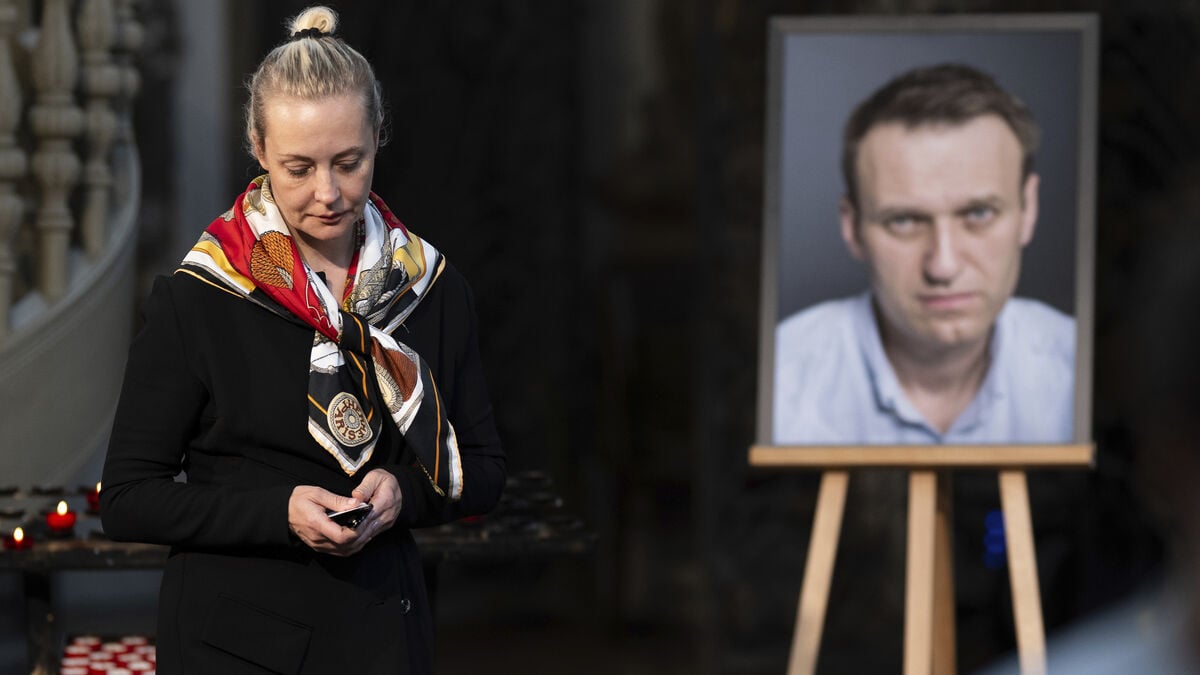
On Monday, it will be two years since Yulia Navalnaya heard the news that her husband, Russian opposition politician Alexei Navalny, had died. She received the news at the Munich Security Conference, and now she is back at the same conference in southern Germany.
Together with five countries, she can say that it was the poison epibatidine that killed Navalny - a very potent poison that is only found naturally in a poison dart frog in Ecuador, but can also be created in a laboratory.
"Now it is scientifically proven that my husband Alexei was poisoned by Russia and Vladimir Putin," says a visibly moved Yulia Navalnaya at a gathering arranged by the five countries.
Samples from Navalny
The countries have had access to biological samples from Navalny and have had experts in toxicology, medicine and chemical weapons examine them, among other things.
The reason why Sweden, France, Great Britain, Germany and the Netherlands have become involved in the poison tracing is that Alexei Navalny needs redress and that his family needs to know what happened, says the Swedish Foreign Minister.
What difference does proving which poison was used make, when many are already convinced that Navalny was poisoned?
"It's a big difference, I would say, because now we know exactly which method Russia has used and what capabilities they have. And we want to cut them off from being able to use it again," says Malmer Stenergard.
It becomes more difficult for them when we clearly show what they are doing and demand responsibility.
The five countries will now turn to the Organization for the Prohibition of Chemical Weapons (OPCW).
"We expect them to act to hold Russia accountable, but also to spread knowledge about what Russia has done to prevent it from happening again," says Malmer Stenergard.
Russia: "Propaganda"
The OPCW cannot pursue legal proceedings, but according to Malmer Stenergard, sanctions can be imposed against individual Russians who commit human rights violations.
Maria Zakharova, spokeswoman for the Russian Foreign Ministry, dismissed the information as disinformation in a comment to the Russian state news agency TASS.
She called it "propaganda aimed at diverting attention from pressing Western issues."