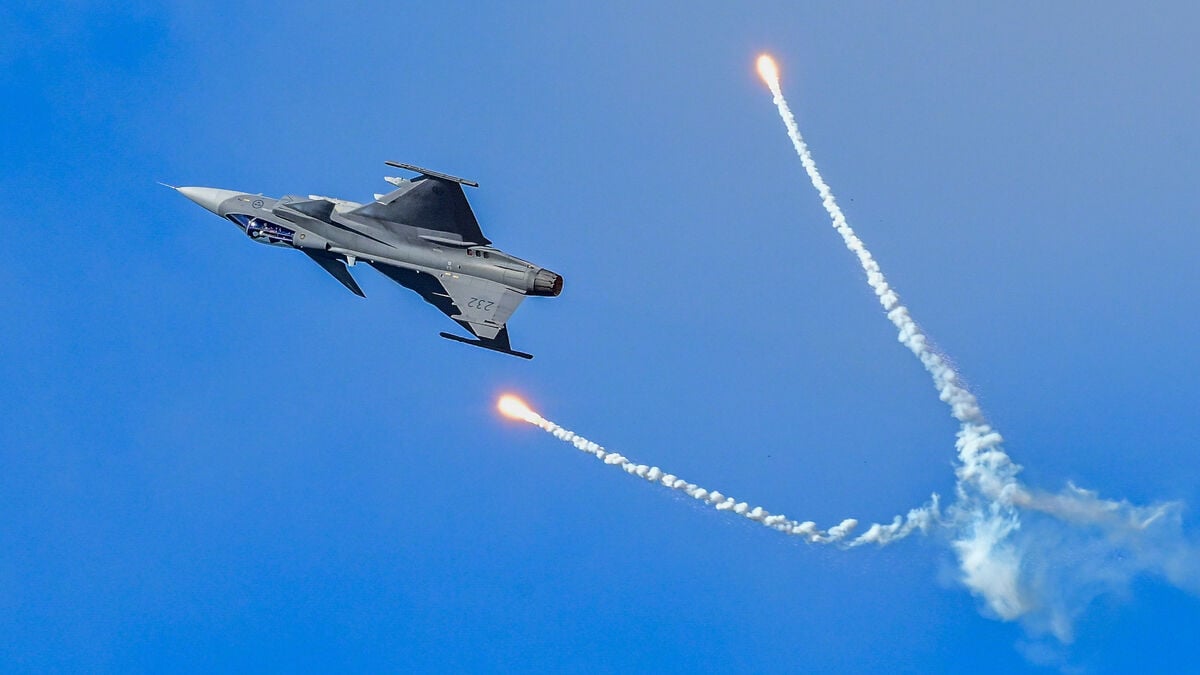
Sweden donates 16 Gripen planes to Ukraine, and will sell another 20.
But it will be 2027 before the first planes are in place in the war-torn country. Not least, pilots must first be trained, which could take a few months, according to Hans Liwång, professor of defense systems at the Swedish National Defense University.
"Here and now, it is rather the signal value that is important, that Ukraine is building for the future and that Sweden is part of it," he says.
“Closest to the front”
In war, fighter jets are mainly used to fire missiles into enemy territory and to conduct reconnaissance.
"The Gripen is rather a way of ensuring that this activity can continue even in a year or so. It is not mainly about making a difference, but about maintaining approximately the same capability as we have today," says Hans Liwång.
He envisions that the Gripen plane can be used to strike military installations, logistics hubs and infrastructure, both in occupied Ukrainian territory and "a bit further" into Russia.
It is not entirely clear what weapons the plane will have, but older Gripen models in particular do not usually have long-range capability, according to Liwång.
"So we're probably talking about relatively short-range weapons. Not ones that can be fired far into Russia, but rather at what's closest to the front," he says.
However, against drones, which play a central role in Russian warfare, fighter jets are usually not an option.
Ideally, one tries to separate the fighter jets from the drones, and then let the cheaper ground defense handle the drones instead.
In Russian hands
Hans Liwång does not see any particularly major risks for the Swedish defense when the plan is given away.
"It is clear that, on paper, it has some effect and it affects the number of aircraft that could be in reserve during the time that Gripen E is implemented."
"But the plans were going to come out of the system anyway, and now they have found a way to get them out a little faster."
However, it could pose risks if Gripen planes are shot down in Ukraine and Russia comes across them.
"There are things on board the plane that we don't want to end up in Russian hands. But there are methods for how to handle the aircraft if that risks happening and that is also something that will definitely be included in the pilots' training," says Liwång.