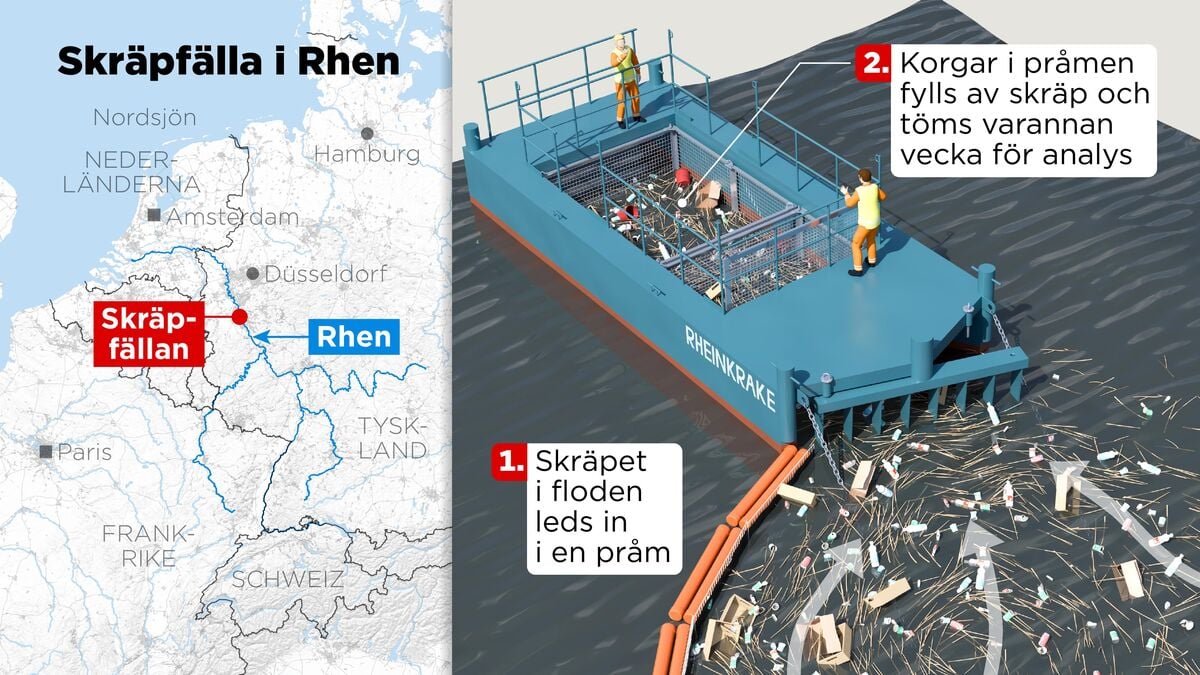
For 16 months, a trash trap sat in the Rhine River, just outside the city of Cologne in Germany. Every two weeks, volunteers would check the trap to see what was caught.
"There were many small pieces of plastic," says Nina Gnann, a researcher at Eberhard Karls University in Tübingen.
"We also found a lot of fireworks, about ten percent, and, although we have a good deposit system in Germany, five percent were glass bottles. There were also a lot of plastic bottle caps."
The Rhine is one of Europe's great rivers, often referred to as the continent's artery. It begins as two smaller streams in the Swiss Alps and winds its way 1,200 kilometers mainly through Germany before reaching the North Sea via the Netherlands.
More than half of the goods moved on the EU's inland waterways are carried on the Rhine, which amounted to 285 million tonnes in 2024. These transport links have meant that a fifth of the world's chemical industry is concentrated along the river.
Ecologically, the Rhine is home to more than 70 species of fish and a range of birds and mammals live on its banks and delta.
Worse than expected
The amount of debris from fireworks stands out. Although they were mostly caught in the trap in January, they accounted for as much as one in ten items during the year.
"It's incredible, because they are only used once a year," says Gnann.
Previous studies have indicated that between 500 kilograms and 31 tonnes of garbage flow annually via the Rhine into the North Sea. But the new study indicates that it is more likely between 3,000 and 4,700 tonnes - up to 42 million items. At the upper end of the range, this corresponds to 470 full garbage trucks of waste in the river. Fifty-six percent is estimated to come from private consumers.
Harmful to the environment
The large difference from previous estimates can be partly explained by previous studies focusing mainly on plastics, while the current study weighed wet objects. But the main reason is that the trap method captures more litter throughout the year.
The researchers also noticed that the amount of trash increased during naturally high water flows, as plastic and other items lying on river banks and beaches were carried away by the river.
Maria Granberg is a researcher at IVL Swedish Environmental Research Institute and was not involved in the study. She reacted to the large amount of garbage being washed into the North Sea.
"It's grotesque. You would think these are countries that should have functioning collection and recycling systems for, for example, plastic, so that it doesn't have to end up in the water."
Reaching the West Coast
Some of the trash that breaks down into smaller pieces settles on the seabed. Other pieces eventually end up in currents along the Swedish west coast. Granberg points out that the chemicals in plastic trash are particularly problematic. They can be endocrine disruptors or even toxic. If small animals and fish ingest them or are exposed to them, the substances can accumulate and affect species higher up the food chain.
"A film of bacteria and algae can form on the floating plastic particles, which smell attractive to birds. It has been seen that the particles can get stuck in their stomachs, or give a false feeling of satiety," says Granberg.
She believes that the research also sheds light on Swedish conditions, where, for example, large amounts of plastic pellets have been found near the factories around Stenungsund.
"We also have problems with many of our treatment plants, such as overflows (temporary discharges of untreated water) when many substances are released. So we are not innocent either," says Maria Granberg.
The study is published in the scientific journal Communications Sustainability.
The researchers, with the help of a volunteer organization and a trap, collected litter floating in a part of the Rhine River between September 2022 and January 2024. The study's main calculations are based on the period from November 19, 2022 to November 18, 2023.
During the statistical year, 17,523 objects larger than one centimeter were collected. Around 70 percent of the objects were plastic, but by weight they amounted to just under 15 percent.