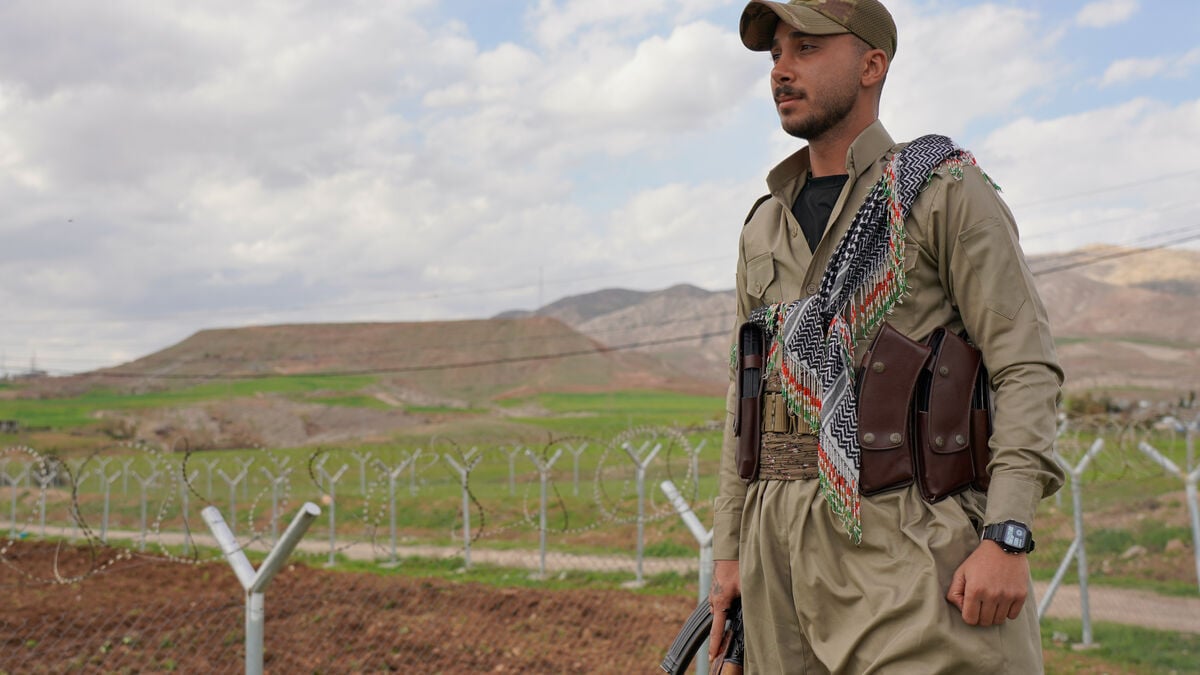
A Kurdish ground offensive is expected soon in northwestern Iran, ITV has learned. Weapons have reportedly been brought to Kurds in western Iran, according to the British broadcaster.
If they receive American support from the air, they have the potential to be quite successful against the Iranian military in those parts of the country, believes Aras Lindh, an analyst at the Swedish National Defense Research Institute (FOI).
The US and Israel are reported to have bombed regime targets in western Iran to create the best possible starting position. Whether the information is accurate is difficult to know - but regardless, the Kurds cannot bring down the regime in Tehran alone, notes Aras Lindh.
CNN's sources also state that the US is working to arm Kurdish forces to fuel an armed uprising.
"We believe we have a great chance now," a senior Iranian-Kurdish source told CNN.
Conversation with Trump
Iran has also intensified its bombing of Kurdish areas. Early Thursday, Iran said it had attacked Kurdish headquarters in Iraq as well as “separatists” who were planning to enter Iran from the west, according to state-run Iranian media.
The semi-autonomous Kurdistan region in northern Iraq is home to camps and bases belonging to several Iranian-Kurdish parties and armed groups. In the days before the outbreak of war, five of them agreed to coordinate in a coalition. Sources told Reuters that they had held discussions with the United States about possible attacks on Iranian security forces in western Iran.
Among other things, President Donald Trump himself is said to have spoken with the Kurdish party KDPI leader Mustafa Hijri on Tuesday, according to CNN's source.
During a press conference on Wednesday
that Trump had supported any insurrection plan.Perceived as betrayal
Iran's approximately ten million Kurds live under great repression under the Islamic regime. Although they have long strived for increased rights and regime change, there are question marks over the willingness to help the United States after the fight against ISIS in Syria, where the Kurds did the heavy lifting and were then more or less left to fend for themselves.
There is a long historical experience of what is perceived as betrayal from a Kurdish perspective – that one has been used in the short term to achieve American goals, and when one no longer fulfills any function, one has simply been left to one's fate, says Aras Lindh.
The Kurds are being used as pawns in a very clear way. On the other hand, the Kurdish actors are mainly positive about receiving American support in their fight against Iran.
The Kurds are a people group that once formed minorities in the Ottoman and Persian empires. They have never had a lasting state of their own, but now form significant minorities primarily in Turkey, Iran, Iraq and Syria.
In all countries, Kurds witness extensive oppression and many strive for an independent Kurdistan consisting of the areas where Kurds primarily live.
Iran's nearly ten million Kurds make up around ten percent of the country's population. They have traditionally lived in the northwestern parts of the country, but many are moving as these areas are lagging behind economically.
Iran's Kurds have long been under strong pressure to assimilate into the majority population. Most Iranian Kurds are Sunni Muslims, while Persians are Shia Muslims.
In 1946, Iran's Kurds, with support from the Soviet Union, founded a small state with Mahabad as its capital, but it was soon crushed by the Iranian Shah. Since then, fighting between various Kurdish groups and the government in Tehran has flared up periodically.
Sources: Landguiden/UI, Amnesty International and others