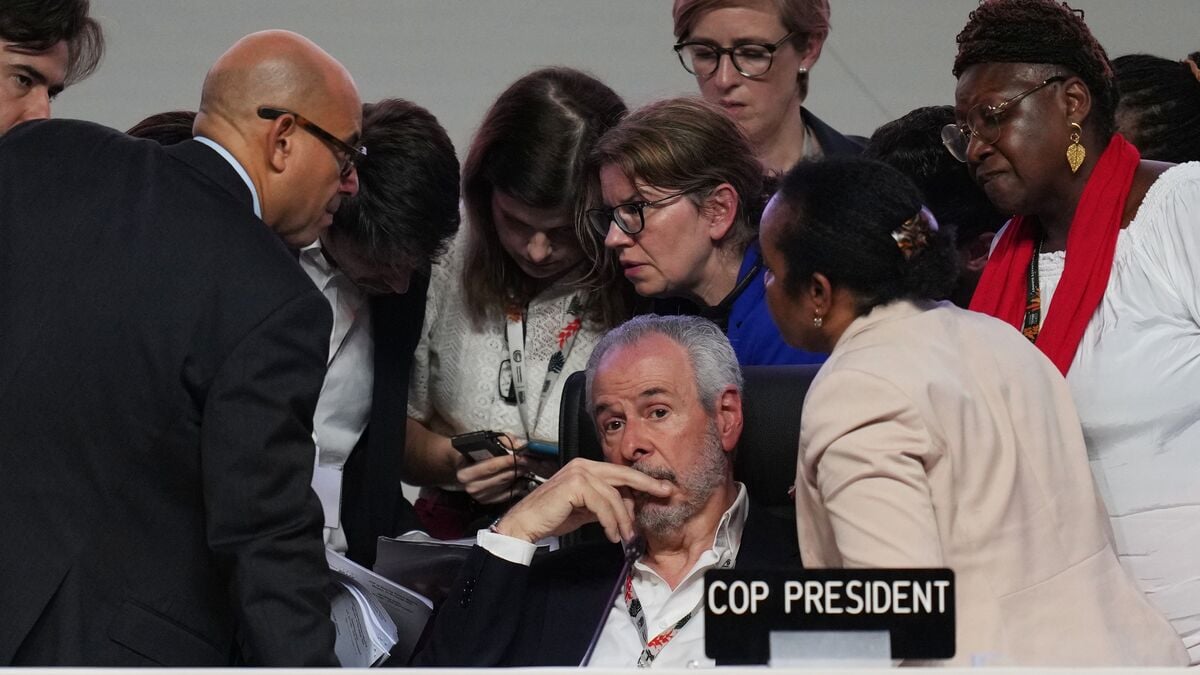
The agreement is a disappointment for many who had hoped for a more ambitious final product, and plenary discussions had to be suspended after several countries objected to the way it was implemented. However, when discussions resumed, it was determined that the decisions hammered out were valid, despite the protests.
The EU and several countries had pushed for an agreement that called for a "roadmap" to phase out fossil fuels - something that is not mentioned in the final declaration. Instead, the text recalls the consensus reached at COP28 in Dubai two years ago when the agreement called on the world to phase out fossil fuels.
“Big disappointment”
Colombian President Gustavo Petro later announced that the country does not accept the agreement because it lacks a plan for fossil fuels, something Colombia is not alone in criticizing.
"It is a great disappointment. This affects all those who will have to endure increasingly harsh consequences of the climate crisis," says Karin Lexén, Secretary General of the Swedish Society for Nature Conservation, in a press release.
EU parliamentarian Emma Wiesner (C), who is part of the EU delegation, is also not satisfied.
"We still do not have a clear path to fossil freedom and despite progress in the smaller negotiating rooms, the result today is far from sufficient. Unfortunately, we still see that the oil countries dominate the climate summits," she writes in a comment to TT.
However, Brazil announced at the closing plenary meeting that they themselves will continue the work to develop a roadmap for phasing out fossil energy.
Light in the final declaration
WWF believes that COP30 ended in one of the weakest results in a long time, but still sees a light in the final declaration – that the parties have agreed to develop a mechanism for just transition, something that has been one of the environmental movement's most important demands.
"This is a victory, but it does not save the Paris Agreement. It is also absolutely necessary that the transition itself actually takes place, and that is missing from the results of COP30," says Martin Wadmark, climate expert at WWF Sweden, in a comment to TT.
Among the most important issues that the negotiators have had on their table is how to distribute $300 billion per year, the amount previously agreed upon in financial assistance to the countries most affected by climate change.
Poor countries have requested a tripling of financial support for climate adaptation, something that is included in the agreement but with an end date of 2035 – five years later than in previous drafts.
The EU, along with more than 80 other countries, wanted to see a roadmap for phasing out fossil fuels, but it is not mentioned at all in the final text since oil states like Saudi Arabia fought hard to keep them out.
The countries have agreed to triple the financing for developing countries' climate adaptation, but the target has been postponed by five years - to 2035.
Pressure to address the huge gap between the emissions reductions countries have committed to and what is actually required to exceed the 1.5 degree target as little as possible has been less successful than many countries had hoped. An accelerator to address the shortfall is due to be presented at next year's COP.
The UN climate summits, COP, are held in different locations each year. COP stands for "Conference of the Parties" and refers to the parties to the UN Climate Convention.
The first climate summit COP1 was held in Berlin, Germany, in 1995.
At the meeting in Kyoto, Japan in 1997, the first global climate agreement, the Kyoto Protocol, was negotiated.
In the 2015 Paris Agreement, most of the world's countries agreed to keep the increase in global average temperature well below 2 degrees, and preferably below 1.5 degrees, compared to pre-industrial times. This will be done primarily by reducing greenhouse gas emissions.
COP30 was held this year in Belém, Brazil, between November 10 and 22.