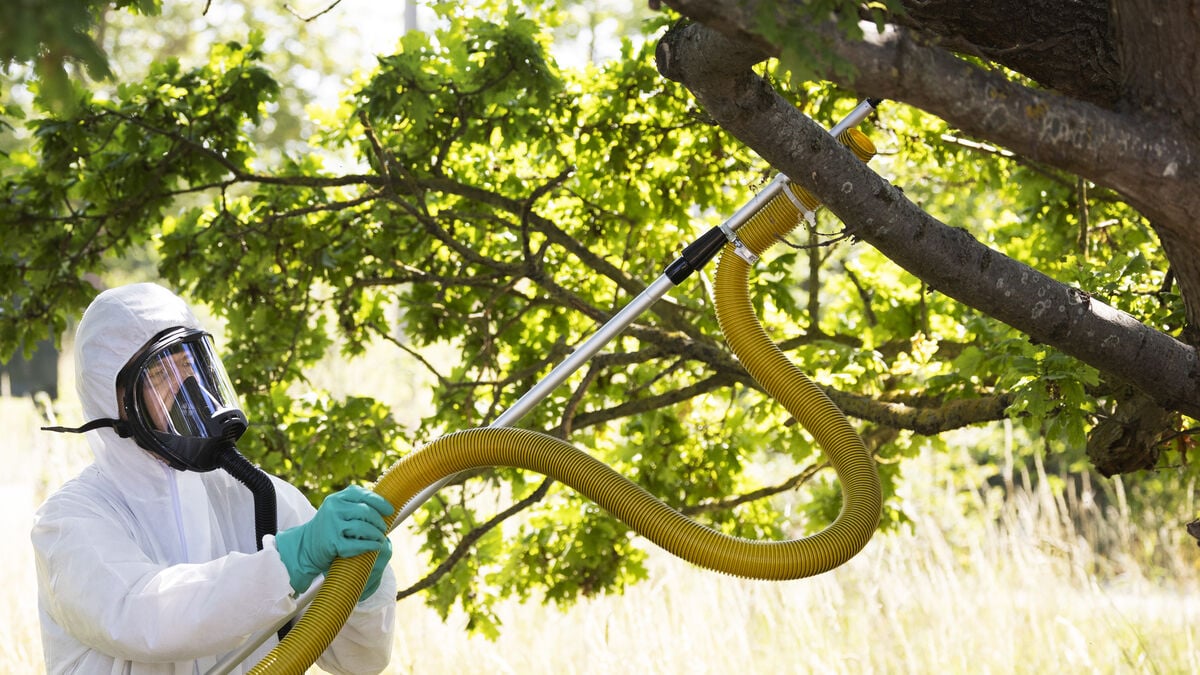
Some Copenhageners have come to Amager out of curiosity to look at the famous caterpillar. They want to know how "difficult" it really is before they make an informed decision about how close they "really dare to go" for a picture.
"You should keep your distance without protective equipment," Tonni Donovan tells the young couple.
But as long as it's not windy, you can get quite close.
The oak processionary moth - or “the caterpillar from hell” as it has come to be called in the Danish media in reference to its hairs that can cause intense itching and strong allergic reactions. The moths it produces can both fly and travel with the wind.
Spread via oak trees
In Denmark, experts believe it has spread primarily through purchased oak trees. It was first found on the island of Funen in 2024, resulting in both school closures and crisis meetings.
In parallel, there is an ongoing debate about how dangerous it really is, since other countries have lived with it for a long time.
It's a bit like the killer slug. It doesn't kill, but this caterpillar is not very nice. Even though the media has probably embellished the wording a bit, I understand that people want it gone, says Donovan.
Last week, an alarm was raised that it had been found on three oak trees on the island of Amager in the Danish capital. The number was quickly adjusted up to ten, then to 40, and now it is clear that it is about 90 trees.
"It's not something you can get rid of in a flash. We expect it to take two to three weeks," says Donovan, standing in full protective gear in 30-degree Copenhagen.
The company Rentokil has been commissioned by the Municipality of Copenhagen to vacuum up all the larvae and then burn them.
We hope we manage to catch them all, but there is always a risk that some have hidden somewhere we haven't seen.
A matter of time
In Sweden, Didrik Vanhoenacker, a biologist at the Swedish Museum of Natural History, believes that it is only a matter of time before it crosses the strait.
At the same time, he emphasizes that the females, which lay eggs, seem to be “quite homesick.” The oak processionary moth has actually been seen in Sweden in the form of single moths that have flown the wrong way, most recently in 2018, but they have always been males.
So there haven't been any larvae in Sweden. It doesn't spread very quickly on its own, he says, and continues:
But if it were to establish itself in the Copenhagen area, it wouldn't be that far for a female to blow across the strait. That would increase the likelihood that it would come to Sweden in a year or so.