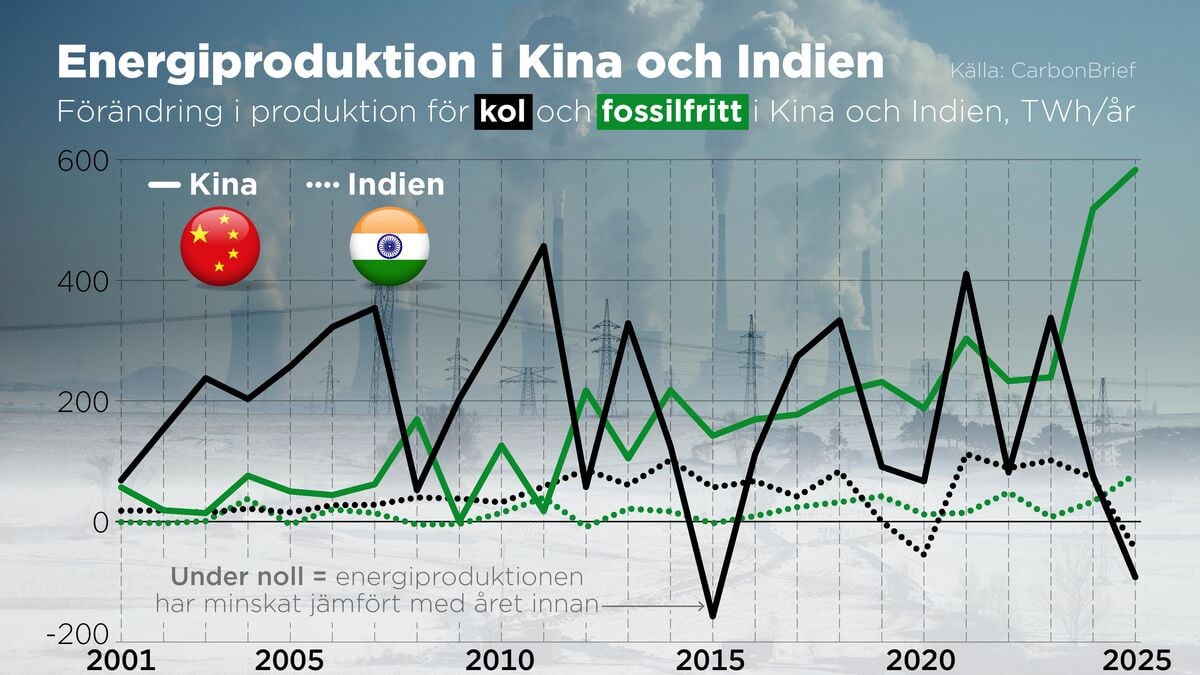
Last year, history was made when India and China both reduced their use of highly polluting coal for the first time since 1973, according to Carbon Brief.
At the same time, China proposed a record number of new or restarted coal power projects with an additional 161 gigawatts, adding 78 gigawatts during the year, according to the analysis organizations Crea and Gem.
"The most important explanation for this paradox is that they are building a lot of coal-fired power plants that they don't expect to use very much," says emissions researcher Robbie Andrew at the Norwegian Climate Research Institute Cicero.
Building unused power plants
China is expanding its green energy at a furious pace. But wind turbines and solar cells are weather-sensitive, and in 2021–2022 the country suffered widespread power outages. The solution was to invest in everything - green energy, energy storage - and coal and gas power plants, according to Lauri Myllyvirta at Crea.
"We have ended up in a situation where the additions and improvements have already solved the problems, while coal power is being switched on. It reflects a mentality that it is much better to have large excess capacity than a shortage," he says.
It is also more difficult to import electricity from a neighboring province in the event of a shortage.
You need much more capacity than if the system were designed more flexibly. In addition, it is very cheap to build coal-fired power plants in China.
May not be built
In India, about 70 percent of electricity generation is from coal, and the government has plans to add 100 gigawatts of new coal power over the next seven years.
At the same time, it seems that planned green energy will cover the increased demand.
"It will probably come as a big shock to the coal industry. The question is whether it will succeed in slowing down the expansion of green energy," says Myllyvirta.
When Robbie Andrew has followed coal power plans in India, he has noticed they are often postponed.
They have been delayed for years for various reasons, either because they encountered local resistance or failed to secure power purchase agreements.
So, does 2025 mean a peak in coal use in these countries? For China, it is more likely than for India, both experts believe. Andrew points out that Indian demand was lower last year due to favorable weather and well-filled water reservoirs.
Will solar and wind be enough if hydropower declines again? Probably not. So it's likely that coal power generation will rise in 2026 in India.
Facts: Coal in China and India
China and India are the countries in the world that use the most coal. Together, they account for 71 percent of global consumption.
In 2024, 8,805 million tons were used, an increase of 1.5 percent. China accounted for 4,953 million tons.
Coal is primarily used to generate electricity. China has a coal-fired power capacity of about 1,265 gigawatts, but last year reached a renewable energy capacity of 1,800 gigawatts.
India had a capacity of 510 gigawatts last year, of which 223 gigawatts were coal-fired. Renewables reached 263 gigawatts.
However, capacity is not the same as how much is actually generated. In 2025, coal power use fell in both countries.
Sources: IEA, Carbon Brief, New China, India's Ministry of New and Renewable Energy.