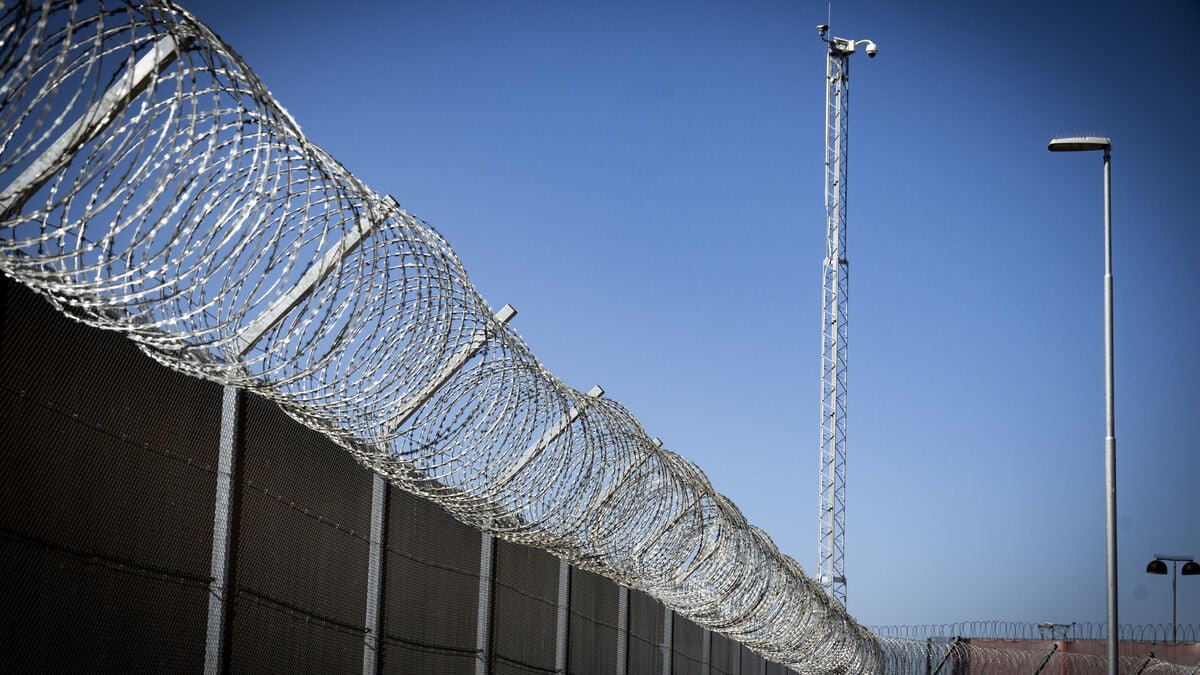
The investigation is part of the government's criminal policy, which calls for children who commit serious crimes to be sentenced to prison. The government also wants to lower the age of criminal responsibility to 13 years - a proposal that has drawn massive criticism.
Even though the political decisions have not yet been made, the Swedish Prison and Probation Service is preparing for schooling for children from July 1st next year.
Prison schools will in principle provide the same education as regular schools, but there will be no traditional classroom education.
There will not be enough young people in the same class, but it will be a more individualized form of teaching. But the aim is that some students will be allowed to sit together unless safety concerns prevent it, says investigator Claes Mårtensson, a lawyer at the Administrative Court in Växjö.
Some elements are skipped
Safety reasons also mean that certain elements in certain subjects are deleted.
In metalwork, you may not be able to put tools in the hands of students who have been incarcerated for serious violent crimes, Claes Mårtensson takes as an example.
However, there may be some distance learning, meaning that the student has digital contact with the teacher. The pandemic showed that face-to-face learning is best, but hybrid solutions may be necessary to make education accessible everywhere, according to government directives.
The investigator's proposal is that distance learning should be allowed to be used to a "limited extent", a maximum of 25 percent of the total teaching time. However, it may not be used in Swedish, English, mathematics and social studies.
Limited selection
The biggest challenge for the Swedish Prison and Probation Service will be to create feasible vocational training at the upper secondary level.
For me as an investigator, it has been important to say that there should be an opportunity for vocational preparation programs. But the structure is the hardest nut to crack, says Claes Mårtensson, referring to premises, equipment and internships.
His proposal is that the Swedish Prison and Probation Service and the Swedish National Agency for Education should jointly investigate which vocational programs can be offered.
Claes Mårtensson emphasizes that prison schools, despite restrictions and limitations, can be a chance for some of the students.
If you can meet the young people in a good way, it can be an opportunity to concentrate on their education in peace and quiet, which they may not have a reasonable chance to do in the open air.
The prison service should be able to have a teacher who is not qualified in the subject in question teach, if it is not possible to use a teacher who is qualified in the subject.
Possibility of distance learning, where students and teachers meet via screen, up to 25 percent of the time.
The possibility of vocational training at upper secondary level should be investigated further.
The right to education for children and young people in detention should be strengthened. Proposes that an investigation be conducted into how the Swedish Prison and Probation Service can be given clear responsibility.
The memorandum (U2025/02404) is open for consultation until February 13.