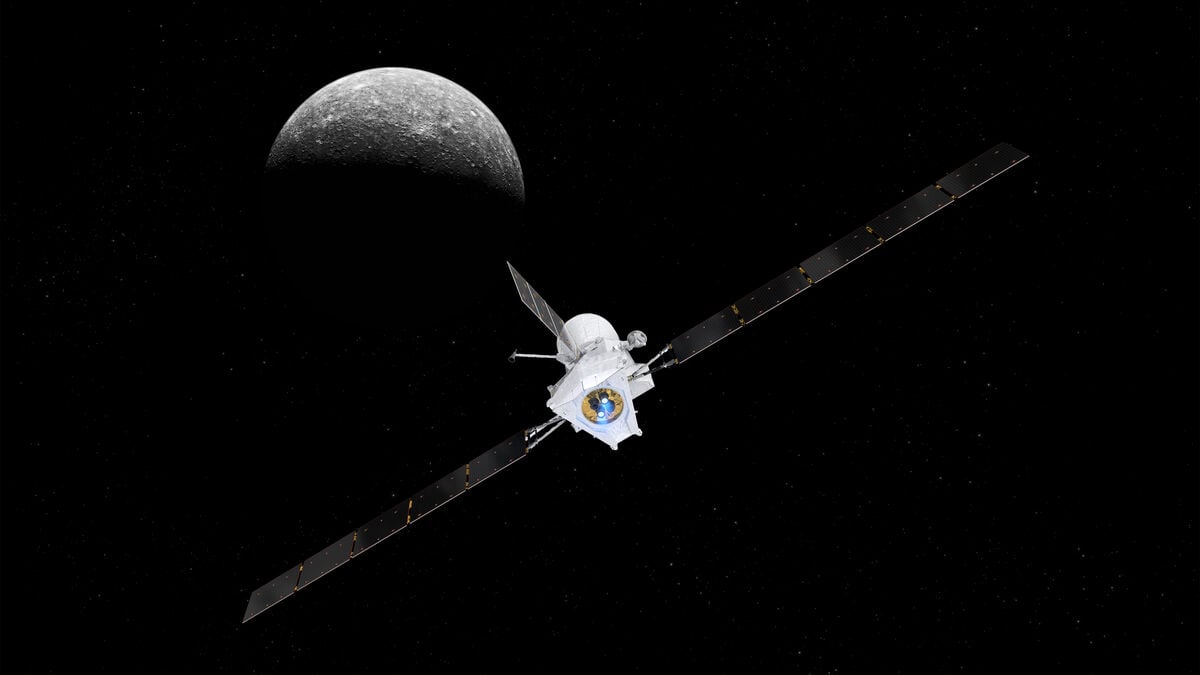
After eight years of travel, the European Space Agency's BepiColombo spacecraft is approaching its climax. On Thursday, September 3, the two space probes on board will separate from their transport module.
"It's a significant challenge. It's the equivalent of launching a new spacecraft. But this one happens to be around a different planet," says flight director Ignacio Tanco, head of ESA's inner solar system missions.
But the separations are just the beginning of the challenges. The area around Mercury, which the entire project literally revolves around, is inhospitable to say the least.
The two main aspects are the extreme temperatures - which range from -180 to 450 degrees Celsius - and the solar radiation, which can be ten times as high as here on Earth, says Santa Martinez, mission manager.
Small margins
The solar panels, which provide the spacecraft with electricity, are the main thing that keeps Ignacio Tanco awake. He likens the situation in space to having a hot pizza oven on the back, while the panels themselves have to be kept cool.
We have extremely tight margins. If we tilt it too little, not enough power is produced, too much towards the sun, the temperature rises immediately and it starts to break down.
Ignacio Tanco says with a laugh that it's almost easier to mention the things that can't go wrong. Much of the technology - power supply, thermal protection, control systems - has never been able to be rigorously tested. In fact, ESA hasn't even bothered to prepare for everything to work perfectly.
"It is likely that everything will not go according to plan. We are of course ready, we are flexible and prepared for the unexpected," says Martinez.
Craters and gas
But the rewards for the scientific community are great if the two probes succeed in their missions. Mercury is the solid planet we know the least about. Cameras will take high-resolution images across its entire surface. There are mysterious depressions here.
It looks like the surface is being eaten away. It seems to be due to volatile substances - that is, things that evaporate or vaporize very easily and turn into gas. Mercury's high surface temperature seems to make the substances easily leave the surface, says research leader Geraint Jones.
Another mystery is the craters at the planet's north pole.
Sunlight never reaches their bottoms, so there is strong evidence that there is ice there, even though the surrounding surface is over 400 degrees Celsius, Jones says.
On the night of October 20, 2018, Bepicolombo, named after an Italian scientist, was launched from ESA's launch site in French Guiana.
After passing Earth once and Venus twice, the probe made its first of six flybys of Mercury on October 1, 2021.
BepiColombo consists of two probes, ESA's planetary MPO, which studies the planet itself, and Japan's JAXA's Mio, which explores the space environment and the planet's magnetic field. They are attached to a transport module. On September 3, the probes will be released from the module and on December 16, they will separate from each other and enter different orbits.
The research mission will begin in April 2027, lasting one year and potentially extending until December 2029. The cost is estimated at 1.7 billion euros.
Mercury is the smallest planet in the solar system and is closest to the sun, at a distance of about 60 million kilometers.
Although the planet was already described on the Babylonian clay tablets "Mul apin", which are about 3,000 years old, much is still unknown about it.
Named after the Roman god Mercury, a Mercury year lasts 88 Earth days, while it rotates slowly on its own axis - taking about 59 Earth days.
The planet has been explored by the American Mariner 10 in the 1970s and Messenger, which orbited the planet from 2011 to 2015. The European-Japanese BepiColombo has also made several flybys before its main mission.
Source: NE