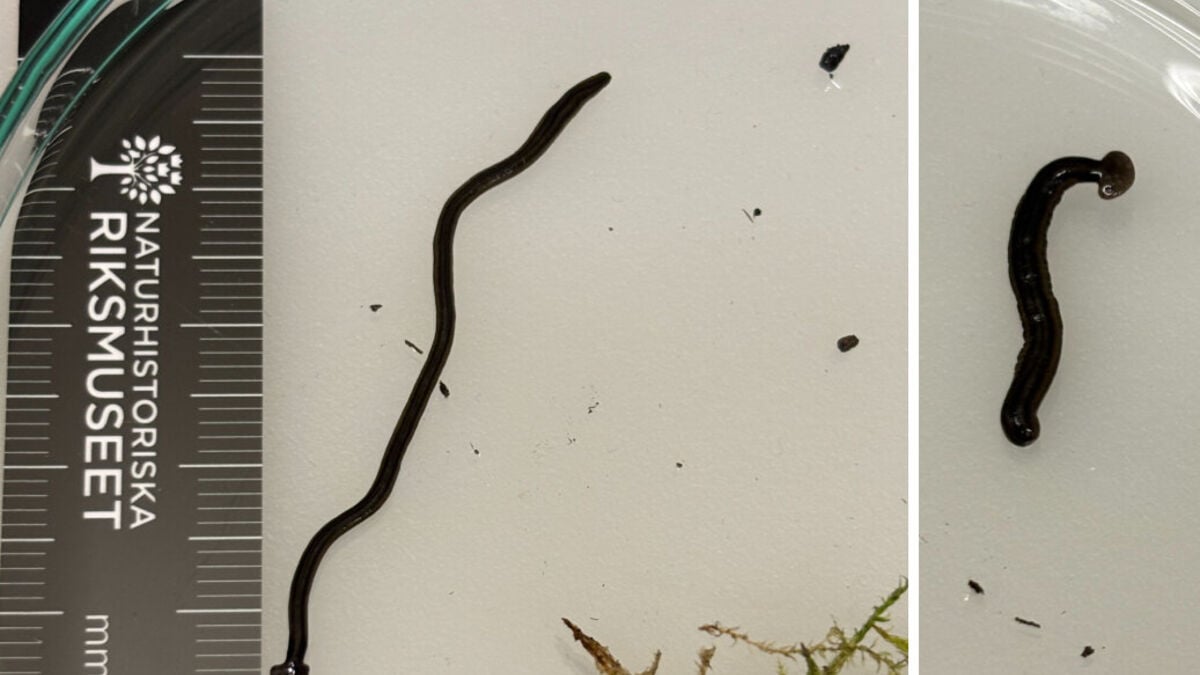
With its hammer-shaped head, it looks almost alien.
But the hammerhead worm (Latin: Bipalium kewense) originates from Southeast Asia. Its snake-like body usually measures around 20 centimetres, but some specimens have grown to 40 centimetres. Chemicals secreted by the worm through its skin can cause skin irritation in humans. Cases have been reported from Australia and the USA, among others, where cats vomited after chewing on the slimy animals.
The hammerhead worm has not previously been found in Sweden, but at the end of last year it was discovered in a store in Karlstad - among imported Mediterranean plants.
“Sticky slime”
They reported the find to the county administrative board, which in turn contacted me, says Chahinez Bouguerche, who researches invasive flatworms and fish parasites at the Natural History Museum in Stockholm.
Another flatworm, the Australian species Caenoplana variegata, has also been discovered in Swedish nurseries.
It produces a sticky mucus that causes it to stick to the backs of cats and dogs, says Chahinez Bouguerche.
She refers to observations made in France, but emphasizes that the worm is not dangerous to the animals and only uses them as involuntary transport.
International trade in ornamental plants has long been considered the main route of spread for flatworms. Chahinez Bouguerche believes that stores and nurseries that report flatworms are the most reliable places to buy from. But she would not say in which stores the worms have been found.
As you can see, it's a bit sensitive.
Flatworms often live hidden under flower pots, in damp soil and among garden waste, where they silently hunt earthworms, spiders, grey slugs and other insects. Since they lack natural enemies in Sweden, they can affect the ecosystem.
Important to report
It has been known for some time that another invasive species, the South American leafworm, can overwinter and has gained a foothold in Sweden. Chahinez Bouguerche is not worried that the hammerhead worm would survive a Swedish winter because it does not thrive in the cold, but when it comes to other species, it is less certain. Therefore, it is important that the public reports findings to SLU's species data bank.
The Swedish climate is a limiting factor for some but not for everyone, she says.
Facts: How to look for flatworms
The Obama nungara leaf flatworm originally comes from South America, but has been on the EU's list of invasive alien species since August 7, 2025. This means that, among other things, it is prohibited to import the leaf flatworm into the EU and to release it into the wild.
Anyone buying a new garden plant is advised to keep their eyes open.
When you buy a new plant: Ask the staff how they check the plants.
When you get the plant home: Check under and in the pot. They are often between the soil and the pot. Use a flashlight to shine light on them.
If you find worms: Put them in a jar and pour boiling water over them. Wait a couple of days before planting the plant and continue looking for worms.
Avoid spilling soil: Soil from an affected plant may contain egg capsules. They look like small peppercorns, first red and then brownish-black. Each capsule can contain up to 20 new worms. The soil may also contain newly hatched miniworms. Therefore, throw away spilled soil in a container for burnable waste or decontaminate the soil by heat.
Sources: Västra Götaland County Administrative Board and the Swedish Environmental Protection Agency.