The largest surface accumulations are currently visible in parts of the Baltic Sea between Åland and Gotland, according to SMHI.
As it stands now, it is the Stockholm area. Then it extends a bit south and also to Gotland, says Örjan Bäck, oceanographer at SMHI.
The worst, from the bather's perspective, is when there is a weak onshore wind - that is, wind blowing in from the sea towards the coast.
The algae bloom began this year in the last week of June. This is clearly earlier than last year, but in line with previous years in the 2020s, according to Bäck.
It doesn't always come so close to the Swedish coast.
It depends on the weather and winds, where it starts and where surface accumulations occur. This year we have experienced a lot near the coast, so many people have been exposed to it, says Bäck.
Unfortunate timing
The timing is unfortunate for anyone who wanted to cool off in the 30-degree heat. But the cyanobacteria, which make up the algal bloom, share the same interests as Swedes in summer: heat, sun and a light breeze.
"What makes people want to swim, really. Warm and calm weather makes the algae thrive and grow," says Bäck.
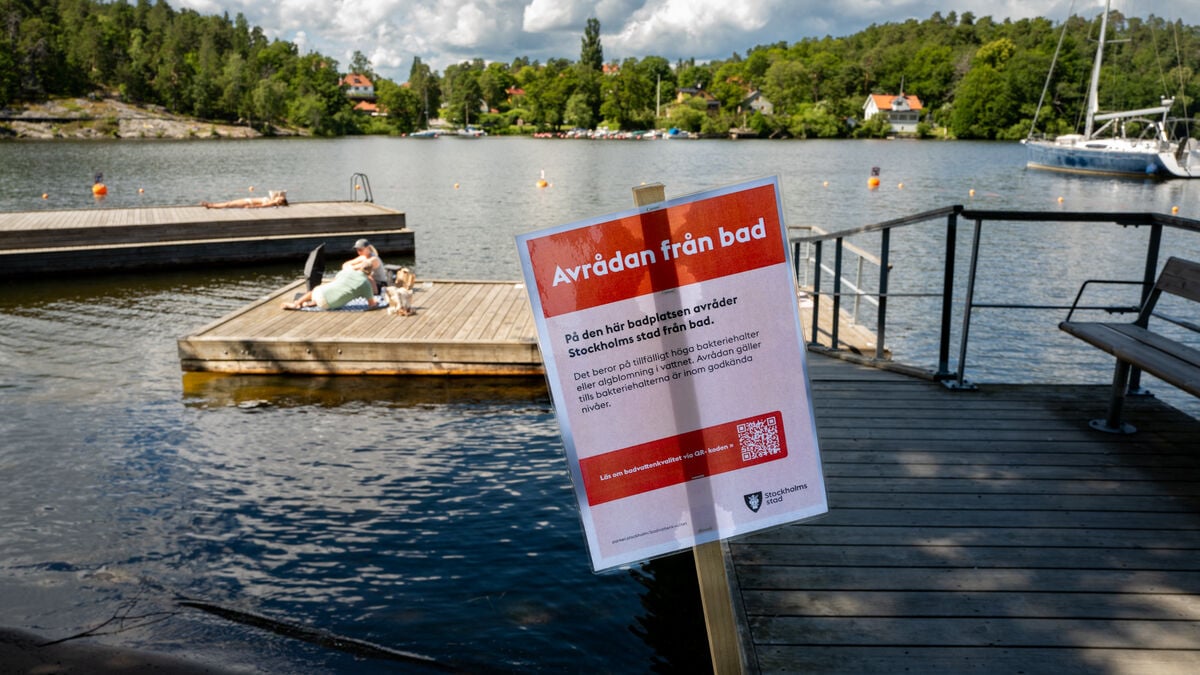
At several bathing areas, including in Stockholm, the bloom is so heavy that swimming is advised against.
Algae poisoning can cause itching, headaches and nausea. Children are often most at risk, but animals are also a high-risk group.
To get rid of the bacteria, a change in weather is required, with stronger winds so that the algae is mixed out and does not settle on the surface to the same extent. And preferably westerly winds, so that it blows out to sea again.
As long as the stable weather persists with warmth and light winds, it will continue, says Bäck.
Can come back
Then, he adds, it can come back several times in the same summer.
Algal blooms are a phenomenon that mainly occur in what is known as the Baltic Sea Proper, between Åland and the Danish Straits. But also to some extent in the southern Bothnian Sea and it can also spill out into the Kattegat.
Then we have blooms of phytoplankton everywhere, really. And toxic algal blooms also occur on the West Coast, but then it is usually poison that is absorbed by mussels and can end up in us through food, says Bäck.
On the Swedish Marine and Water Authority's website you can see which bathing areas have suitable bathing water.
The “algae” are actually cyanobacteria that bloom in summer and then look like algae. Unlike other phytoplankton, they can use nitrogen gas as nutrition, which is why they dominate the Baltic Sea in summer.
You should avoid swimming or having unnecessary contact with the water when it is no longer as clear as it usually is but is covered by a clear blue-green, green or yellow-green-yellow-brown film, or if the water is cloudy with fine threads or small grains.
A general rule is to be able to see your feet when the water reaches your knees.
Children and animals are high-risk groups. Contact a doctor or veterinarian if children, adults or animals show symptoms of illness after swimming or contact with blooming water.
The water in affected areas should not be drunk or used for cooking - many algal toxins survive boiling.
Sources: SMHI, Stockholm County Administrative Board