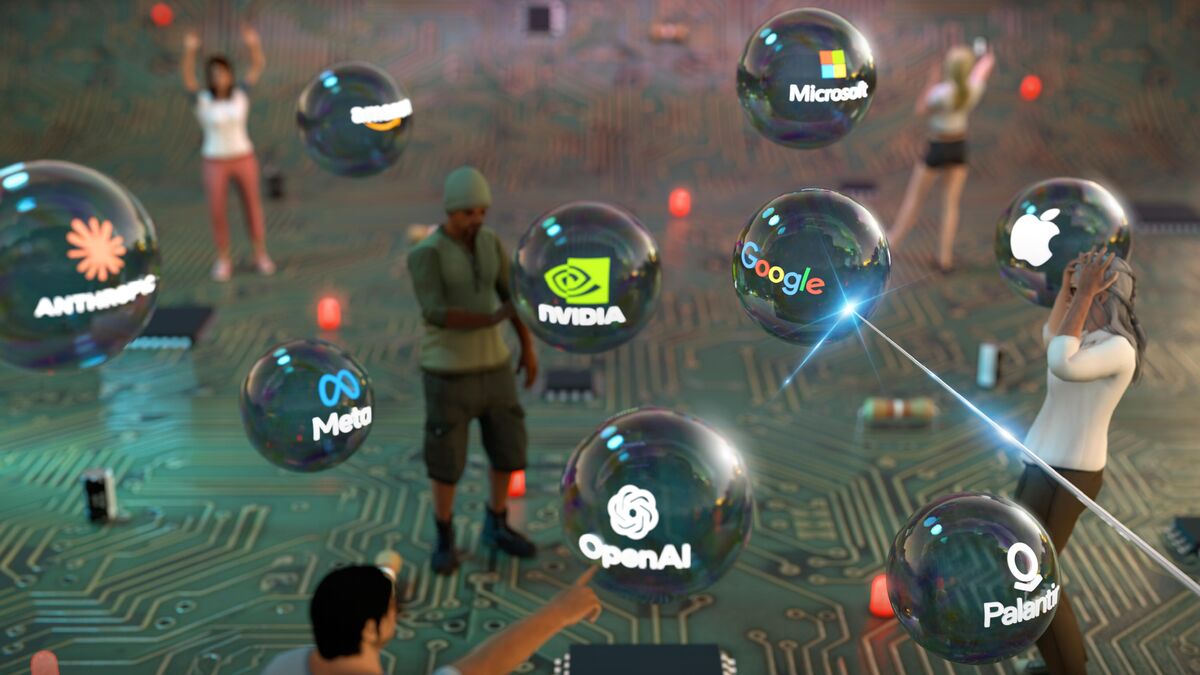
The successful launch of ChatGPT in November 2022 made AI the buzzword. Since then, large parts of the global community have been trying to find a way to relate to the “new” technology, while AI companies have seen their valuations skyrocket.
The type of AI that became popular with ChatGPT is based on the principle that more data is better data. The latest versions of the service are better than the early ones, largely because they are based on more information, i.e. more data.
But now the data is gone. At least the historical human knowledge. ChatGPT and its competitors have already been trained on “everything on the internet”.
These services have consumed all the "original content" on the web, so they can only be trained on the new content that is generated, says Fredrik Lindsten, a professor at Linköping University who researches machine learning models.
Inhuman garbage
Until recently, new content was created by humans, whether it was text, images or video. That is no longer the case. Much, exactly how much is disputed, of what is now being created is created by AI. The trend seems to be escalating as more people use various AI services.
It is at this point that the first and perhaps most obvious AI bubble risks bursting, because AI creates a completely new type of “garbage” compared to humans.
Research indicates that when AI trains on text created by AI, the amount of "garbage" increases. At a certain point, it is not possible to guarantee that what AI generates is not completely crazy. The technology behind it is not designed to determine what is true or false, says Virginia Dignum, professor of responsible AI at Umeå University.
A research study published in Nature in 2024 shows that language models, like ChatGPT, that train on AI-generated material create irreversible errors and the answers come further and further from the original source. The researchers describe this as the answers generated becoming contaminated at every step.
Although language models risk deteriorating with an increased influx of AI-generated content and training materials, it does not mean the end of the AI boom, according to Mattias Rost, associate professor of interaction design at the University of Gothenburg.
To get further, you need other ways to train. And we have that now, we have new ways to train these models, he says.
Is like a child
Exactly how the underlying changes are made depends on which service or technology you are talking about.
It's a bit like training a child. We give them tests. If they get the tests right, they don't have to practice any more; if they get the tests wrong, they have to repeat a grade. It works very well, especially in mathematics and programming, says Mattias Rost.
Studies show we reduce certain brain activity when we use AI agents; for example, we become worse at finding directions when we constantly rely on our mobile phone's map function.
Sam Altman, CEO of OpenAI, recently said in an interview that he didn't really know how he would be able to take care of his newborn child without the help of ChatGPT. He may have said it with a twinkle in his eye, but the number of individuals consulting a language model is growing.
Cognitive laziness
Olof Sundin, professor of library and information science at Lund University, points to risks when we turn to generative AI in large and small ways.
If we outsource our cognitive thinking to a chatbot, what happens in the long run? The risk is that we develop cognitive laziness and become more vulnerable to influence, he says.
He points out that universities and colleges have an important role to play when it comes to teaching critical thinking.
–Knowledge is not a big fact machine that can only deliver straight answers. We need to practice turning and twisting different arguments, being creative and seeing different perspectives, he says and continues:
Overall, this technology is very unregulated and widely used. Compare that to when a new drug goes to market: it is tested and every little risk is listed.
The pace of change in AI is fast, but not fast enough to satisfy the hunger of the global market economy. And in recent weeks, the International Monetary Fund, bankers, Wall Street executives and Google CEO Sundar Pichai, among others, have warned of an overinvestment in AI - similar to that which took place during the dotcom bubble in the early days of the internet.
"I think it will be the same with AI," Pichai said recently in an interview with the BBC.
Should the economic AI bubble burst, Pichai predicts massive consequences.
I don't think any company will be immune (to the effects), including ourselves.
AI is an abbreviation for artificial intelligence. It is a collective term for a range of different technologies that try to make computer programs function more like humans. For example, this includes the ability to reason and plan, understand ordinary language, learn from data, recognize patterns and combine different inputs to reach a conclusion.
An important prerequisite for AI is machine learning. In a regular computer program, a human must enter everything that the program should be able to do, and program it. The program acts based on a system of rules that is written in its code. Machine learning is a method where a computer program is allowed to create a system of rules on its own by feeding it a large amount of data.
Source: Internet Foundation