The engagement began in December, when federal immigration agents from ICE showed up in the Minneapolis-Saint Paul twin cities to deliver on President Trump’s campaign promise to deport migrants who entered the country illegally. The city had been plagued by fraud cases involving Somalis, and the White House claimed that immigration officers would arrest and deport “fraudsters, murderers, rapists and gang members.”
The city government had shied away from the initiative. Sarah Stephens, who is a music industry agent and is active in the League of Women Voters, says that a grassroots movement called Defend 612 was born.
"612 is our area code in Minneapolis, hence the name. We organized ourselves digitally and started local Signal groups (an encrypted messaging app) in the different neighborhoods," she says.
Noise and cameras
She joined in January. At that time, other activists, including from Chicago, where border police had previously conducted raids, had shared their experiences and trained Minneapolis residents. Together, they developed a technique for those who wanted to show their dissatisfaction with the immigration police and document what was happening.
"It's legal to take photos and videos, and in Minnesota you can stay eight feet (2.4 meters) away from a federal officer. We took note of that," Stephens says.
The many Signal groups had different purposes. Some helped undocumented immigrants who had gone underground buy food. Others accompanied migrants to work or school. And some groups, like the one Sarah Stephens was part of, were a form of rapid response force that alerted when ICE or other federal border police were in the area. In those cases, members were urged to quickly take to the streets with their wallets and smartphones.
The noise was part of the strategy, acting as an immediate protest that often caused ICE agents to lose concentration or become irritated, according to Stephens.
They sometimes swore at us, pushed us, or used pepper spray on us observers.
Could refute
Other Minneapolis residents the reporter spoke to have similar experiences. Film producer Alexander, who does not want to give his last name, says that most people in his neighborhood see ICE as President Donald Trump's private army. The resistance among residents was massive – and creative, he says.
A local business let activists print T-shirts for free. Others opened their doors for activists to come in and warm themselves or helped distribute gas masks.
The second part of the strategy was documentation. It proved to be important in the case of nurse and American citizen Alex Pretti, who was shot and killed in a federal police raid in late January. Immediately after the shooting, Pretti, who had previously been captured on camera fighting with federal officers, was described as “a threat” and a “domestic terrorist” by, among others, then-US Secretary of Homeland Security Kristi Noem.
"We were able to disprove Noem. We had four or five videos taken from different angles that could show that Alex Pretti posed no threat," says Sarah Stephens.
The city did not “burn”
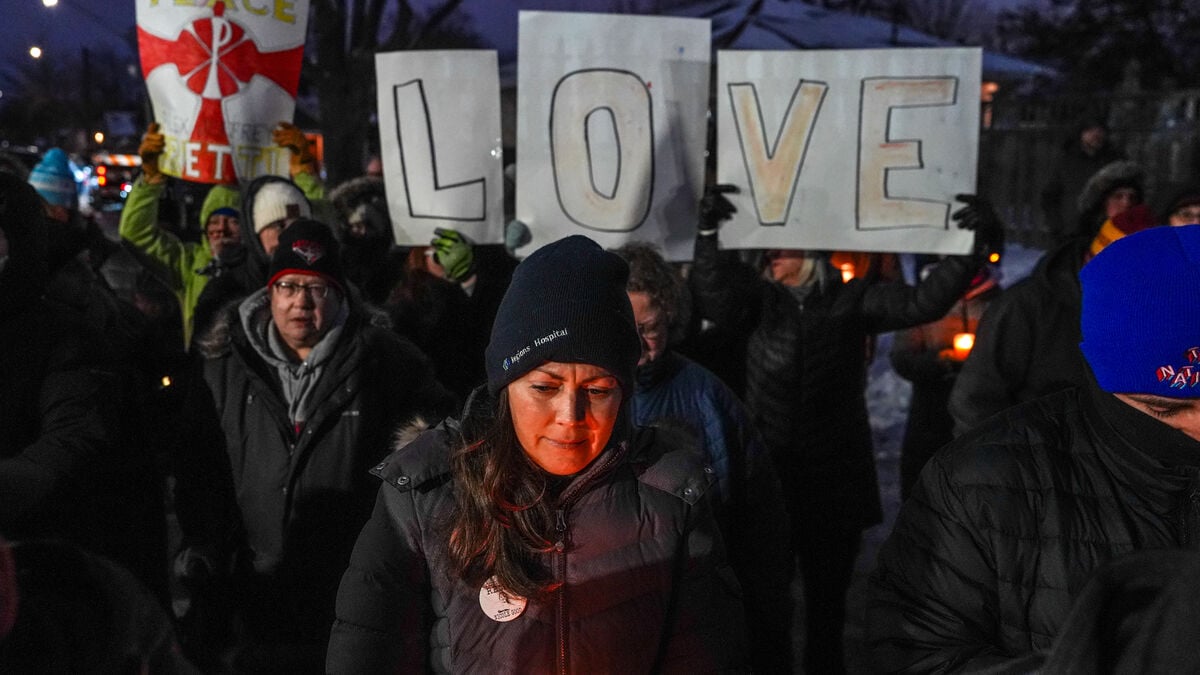
Earlier in January, another American, Renee Good, a mother of three, was shot dead by federal police a short distance away. This resulted in large protests in the Twin Cities. However, Sarah Stephens says she is proud that the demonstrations were relatively peaceful, that Minneapolis "didn't burn like after (the murder of) George Floyd."
"I think Donald Trump was hoping there would be riots so he could invoke the Insurrection Act and send in soldiers," she says.
Such preparations existed. 1,500 soldiers were put on standby in January in case the president wanted to invoke the more than 200-year-old "insurrection law" to quell protests, according to The Washington Post. But despite the anger bubbling in the streets, most demonstrations were peaceful.
And in March, the state of Minnesota sued the US federal government over the shootings.
Are our neighbors
Shortly after Alex Pretti's death, Donald Trump announced that the operation in Minneapolis would be scaled back. He also replaced Border Patrol Commissioner Greg Bovino, who had been portrayed in the media as a hardliner. And in February, the new US border commissioner, Tom Homan, said that the special operation would be dismantled.
But that doesn't mean ICE has left Minnesota. Border Patrol agents are still conducting raids in the state and surrounding areas. Defend 612 observers have recorded more than 3,500 migrants being flown out of the state in handcuffs and shackles between January and mid-May, according to Stephens.
Many of them are legitimate asylum seekers.
So what does she say to those who think ICE is doing a good job, that they are arresting criminals and that it is wrong to stop them?
I answer that we need the migrants. They are our neighbors and our workforce. There must be a way for them to be here legally, to come out of the shadows.
But, she adds, migrants who commit crimes must be prosecuted, just like everyone in the United States.
Share strategy
In recent weeks, Sarah Stephens and her colleagues have shared the noise and documentation strategy with like-minded people in Michigan, Florida, and Montana - places where you want to be prepared for possible ICE operations.
She has spoken openly about the frustration when her signal group was infiltrated and how frightening it can be to stand in front of riot-equipped ICE agents.
But she has also spoken about the strength of peaceful resistance together with neighbors and acquaintances.
We got ICE off the streets. I'm proud of our resistance.
One of President Donald Trump's most prominent campaign promises was to arrest and deport undocumented immigrants residing in the United States. During his time in office, he has sent federal agents to Los Angeles, Portland, and Chicago, among other places.
One force that has received a lot of attention is ICE, Immigration and Customs Enforcement, which is formally a federal law enforcement agency with over 20,000 employees and more than 400 offices in the United States and the world.
ICE was founded in 2003 in the wake of the terrorist attacks of September 11, 2001. Its mission is to protect the United States against cross-border crime and illegal immigration.
Earlier this year, ICE and other federal police conducted a special operation in Minneapolis-Saint Paul, where two American citizens were shot and killed:
Renee Good, a 37-year-old mother of three and poet, was shot dead in her car by an ICE patrol on January 7. Authorities claim she tried to run over the immigration officers, while critics believe that analysis of video clips supports that she tried to swerve and leave the scene.
Alex Pretti, a 37-year-old nurse, was shot and killed on January 24. Authorities say he was shot in self-defense by a Border Patrol agent. However, analysis of video footage of the incident shows he was shot multiple times while lying on the ground, after being subdued and disarmed by several agents.