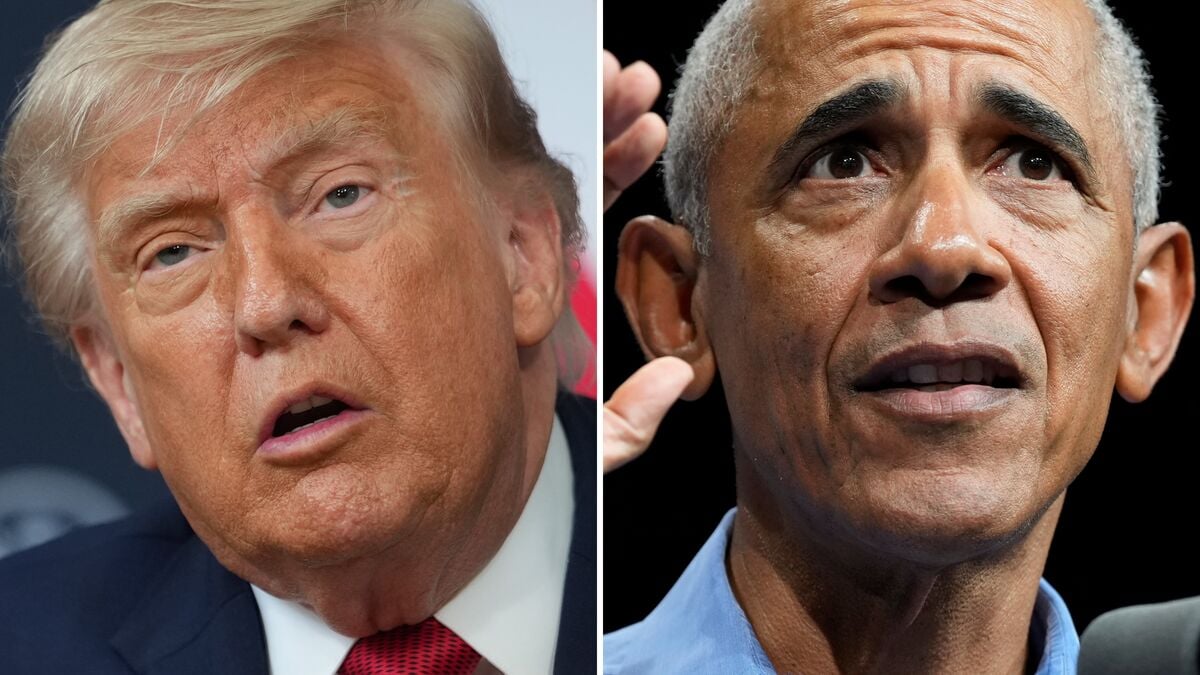
“Obuma’s deal was a path to nuclear weapons for Iran, money and all, one of the worst and stupidest (hence the Dumocrats!) deals the US has ever made. Our deal is a WALL against Iran ever getting a nuclear weapon, the complete opposite of Obuma,” President Trump wrote on Truth Social last weekend, likely with intentional misspellings.
The agreement he is referring to is the 2015 JCPOA. The then US President Barack Obama was the driving force behind that deal, which effectively locked down Iran's nuclear weapons program. Under the JCPOA, the International Atomic Energy Agency (IAEA) verified that Iran kept uranium enrichment well below the concentration needed to produce weapons. In exchange, the US and other Western countries eased economic sanctions.
But in May 2018, Trump announced that the US was leaving the agreement. Harsh economic sanctions were reimposed, the JCPOA collapsed, and Iran gradually increased its uranium enrichment.
Nothing about proxy groups
Now the president claims that the US negotiated a better deal with Iran. However, comparing the agreements is difficult.
"The Islamic Republic of Iran confirms that it will not acquire or develop nuclear weapons," the new 14-point agreement states, but otherwise the document focuses primarily on conventional weapons, a reopened Strait of Hormuz, and eased sanctions - with the possibility of significantly greater relief than under the JCPOA.
Trump has previously demanded that a deal also limit Iran's missile program and support for proxy groups like Hezbollah, but the agreement makes no mention of that.
"All we've heard so far is that they (Iran) are committing not to acquire nuclear weapons, which is what they've said all along," former US NATO Ambassador Kurt Volker told CNN this week.
Obama doubts
Under the agreement, the US and Iran have agreed to "resolve the disposal" of enriched uranium. The issue will now be discussed over the next 60 days.
"What he (Trump) has to do is even more difficult than what we had to do in 2015, because we didn't have to deal with a uranium stockpile approaching what's needed for a nuclear weapon," Wendy Sherman, the US's chief negotiator during the JCPOA talks, told The New York Times.
Even Barack Obama has his doubts.
It is doubtful whether the agreement will be significantly different, he told ABC News this week, adding that it is not possible to "bully or bomb" our way into solutions:
You would think we would have learned that by now.
In 2015, the nuclear agreement, the JCPOA, was signed between Iran and the “P5+1” – the five permanent members of the UN Security Council (France, China, the UK, Russia and the US) plus Germany and the EU.
Iran would only be allowed to enrich a certain amount of uranium to a relatively low purity (3.67 percent), far from that required for nuclear weapons, but sufficient for civilian purposes. The outside world would also be given greater transparency. In exchange, sanctions would be lifted.
In 2018, US President Donald Trump decided to withdraw from the agreement and impose stricter sanctions. Iran responded by stepping up its enrichment and stockpiles of uranium.
In recent years of escalation and war, the US has previously demanded that Iran stop enriching uranium altogether. Iran has objected that all countries that have signed the Nuclear Non-Proliferation Treaty have the right to enrich uranium for civilian purposes.
According to the UN's International Atomic Energy Agency (IAEA), Iran had enriched around 440 kilograms of uranium to 60 percent before the 12-day war in 2025. Nuclear weapons usually require an enrichment level of at least 90 percent.
Iran has long claimed that it has no intention of acquiring nuclear weapons.