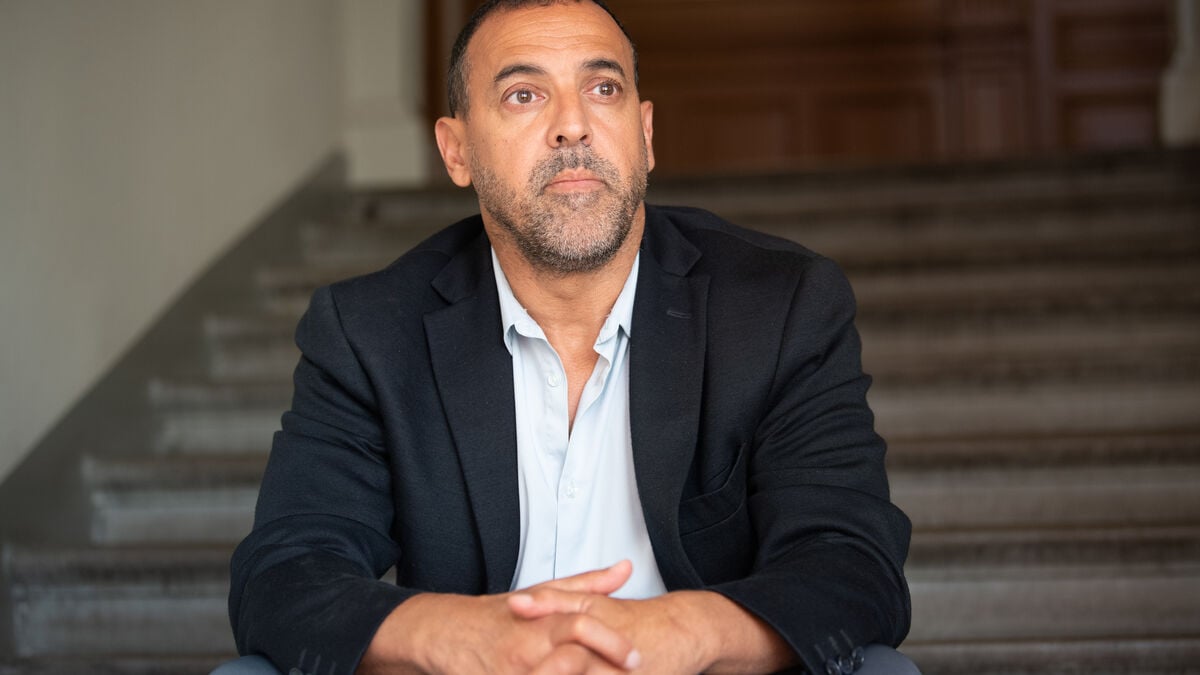
At the time of the Hamas terror attacks, Eli Sharabi, now 54, lived with his wife and two teenage daughters in the kibbutz Be'eri, near Gaza. Many there were active in the peace process, he says.
"It was the best place to raise your children, they had a wonderful childhood. I just remember it with a smile," says Sharabi.
The irony is that it was the people who tried the hardest who were hit hardest by October 7th.
In his book, he tells the story of 491 days of captivity. The thought of reuniting with his family kept him going - only when he was freed did he learn that his wife and daughters had been killed.
"Pain pulses through my broken body, a pain without a name and without a form, and no one needs to say a single word," he writes in his book.
Remaining in the tunnels was Alon Ohel, then 24, for whom Eli Sharabi had become a father figure. When Sharabi spoke before the UN Security Council, he called for the release of the others, including Alon - something that took another seven months.
Now we talk to each other every day.
Worms
In captivity, the toilet was permanently blocked, the stench persistent and worms spread. Every six weeks they had to shower with half a bucket of water and no soap. But the worst thing was that they didn't get enough to eat.
They had been deprived of their shoes, and kept track of the date and time only by the regular prayers of the Hamas guards. Sharabi knows Arabic and could ask questions.
He heard Hamas members crying and saw them having panic attacks. The younger ones saw him as “a person who wanted to kill Palestinians every day,” he says.
"I would really like to separate Hamas and the civilian Palestinians, but sadly, it is not possible. The day after the kidnapping, a civilian mob tried to lynch me," says Sharabi, who was rescued by Hamas at that time.
The horror
He supports the Israeli army but writes nothing about Prime Minister Netanyahu.
Who cares about Netanyahu, who cares about politics? In this book, people are suffering 50 meters underground. All I cared about was the horror I saw in my daughter's eyes.
According to UNICEF, 71,000 Palestinians have died in the war since October 7 in Gaza.
Is it possible to see a future in this?
How do you fight terrorists who hide behind their own population? If you have a good solution, I think the Israeli army would be happy to listen.
Facts: Eli Sharabi
Born in 1972 in Tel Aviv. Came to Kibbutz Be'eri at the age of 16. Met his future wife there who came there as a British volunteer. After the terrorist attacks on October 7 he has no desire to move there again.
He was taken hostage by Hamas on October 7, 2023 and taken to Gaza; he was released on February 8, 2025. He was received by his mother and sister.
Current: He is the first former Hamas hostage to have written a book about his time in the Gaza tunnels: "The Hostage. 491 Days in Hamas Captivity" has now sold over 130,000 copies in Israel and is published in 20 languages. Eli Sharabi sees what he experienced as part of Israel's history and wants to bear witness himself.
Future project: "I hope this will be the only book. I want to rest."