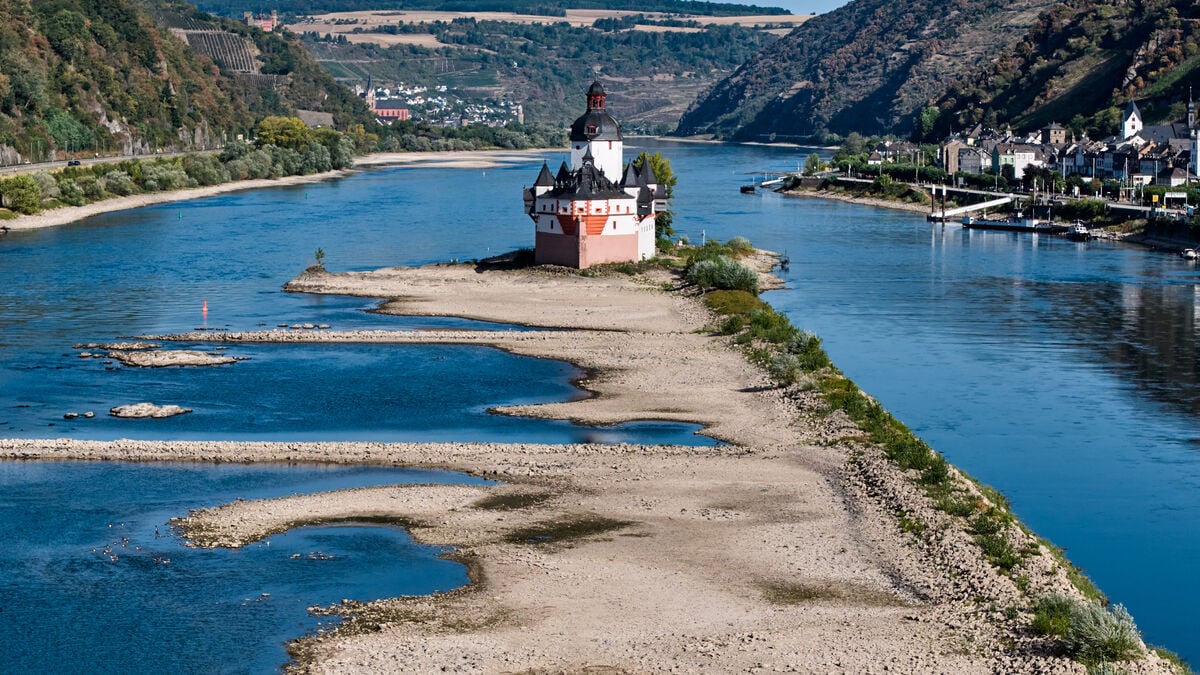
Water levels at the measuring station in the German town of Kaub, a bottleneck for shipping along the Rhine, are expected to fall into single digits for the first time because of a lack of rain.
Commercial shipping will no longer be able to transport goods in the region at such low water levels, BDB CEO Jens Schwanen tells Rheinische Post.
In principle, the Rhine will no longer be navigable along its entire length, and will thus be divided in two, he explains.
The possibilities of expanding truck and train transport on the route are now being examined.
Crops are threatened
The Po - Italy’s longest river - is also suffering from persistent drought and a series of heat waves. Low water levels are causing saltwater to penetrate more than 20 to 25 kilometers into the delta at the river’s mouth. This means the water has become too salty to be used for irrigating agricultural land. Irrigation has been partially stopped and harvests are at risk, reports the APA news agency. The water shortage in the entire Po catchment area is classified as “high.”
Reduces electricity consumption
In the Danube, by far the largest river in the EU, low water levels have forced countries dependent on the river to take drastic measures. In Hungary, the government has asked industries in the country to reduce electricity consumption as the country's only nuclear power plant, Paks south of Budapest, has drastically cut production due to record low water levels in the Danube.
In neighboring Romania, part of a canal was blown up in early August to redirect water so that the Cernavoda nuclear power plant would not have to be completely shut down.
Facts: Europe's largest rivers
In terms of water flow, Europe's largest river is called the Volga, but it only flows through Russia.
For the rest of Europe, the Danube and the Rhine are first and second. The Danube flows through or along the borders of Germany, Austria, Slovakia, Hungary, Croatia, Serbia, Bulgaria, Romania, Moldova and Ukraine, in that order.
The Rhine flows from the Alps to the North Sea. It forms part of the border between Germany and Switzerland, and between Germany and France. It also flows in or near the Netherlands and Liechtenstein.
The water flow in the large rivers normally amounts to several thousand cubic meters every second.