One hundred thousand years ago, impressive rhinoceroses roamed across Europe and northern Asia. Three meters long, with two massive horns on their snouts and a thick coat, they were well equipped for the harsh climate.
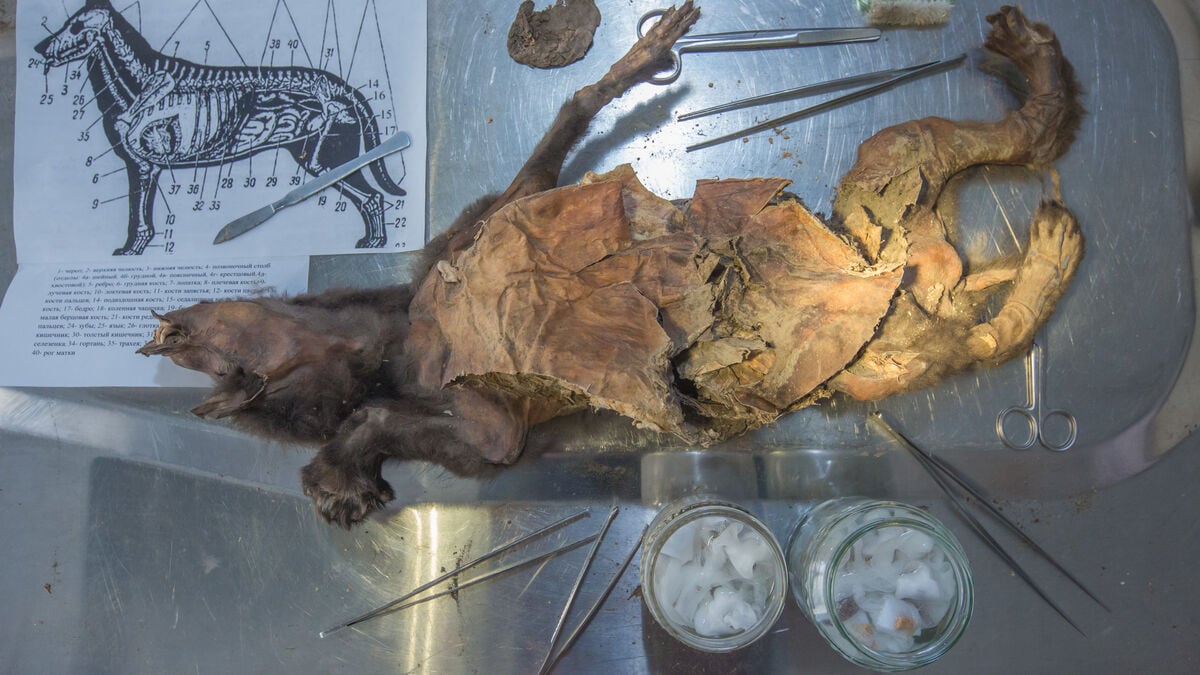
14,400 years ago, they were only found in parts of Siberia. One of these woolly rhinos ended up in the stomach of a wolf pup in Yakutia. The pup also died shortly after the meal, probably in a landslide, and froze to death in the permafrost, where it has been preserved to this day.
“Push the boundaries”
Doing a complete analysis of prehistoric DNA is difficult as it is. To be able to do this with tissue found in a stomach – whose job is to break down meat – makes it even more complicated. According to the researchers, it has never been done before.
"We were very lucky, because it had barely started to melt at all," says Camilo Chacón-Duque, one of the researchers.
What made it worth trying, though, is that the find is so young. The last woolly rhinoceros is believed to have died 14,000 years ago, just 400 years after this specimen lived. Therefore, the DNA can provide clues about how the species was doing just before extinction.
"And we wanted to push the boundaries of what can be done with these unusual, challenging samples," says Chacón-Duque.
When he and his colleague put the knife into the piece of meat in the laboratory, they knew from previous studies that it belonged to a rhinoceros.
"It's very exciting and very scary because you don't want to damage the sample by contaminating it. You also feel privileged to be holding something that has been preserved for more than 14,000 years. It's an honor."
Climate change likely cause
The researchers succeeded, and were able to compare it with DNA from older rhinos (18,000 and 49,000 years old, respectively). The recent find showed no traces of inbreeding, which suggests there were probably many rhinos until they suddenly disappeared. It was probably not humans who hunted the animals to extinction. So what did they die of? The clues point to another likely culprit - climate change as the ice age ended, although other possibilities cannot be ruled out.
"They were well adapted to the cold and a certain kind of landscape. When the landscapes changed, it may have put a lot of pressure on them," Chacón-Duque says.
Researchers at the Center for Paleogenetics, a collaboration between Stockholm University and the Swedish Museum of Natural History, have studied DNA from a piece of meat belonging to a woolly rhinoceros (Coelodonta antiquitatis) found in a mummified wolf stomach.
It is one of the youngest specimens of the rhinoceros ever found, dating to just a few hundred years before the species became extinct.
The study was published in Genome Biology and Evolution.