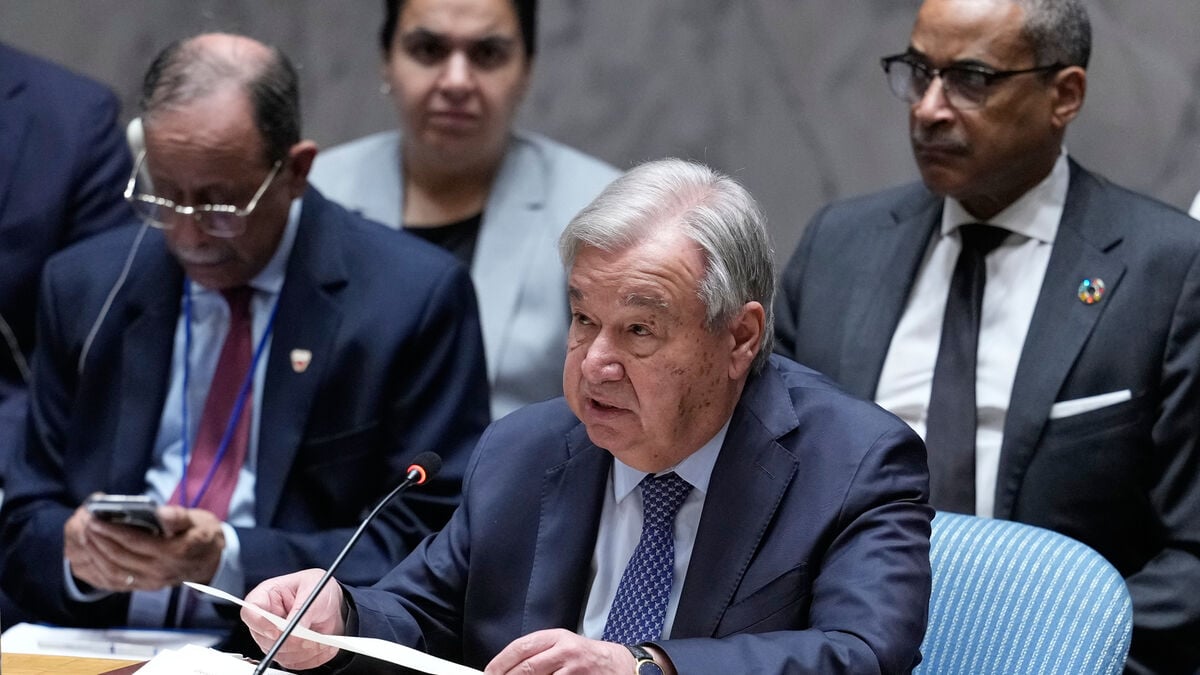
The UN has been put to the test during António Guterres' time at the helm. The wars in Ukraine and Gaza have been difficult for the Security Council to handle, where the five permanent members - France, China, Russia, the United Kingdom and the United States - have veto power.
António Guterres himself has repeatedly expressed dissatisfaction with the Council's efforts.
External criticism has not been kind either. Among other things, the veto right has been questioned after Russia and the US were able to put a stop to resolutions that other members wanted to push through because of the wars in Ukraine and Gaza.
“Dysfunctional”
Even the UN's own High Commissioner for Refugees, Filippo Grandi, has called the UN a "rather dysfunctional body."
"The institution is not stronger than its member states. That is where the erosion occurs and that is where the UN's reputation as a system for international coexistence fades," he said in an interview with TT last year.
Even US President Donald Trump has called the UN ineffective.
"All they seem to do is write a sharply worded letter and then never follow up on that letter. Those are empty words, and empty words don't solve wars," he said last fall.
The question is whether a new Secretary-General can make a difference. So far, only men have held the prestigious position. The UN has therefore encouraged member states to nominate women, but does not see it as a formal selection criterion.
Geography can affect
There is also a certain tradition of geographical spread when it comes to the selection of leaders, which means that a person from Latin America could be a good fit. Of the previous secretaries-general, four have come from Europe, two from Asia, two from Africa and one from Latin America.
Although there are currently seven nominees, other candidates could be considered if the Security Council members cannot agree on any of the seven on the list. The five permanent members of the Security Council also have veto power in the selection of a new UN chief.
Michelle Bachelet, former president of Chile and UN human rights chief, is one of the hottest names for the top job. In her statement on what she wants for the UN, she writes, among other things, that the future of the UN will depend on “its ability to adapt, innovate and lead.”
Who gets the job is decided by the General Assembly after the Security Council has reviewed the candidates and made a recommendation.
Michelle Bachelet, Chile. Former President of Chile, head of the UN gender equality agency UN Women and UN High Commissioner for Human Rights.
María Fernanda Espinosa, Ecuador. Former President of the UN General Assembly, Minister of Foreign Affairs and Permanent Representative to the UN.
Rafael Grossi, Argentina. Director General of the UN Atomic Energy Agency IAEA.
Rebeca Grynspan, Costa Rica. Former Vice President of Costa Rica and Secretary-General of the UN trade agency Unctad.
Carolyn Rodrigues, Guyana. Former Minister of Foreign Affairs and Guyana's Permanent Representative to the UN.
Macky Sall, Senegal. Former President of Senegal and Chairman of the African Union.
Olara Otunnu, Uganda. Former Minister of Foreign Affairs and UN Envoy. Served as Under-Secretary-General and Envoy for Children and Armed Conflict from 1997 to 2005.
Source: UN
The new UN Secretary-General will take office on 1 January 2027 and will be the UN's tenth in succession. The nine previous holders of the post have all been men:
António Guterres, Portugal, 2017 to 2026
Ban Ki-Moon, South Korea, 2007 to 2016
Kofi Annan, Ghana, 1997 to 2006
Boutros Boutros-Ghali, Egypt, 1992 to 1996
Javier Pérez de Cuéllar, Peru, 1982 to 1991
Kurt Waldheim, Austria, 1972 to 1981
U Thant, Myanmar (Burma), 1961 to 1971
Dag Hammarskjöld, Sweden, 1953 to 1961
Trygve Lie, Norway, 1946 to 1952
Source: UN
The United Nations was formed during the final stages of World War II. The UN Charter was signed by 51 member states in the summer of 1945 and entered into force on 24 October of that year. Today, the UN has 193 member states.
The work is led by the Secretary-General and is largely based on the UN Charter.
Important chambers where decisions are made are the General Assembly, the Security Council and the UN Economic and Social Council (ECOSOC).
In the General Assembly at the UN headquarters in New York, the 193 member states each have their own seat and vote. Decisions are made in the form of resolutions that are not binding on the member states. However, they are considered morally binding as they are a reflection of world opinion. A new General Assembly begins each year in September. This is also when the general debate is held, when leaders from the member states speak in the chamber, hold individual meetings and put forward initiatives.
Source: UN