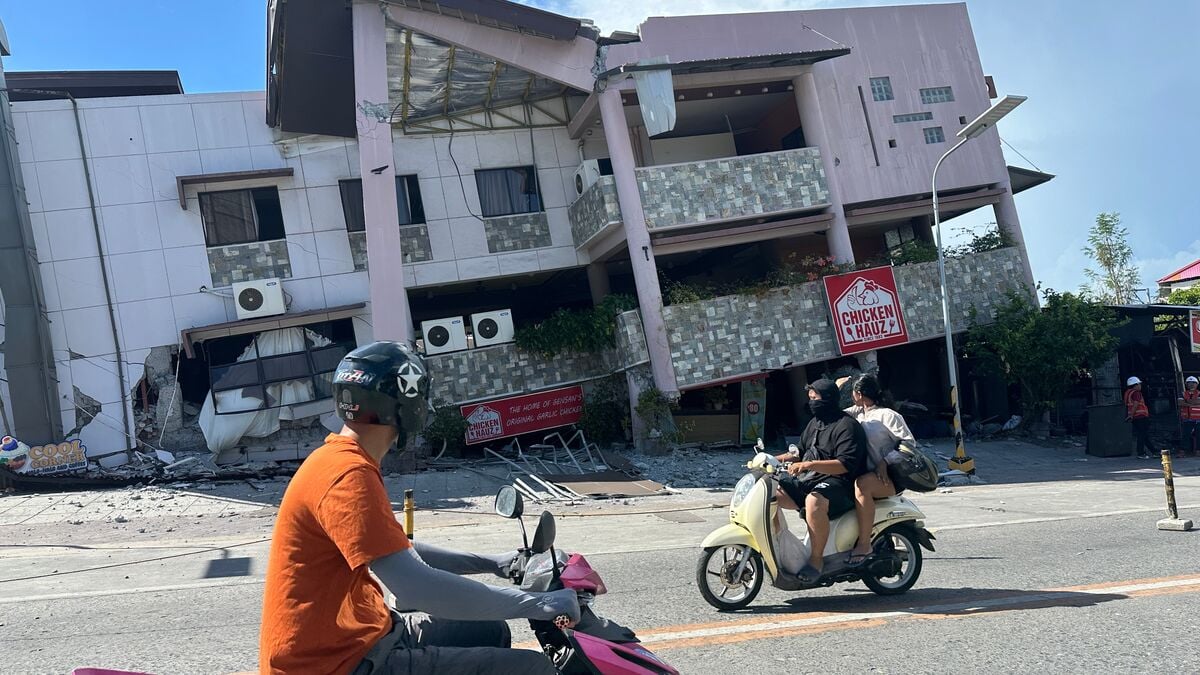
The earthquake had a magnitude of 7.8, and its epicenter was 13 kilometers south of the Philippine port city of General Santos, according to the US Geological Survey. Several buildings were reported to have collapsed there, and a major bridge was cracked.
Disaster officials are assessing the damage, and at least 32 people have been reported dead so far. At least three of them died in General Santos and at least 13 were killed in a landslide in nearby Sarangani province, according to the AP. In addition, two people were killed when a wall collapsed on them in the community of Alabel, a police chief said.
Demolished buildings
Flood damage and power outages were reported in other areas. Social media posts, verified by AFP, showed a fast-food restaurant in a shopping mall and an empty school building collapsing. Another post showed frightened and screaming schoolchildren holding on to their teacher as the quake continued.
"Our car suddenly jerked and I thought we had a flat tire," said Rod Sosmeña, regional director of civil defense, who was on his way to work when the ground started shaking during Monday night, local time in Sweden.
He said terrified people ran into the streets. According to police, several buildings have collapsed.
Philippine President Ferdinand Marcos has promised full disaster aid to the island of Mindanao, where General Santos is located.
An aftershock
People were initially urged to move to higher ground. Tsunami waves of up to one meter high reached the coast of the Philippines, and initial tsunami warnings were issued for Japan, Malaysia and Indonesia, among others. The warning was withdrawn after a few hours.
The quake struck at a depth of 35 kilometers, according to the USGS. An aftershock with a magnitude of 6.1 was also recorded at a depth of 67 kilometers.
The Philippines is located along the so-called Ring of Fire, an area of intense seismic and volcanic activity.