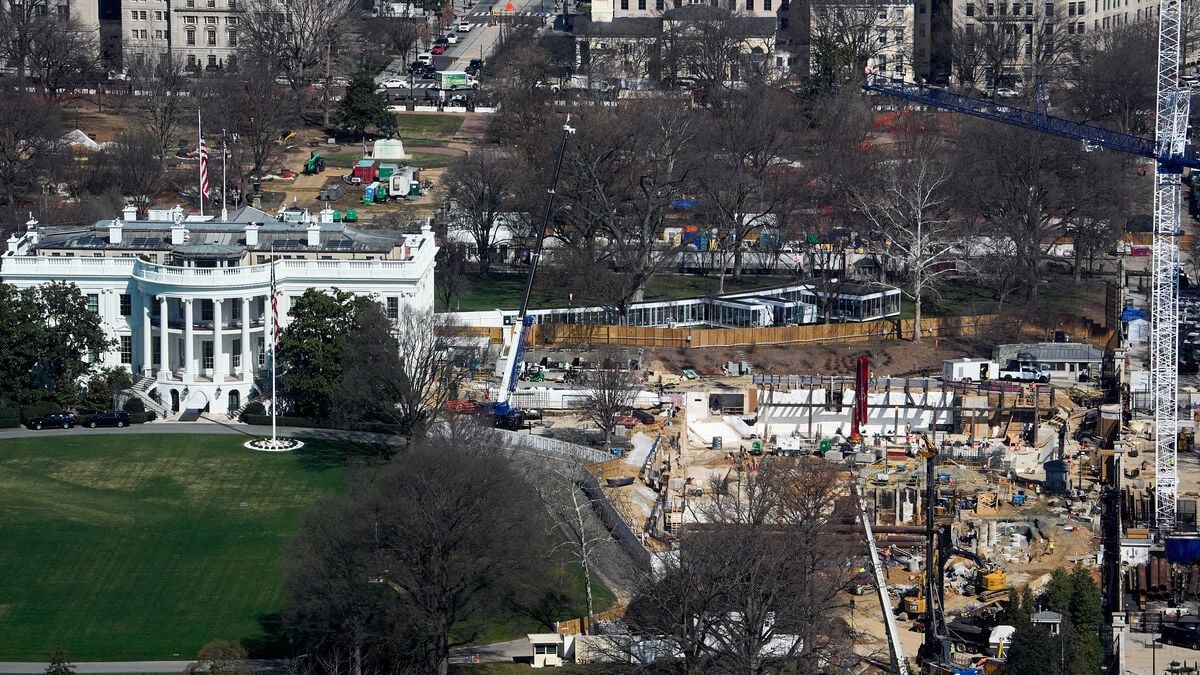
The East Wing of the White House has been leveled and construction cranes are ready. The idea is that Donald Trump's prestige project - a large addition with a grand ballroom - will get underway as soon as possible.
Where other large public buildings undergo review and rounds of consultation, the ballroom plan has been allowed to take shape in no time. Architects, urban planners and heritage conservationists say it shows, pointing to sloppiness and strange solutions in the finished drawings submitted in January.
The sketches showed, among other things, a large staircase at the front of the wing that led nowhere. After the criticism, Donald Trump emerged with an adjusted drawing.
"We just received this from the architects," he told reporters last weekend, showing a new sketch in which the staircase in question is no longer included.
The fence took longer
Trump's adjustments came at the eleventh hour. Critics had already taken the project to federal court, where a judge last week found that the process had moved too quickly.
Plans for an extension were announced last summer, drawings were produced in the fall, and the proposal was completed in January. On Thursday, three months later, a committee gave the final go-ahead for the drawings and plan, even though obstacles to implementation were placed on the work.
For comparison, the fence around the White House was to be given a new look a few years ago. At that time, experts had to review the decorations and proportions for nine months. For larger projects in the highly symmetrical Washington, DC, such work has often taken several years.
Federal Judge Richard Leon, who stayed the proceedings, believes that Congress should be allowed to decide on the construction. The Office of the President is appealing, citing the security of both the residence and the president.
Democratic obstacle?
Most of the objections have to do with the size and appearance of the building. Many also concern one person becoming the sole developer.
The addition will break a symbolic line of sight that has run along the wide Pennsylvania Avenue for over 200 years, from the Capitol building's entrance to the White House.
The ballroom literally juts out between two of the branches of our country's separation of powers, David Scott Parker, an architect working for a heritage foundation that opposes the construction, told The New York Times.
The new ballroom building planned for the White House will be larger than the presidential residence itself. The expanded East Wing will be wider and taller, with more than three times the cubic footage. It will accommodate more than a thousand guests in over 8,000 square feet of floor space.
Construction work has begun with the demolition and reconstruction of a military bunker underneath it. The bunker was built during World War II to protect the US government in the event of an attack but needs to be modernized.
The construction of the ballroom was initially said to cost the equivalent of just over two billion kronor, but the project has grown in scope and the budget has doubled to around four billion. According to the president, no tax money will go to the ballroom. However, a private financing model where donors are invited has raised some ethical concerns. The bunker upgrade and security-related parts are being paid for by tax money.