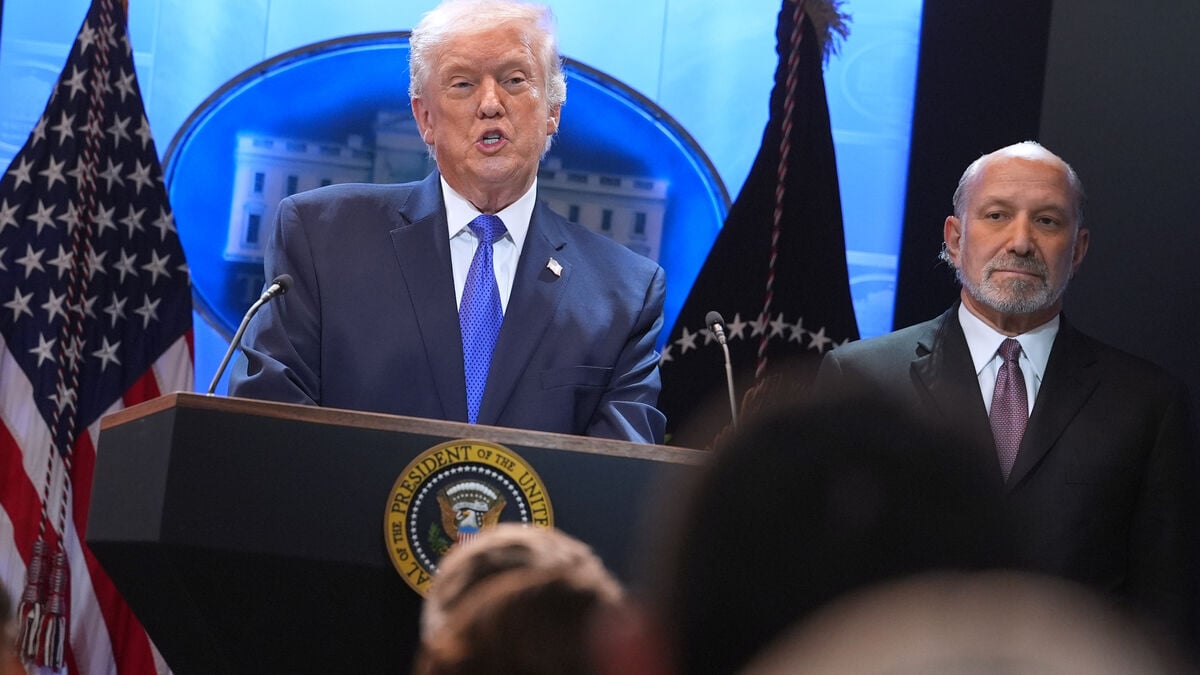
First came the Supreme Court's decision invalidating Donald Trump's previous trade tariffs, then the announcement that new global tariffs equivalent to ten percent will be imposed. Trump has now become the first president in US history to use Section 122 of the Trade Expansion Act - a kind of fast track, since one does not have to wait for an official investigation before imposing the tariffs.
A counter-move from Trump was expected, Mattias Persson points out, but what it actually means for the global economy and trade remains unclear.
According to the White House, the tariffs will take effect as early as Tuesday. However, the presidential order is only valid for 150 days, after which Congress must approve an extension.
"It creates a completely different uncertainty. You don't know which tariffs will apply, or whether they will apply throughout the year," says Mattias Persson.
Multiple questions
Another question is what will happen to claims for compensation for previously imposed tariffs. More than 1,500 American companies have requested over $170 billion in compensation for the tariffs that Trump imposed during the so-called "Liberation Day."
This could have implications for US government finances and thus the global economy, Mattias Persson points out.
"It's a lot of money to be paid out. It's about sustainability and could dig further holes if you need to borrow more," he says.
What further complicates the tariff issue are the exemptions granted to certain countries. For example, for Canada and Mexico, Trump's latest announcement could mean that tariffs are actually reduced under the United States-Mexico-Canada Agreement (USMCA).
New meeting
Regarding Europe and Sweden, a meeting will be held in the European Parliament's Trade Committee on Monday to assess the situation.
"What I think the EU can do is prepare for it to get worse again, but proceed cautiously. There is no reason to act at this point until you know what is actually going on."
Historically, Trump has on several occasions withdrawn various statements. Mattias Persson points out that it could happen again but is doubtful this time:
"What makes me doubtful is that tariffs are so central to his economic policy, and to his way of challenging the rest of the world to get the agreements he is after."