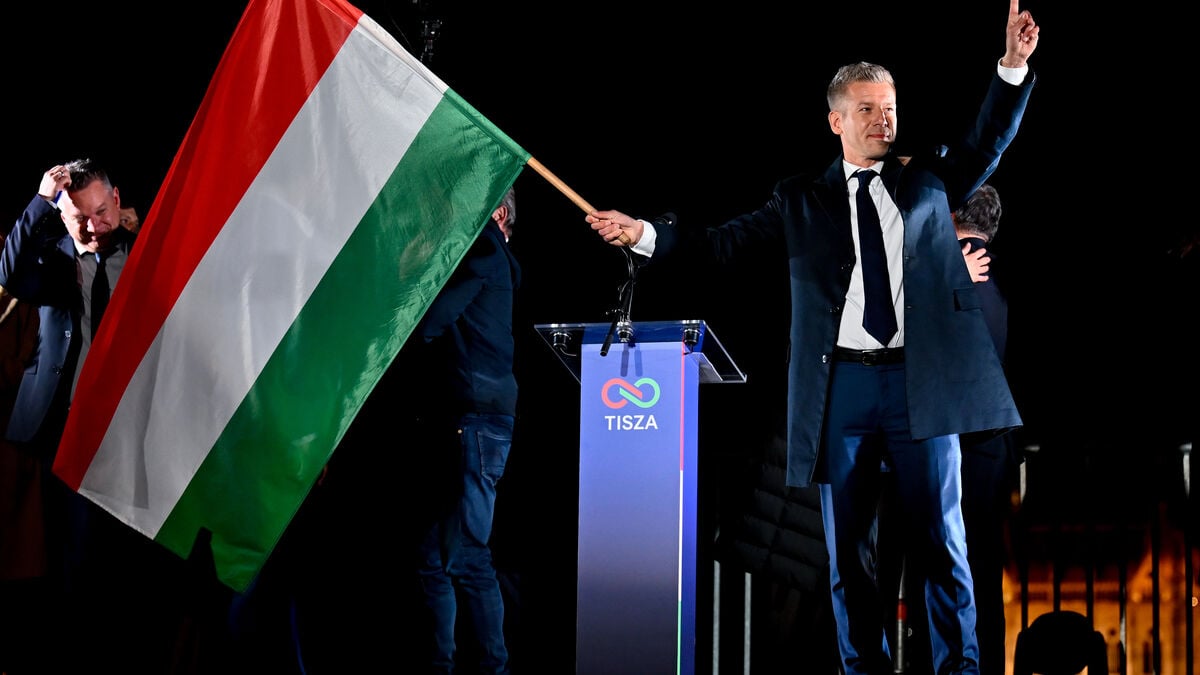
The party is aiming for 138 of the 199 seats in parliament, which means a so-called supermajority. This could open the way for constitutional amendments, for example.
Outgoing Prime Minister Viktor Orbán's party Fidesz, together with the alliance party KDNP, will receive 55 seats in parliament.
The far-right party Mi Hazánk will receive six seats.
Tisza's success in the election has been praised by Europeans. Polish Prime Minister Donald Tusk also took the opportunity to mock Orbán over his ties to Russia.
“A wonderful victory, dear friends!” Tusk said on X, adding “Russians, go home!” in Hungarian.
Facts: Parliamentary elections in Hungary
Each voter has two votes: one for their own constituency and one for national party lists.
Of the 199 seats in the Parliament (Országház), 106 are elected via single-member constituencies. 93 seats are distributed proportionally based on national party lists.
The electoral system also has a peculiarity, sometimes called winner's bonus, which is considered to favor large parties. This means that the votes that the winner in a constituency receives in addition to what was required to win are added to the party in the national count.
The result is that a large party can receive more seats than its share of the vote would suggest. The system is considered to have given Viktor Orbán's ruling party Fidesz a two-thirds majority in recent elections, despite the party only receiving around 45–50 percent of the vote.
Special rules also apply to make it easier for 13 specific national minorities (including Roma, Germans and Slovaks, the most numerous) to win individual mandates.
Parliament has a 5 percent threshold.
Hungary has just over 7.5 million eligible voters.
Sources: UI, NE.
Fidesz: A nationalist right-wing party led by outgoing Prime Minister Viktor Orbán. Clearly critical of the EU, it has close contacts with Moscow and has been accused, among other things, of authoritarian rule. It is in alliance with the Christian Democratic Party of Hungary (KDNP).
Tisza: A social-conservative right-wing party led by Péter Magyar, a former member of Fidesz. The party is considered more pro-EU than Fidesz. Also called the Respect and Freedom Party.
Our Homeland (MH – Mi Hazánk): An extreme right-wing party that is also described as neo-fascist.
Sources: Politico.org, Expo, UI.