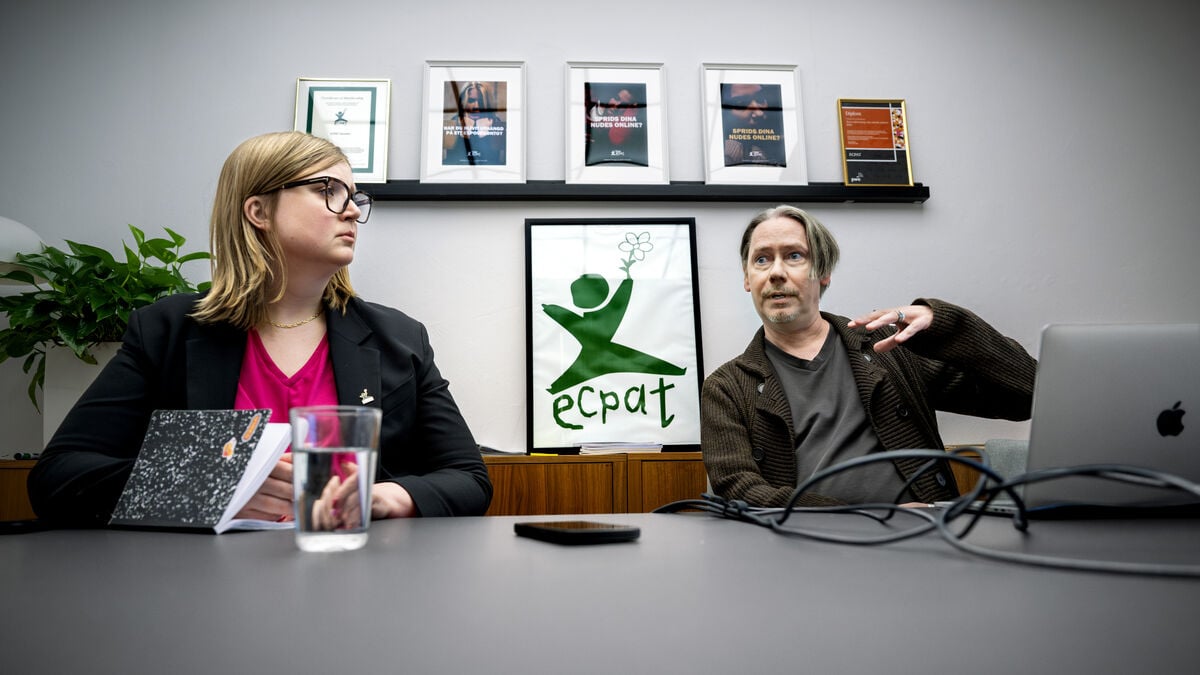
The numbers on the screen inside Ecpat Sweden's office in Stockholm are ticking steadily upwards.
There you have "Arachnid" in real time, says analyst Thomas Andersson.
The web spider that scans the internet for abuse material has so far analyzed just over 176 billion images, the meter shows. Below is the figure showing how many human assessments of suspected abuse images have been made: over 37 million.
It's ticking a little slower right now, because Canada hasn't really woken up yet, says Susanna Pettersson, child rights lawyer at Ecpat Sweden.
Project Arachnid was started in 2017 by the Canadian Centre for Child Protection. The idea was to move from a purely reactive approach - where you try to take down images only when you become aware of an individual publication - to a more proactive approach, with a spider constantly searching the internet for abuse material.
Ecpat Sweden joined Arachnid as the first European organization in 2018. Today, organizations in 17 countries are members.
Millions of images
Further down the screen, the number 124 million is displayed. This is the number of images identified as likely to be abuse material, but which have not yet been examined by analysts and added to the spider.
You could say it's our "backlog," says Thomas Andersson.
Every workday, he and Ecpat's three other analysts sit down and try to sift through that mass, image after image, together with their colleagues around the world.
When we have two assessments that say the same thing, for example that it is a prepubescent child being sexually abused, then Arachnid will automatically send a takedown request when it gets a hit.
If the same image appears in another location, a new request is immediately sent. Since its inception, over 140 million requests have been sent out.
A single assessment by us can lead to several hundred takedowns per year, says Andersson.
People who have their abuse documented and shared online have described it as ongoing abuse. That's why proactive work is crucial, he says.
This is such enormous suffering for so many, so it is not acceptable from a child rights perspective to continue treating new victims solely in this reactive way.
For an individual child, it can make a big difference, especially if the image is reported early. Once the images have spread widely, it is almost impossible to stop.
Spread for decades
Thomas Andersson tells the story of a Swedish child, “Kim”, who was abused around 2010. The perpetrator who documented the abuse was convicted and has served his sentence. Ecpat has studied the case and found that between 2018 and 2022, Arachnid detected images of “Kim” thousands of times every quarter.
Decades after the abuse, years after the perpetrator has been released, the victims are living with this.
The pictures of "Kim" continue to be spread to this day.
"I see "Kim" in the work every week with new distribution. It is one of the more widespread ones," says Thomas Andersson.
Some images are shared more than others, says Susanna Pettersson.
You can see that it becomes a bit, as absurd as it sounds, almost like an idolatry of these children in the material. That you want to collect all the pictures. It becomes a hoarding mentality.
The perpetrators thus build up entire catalogs of individual children with whom they have developed a fixation.
They are very aware if, for example, they are missing images that they know exist somewhere else, which they might then be looking for, says Thomas Andersson.
Sextortion worries
When they are not working at Arachnid, the analysts are on the organization's hotline. Anyone can call there with tips about child abuse, including children themselves. Increasingly, it has come to be about "sextortion", where children are tricked into sending nude photos to what they believe is a child of the same age. Once the photo has been sent, the child begins to be pressured for money.
When it comes to financial motives, it is almost only boys who are targeted. It is an extremely fast-paced situation, which is why Ecpat has to act quickly when they receive tips.
In almost all such cases, the blackmail begins the same evening as the first contact is made. And internationally, we see that this is a sexual crime with a high suicide risk. The suicides also usually occur on the same day, says Thomas Andersson.
Many of these crimes, according to Ecpat, can be traced to loosely organized networks, often centered around certain West African countries and the Philippines, targeting countries where children are relatively proficient in English.
Alexandra Lindgren at the police unit for IT-related sexual abuse of children in the Eastern region says that sextortion often begins on gaming platforms.
And when you've got the boy on the hook, so to speak, you move on to another forum.
However, most of the sexual crimes she handles involve girls and it is clear that boys have a harder time talking about what they are being subjected to.
I can hear people saying, “I have to educate my son on how to be around other girls.” But it's just as important that they learn how to avoid being victimized online.
As a parent, you should talk to your children about what they might encounter even before they get their first cell phone. They should feel safe enough to tell you if someone forces them to send pictures, or spreads their pictures online.
"It's a fear that many children have that they have disappointed or saddened their parents. As an adult, you have to be clear that it's never the child's fault," says Alexandra Lindgren.
Facts: Rated over 2.5 million images
In 2024, Ecpat Hotline analysts assessed 2,546,875 individual images in Arachnid. This corresponds to approximately 47 percent of the total 5.3 million images assessed by the entire network.
The joint work led to over 9.1 million requests for removal of abuse material being sent via Arachnid in 2024.
Since Ecpat joined Arachnid, their analysts have assessed approximately 6.3 million images.
Source: Ecpat Sweden
Suicide helpline Mind: Here you can get help if you or someone you know is thinking about suicide. You can call 90 101, chat or email.
Ecpat helpline: Provides help and advice about sexual harassment, threats and abuse for those under 18 years of age.
Bris: You can call, email or chat with adults at Bris. Phone number: 116 111, open 24 hours a day.
Ungasjourer.se: Here you will find contact information and opening hours for all of Sweden's youth shelters.
Killar.se: Here you, as a guy, can chat with young people and adults.
Buddy on call: Here you can chat with young people, run by the Red Cross Youth Association.
Tilia: Here you can chat about feeling mentally unwell.
Novahuset: Offers support and advice to those who have been subjected to any form of sexual violence, regardless of whether the abuse occurred online or offline.
Big Sister: Offers support to anyone aged 13 and over, regardless of gender identity, who has been a victim of rape or sexual assault.
BOUJT - Children and Youth Helpline in sign language. Here, if you are deaf or hearing impaired, you can get encouragement, support or ask questions in Swedish, written Swedish or sign language.