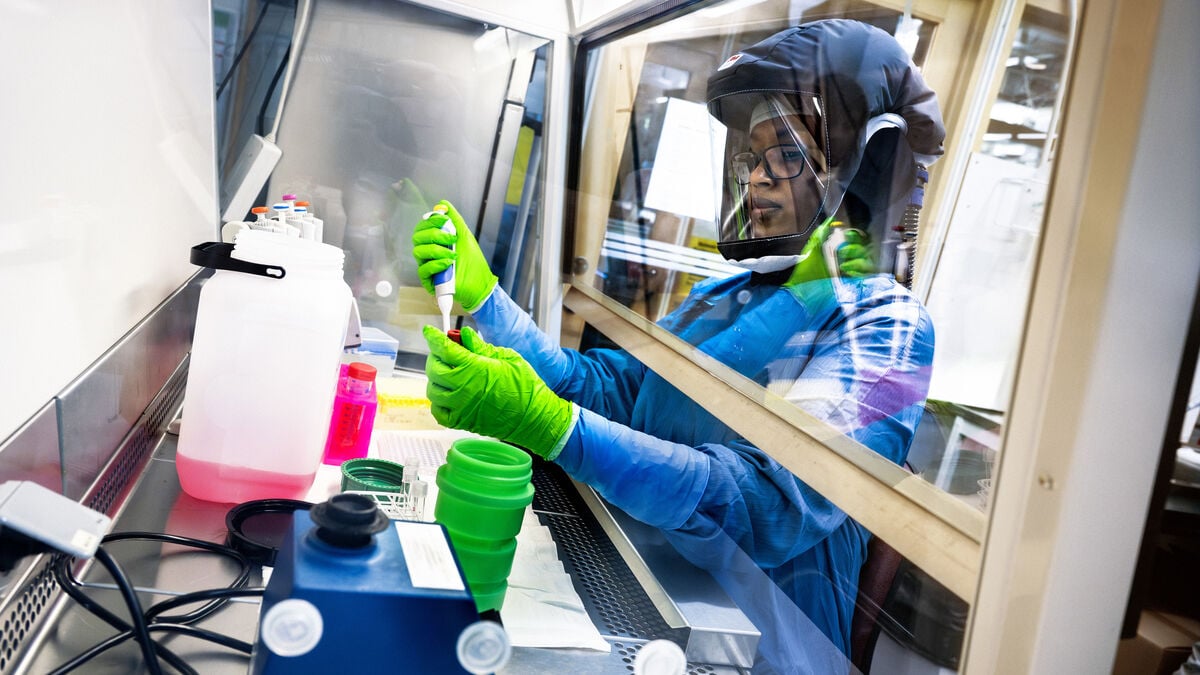
There are around ten people - those who have the skills to get through airlocks, put on protective suits and gloves, and handle samples that scare most people. Here at the Public Health Agency's security laboratory with the highest protection class, unpleasant infections such as rabies and Ebola are analyzed. If a suspected case of Ebola were to emerge now during the ongoing outbreak in Congo-Kinshasa, this is where it would come from.
How transport takes place depends on the type of infection.
"We have agreements with courier companies that are used to handling dangerous goods, so you could say that the samples are delivered here by taxi," says Johan Aarum, head of the unit for emergency preparedness and infectious disease diagnostics.
What the samples have in common is that they are unusual infections, often from people who have traveled. On-site, they are received by staff with the necessary protective equipment. It requires some training to perform all the steps with the seemingly cumbersome protective clothing.
"You get used to it, and we train regularly," says Ryan, who has worked at the security lab since 2020.
Always two
Like many of his colleagues, he is a biomedical analyst. At protection level 3, the staff wears gloves, a protective coat and a special helmet that filters the air so that no microorganisms can pass through. Before the jar containing the sample is opened, it is also placed in a safety cabinet.
"There are always at least two of us working together," says Degmo, one of those on 24/7 standby.
There must be two people so they can discuss issues or if something were to happen to one of the employees.
A few hours
On average, about one sample arrives every two weeks and is analyzed in one of the safety-classified laboratories. But it happens much less often at the very highest level, level 4. That's where any Ebola sample would end up. Then an even more advanced protective suit is required with its own air supply.
From the time a sample arrives, it takes between two and four hours for results to be ready. When new infections occur, the agency is in close contact with, among others, the WHO and researchers around the world.
If a patient turns out to be infected with, for example, Ebola, they are cared for in a high-isolation unit. There are two of these in Sweden, one at Karolinska University Hospital and one at Linköping University Hospital.
Footnote: For reasons related to the work, the last names of those who work there are not given.
Facts: Ebola outbreak 2026
On May 15, the World Health Organization (WHO) announced an outbreak of Ebola caused by Bundibugyo virus in Congo. Cases have also been reported in Uganda.
As of May 27, a total of 906 suspected cases and 223 deaths among the suspected cases had been reported in Congo-Kinshasa.
As of 29 May, a total of 134 confirmed cases had been reported in both countries, nine of which were in Uganda, with 18 deaths among the confirmed cases.
Ebola virus is an RNA virus that causes hemorrhagic fever. There are six variants of Ebola virus – four of which cause disease in humans.
The Bundibugyo virus variant is behind the current outbreak in Congo-Kinshasa. There are no vaccines or specific treatments for it, but development is underway.
Ebola virus is transmitted between people through bodily fluids. Sexual transmission also occurs. The illness occurs quickly with flu-like symptoms such as high fever, headache, sore throat, stomach and intestinal symptoms and muscle pain. At the end of the course, bleeding can occur on the skin and in internal organs.
The mortality rate is estimated to be 50–90 percent in outbreaks in affected African countries. With access to adequate intensive care, the mortality rate is likely to be significantly lower.
Source: WHO, Swedish Public Health Agency