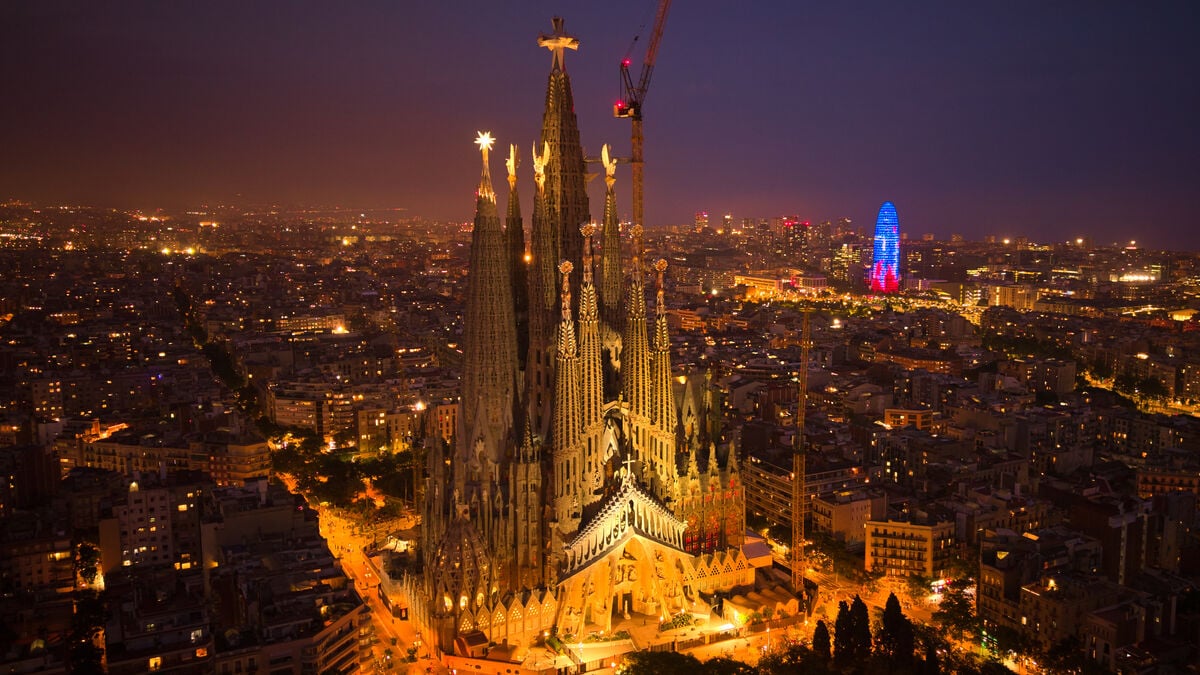
The giant church is considered one of Europe's biggest tourist attractions. Millions of people visit it every year, despite – or perhaps because of – the fact that the nearly 150-year-old construction never seems to be finished.
But there will now be an inauguration, when Leo XIV holds a mass on June 10 to bless the Tower of Christ (La torre de Jesucrist), the centrally located spire that extends 172.5 meters into the air and makes the church the tallest in the world.
The date was chosen with care, to honor the church's creator. Exactly a century earlier, on June 10, 1926, Antoni Gaudí died at the Santa Creu Hospital in Barcelona's old Raval district. He had been taken to the modest hospital a few days earlier after being hit by a tram.
“Dedicate myself completely to the church”
At first, no one recognized the shabbily dressed patient. Gaudí, then 73, had long been a successful architect. But after losing several close friends, he had stopped caring about anything other than church building in the last 15 years of his life.
My friends are dead. I have no family or clients, no fortune or anything, Gaudí is said to have said.
Now I can devote myself fully to the church.
The building had thus become his lifeblood, perhaps an obsession. Yet the Sagrada Família project had originally had nothing to do with him at all.
The idea of a church dedicated to the Holy Family – Jesus, Mary and Joseph – came in the mid-19th century from bookseller José María Bocabella and priest Josep Manyanet. Bocabella had visited Loreto, south of Ancona in Italy, where the original home of the Jesus family is believed to be located in the Basilica della Santa Casa.
172,000 pesetas
Bocabella and Manyanet wanted something similar in Barcelona and therefore bought a plot of land in what is now Eixample in 1881. The price for the 12,800 square meter plot of land was 172,000 pesetas, a fairly modest sum equivalent to only about ten thousand euros today.
Construction began a few years later, financed entirely by donations and based on drawings by architect Francisco de Paula del Villar – a typical neo-Gothic building of the time, in the same style as Allhelgonakyrkan in Lund or Oscar Fredriks kyrka in Gothenburg. But it didn't take long before Villar, after a disagreement with Bocabella, among others, dropped out.
Gaudí was allowed to take over. And he began to steer the project in a completely different direction, according to a motto the then 30-year-old architect is said to have expressed as:
The straight line belongs to man, the curve belongs to God.
“Half a spaceship”
The plot soon became too small as the drawings grew and the buildings took on the round shapes that are typical of his work.
“Gaudí drew on the Holy Scriptures and nature and wanted to spread the evangelical message through architecture,” as it is now described on the Sagrada Família website. Or, as The Guardian describes the style a little less pompously: “Half sandcastle, half spaceship.”
The project became so ambitious that over the years he realized that it would need to be completed by others. By the time of Gaudí's death in 1926, only about a quarter of the building was complete.
My client is in no hurry, he is also said to have said, referring to God.
His followers were able to continue the work, but not without drama. In connection with the start of the Spanish Civil War in 1936, anarchists entered the crypt and partially destroyed Gaudí's drawings. This may have contributed to the fact that the construction then, during the poor post-war period, crept forward for a long time; it took until 2010 before it was said to be halfway done.
Inauguration 2010
But by then the sacred project had received a modern, worldly salvation: mass tourism. As Barcelona grew as a global tourist destination, donations skyrocketed. Once funded by pennies from Catholics repenting their sins, construction revenue now comes from several hundred Swedish kronor per ticket and several million annual visitors from countries such as China, the USA and South Korea.
And even though there was only half the work left, in 2010 then-Pope Benedict XVI showed his support by consecrating the Sagrada Família on site as a Catholic basilica.
Since then, it has been a functioning church, while construction continues at full speed. And in February this year, it reached a literal culmination, when the cross on the Christ tower was installed. With a new height of 172.5 meters, the Sagrada Família beats the previous record holder, Ulmer Münster in Germany, by a margin of ten meters, as the world's tallest church.
Step two of four
The foundation that manages the church and the building now calls the Sagrada Família “architecturally complete.” And on the evening of June 10, Leo XIV will rededicate it. The Pope will hold a mass with a ceremony to bless the tower of Christ.
The grand event is a stark contrast to Gaudí’s quiet passing exactly 100 years earlier. But “God’s Architect,” as he was called, is in more focus than ever. He was declared venerabilis (Latin for “venerable”) in 2025, the second of four steps to becoming a saint. And with the Pope’s visit to Spain, many are looking for clues about how Leo wants to take that process further.
The full name is “Basílica i Temple Expiatori de la Sagrada Família” (Basilica and Temple of the Holy Family), referring to the family of the baby Jesus, Mary and Joseph.
The church began to be built north of the old city center of Barcelona in 1882.
The financial foundation was the purchase of the plot of land for a sum equivalent to only about ten thousand euros in today's money. Ever since then, the construction has been financed by donations and other visitor income. The size of these reflects how the project has grown. In 2025 , the church foundation reported income of 134.5 million euros (1.45 billion kronor). This corresponds to 4 million kronor every day, or 10,000 kronor every four minutes.
Construction has been ongoing for over 140 years. According to current plans, the last major construction work should be completed in the mid-2030s.