Since the business model is based on us being there as much and for as long as possible, they have a well-thought-out design to get us to meet that goal, explains Sissela Nutley, who has a doctorate in cognitive neuroscience at Karolinska Institutet.
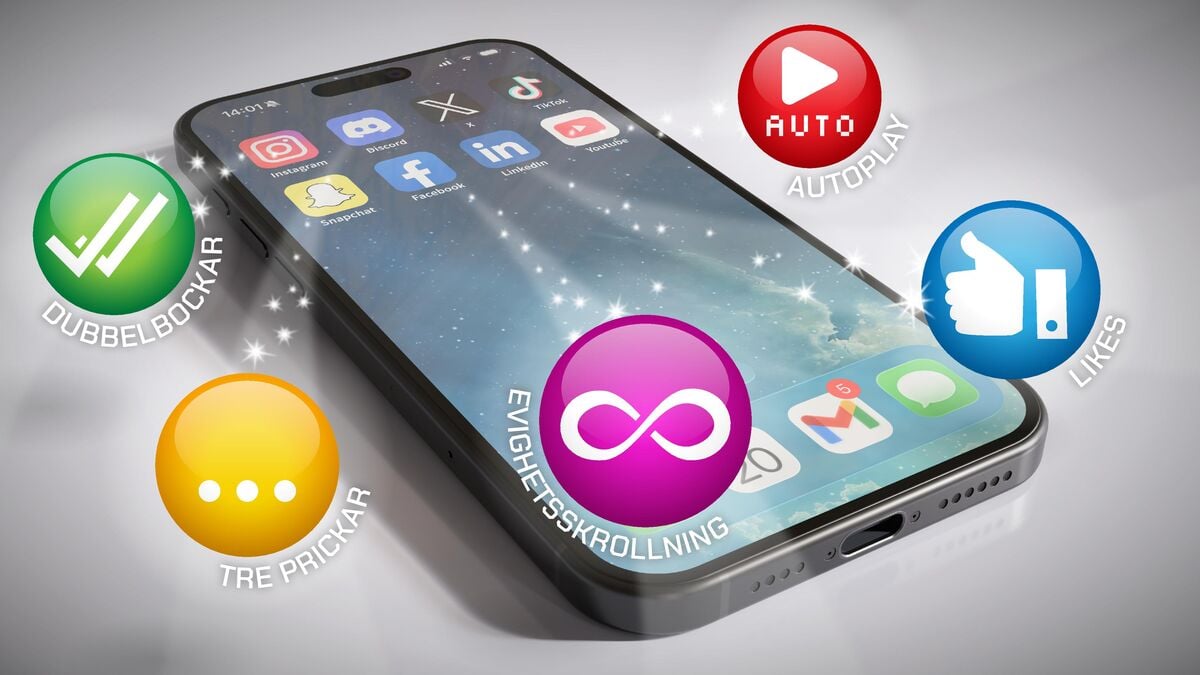
Here are some of the tricks used:
+ Infinite scrolling. It is possible to scroll endlessly. The user is constantly confronted with new material, which triggers our curiosity and satisfies the brain's thirst for knowledge.
+ Algorithm-driven content.
Personal feeds show posts based on what you've previously interacted with, liked, or even briefly viewed.
It pays companies to serve more "edgy" content, things our brains don't classify as normal or boring, says Nutley.
It leads to material that is more extreme.
We are probably seeing the consequences of this in the form of increased polarization in society and a shift in norms.
+ Personal push notifications.
With a push notification, the apps take advantage of the personal investment we have made, and serve up content they know we have engaged with - and that we have now clearly missed.
+ Three points...
The three dots when someone writes make us stop and wait.
We get a clear signal that something will happen soon. This is the phase where we have the greatest dopamine release, when we expect it.
+ The double tick.
The second check mark showing that a message has been read is a strong signal.
If we see that someone has received our message and read it but has not responded, we interpret it as a social defeat, a drop in status.
You don't want to expose the other person to that knowledge, which means you respond quickly to confirm that the person is important.
+ Streaks.
A system to encourage daily use. You simply don't want to break a long "streak", which is exploited with push notifications, among other things.
We know from other psychological research that when we have invested continuously over time, we become more reluctant to lose what we have begun to accumulate.
+ Disappearing content.
Material that only exists for a certain time and then disappears - such as Instagram's "events" - creates a feeling that you risk missing something if you don't log in, so-called "FOMO" (fear of missing out).
+ Likes and comments.
Humans are made to live in groups. The brain releases dopamine as a reward when we connect with others, making us want to do it more. The same ancient reward system is triggered by likes and comments.
It can feel rewarding, or create anxiety if it is less than expected.
+ Autoplay.
When a video clip automatically starts playing after you finish watching the previous one, it removes the small barrier that an active selection entails.
"It's another way to trigger our curiosity. We have a hard time stopping it once it starts," says Nutley.