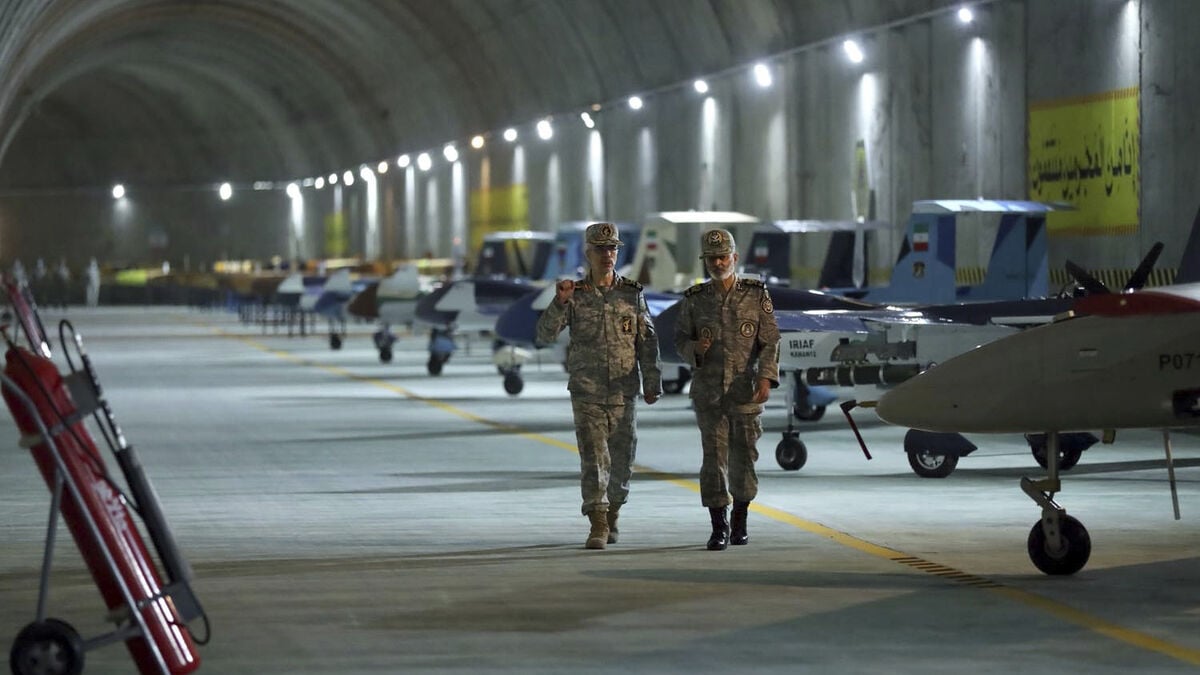
Last year, Iran released a
from one of its infamous underground bases. Two generals were seen standing on the back of a pickup truck in an underground tunnel system, passing rows upon rows of large robots.They are probably not stored in a row like in the videos, because you want to limit the dangers if something goes wrong, says Sidharth Kaushal at the British Royal United Services Institute.
But the point - that there are huge amounts of missiles in these bases - is true. They had almost 3,000 ballistic missiles before the war broke out.
Protect and hide
Iran has underground facilities in several locations around the country. They are sometimes called “missile cities.”
They are very large bases for Iran's missiles. They are a kind of reinforced structure to protect and conceal launch sites.
This probably includes a command post, accommodation, areas for mounting warheads, temperature-controlled storage areas and fuel storage, according to Kaushal.
The idea is to survive an initial attack and then roll out the mobile launchers through the tunnel openings and quickly fire them at the enemy. In some cases, the robots are hidden in silos.
"But this protection is not as useful if the adversary has mapped the entrances and exits. That's what we see from a lot of the footage that's coming in: the Iranian missile launchers are hit basically immediately as they leave what the Iranians thought were hidden exits," he says.
The US has deployed special 900-kilogram bombs to knock out underground facilities. Israel has said that the majority of Iran's launch platforms have been destroyed.
Have in reserve
At the same time, Iran still manages to fire missiles and drones.
They are still managing to hit the economies and energy infrastructure of the Gulf region in a significant way. But for the most part, the strategy has been a failure, says Kaushal.
The question is what capacity Iran actually has left to deploy. Kaushal notes that the volume of ballistic missiles fired has decreased significantly.
Whether it is because Iran lacks the capacity or because they have them in reserve for a protracted war will be a question for the future, he says.