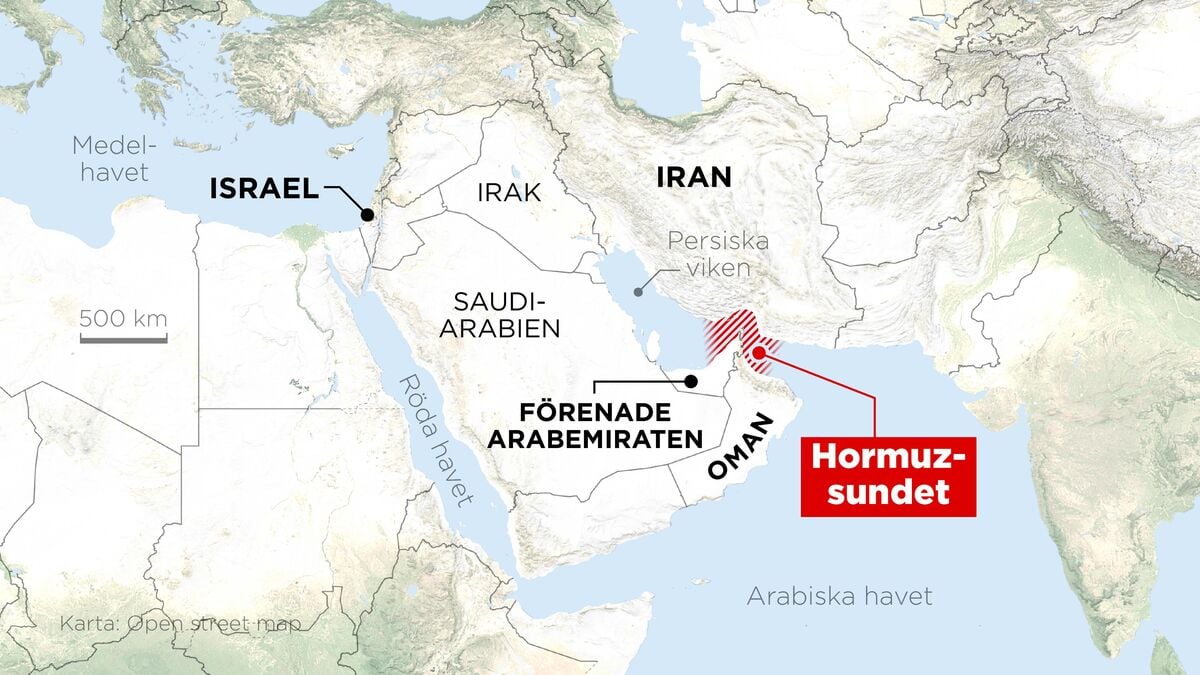
Before the war with Iran broke out, 20 million barrels of oil flowed daily out of the Persian Gulf, through the Strait of Hormuz and on to the Indian Ocean.
That route is virtually closed. This means, among other things, that oil prices are rising and that stocks in the Gulf are filling up. According to Bloomberg, Saudi Arabia's powerful oil company Saudi Aramco has cut production and is directing tankers towards the port of Yanbu, on the country's west coast facing the Red Sea.
It is the final station for a pipeline that is said to be able to deliver around five million barrels of oil a day - but those levels have never been tested.
"It hasn't been used at full capacity, as far as I understand, but now it's definitely starting to approach a record. It's not entirely surprising, because we see that Saudi Arabia is now, like Kuwait and the Emirates, having to start cutting production," says Thina Saltvedt, energy analyst at Nordea.
“Anything extra helps”
In the United Arab Emirates, there is another pipeline that, according to Bloomberg, can deliver up to two million barrels of oil a day to the Gulf of Oman, on the other side of the Strait of Hormuz. So, together, at most seven million barrels a day.
Is that enough to stop the price surge?
Of course it helps - at the moment nothing is coming out. But even if on paper they can export around five million, you're not sure if it can handle that. So we don't know if it can be done.
But anything extra you can get out of it helps, says Thina Saltvedt.
The Houthi threat
But new problems await in Yanbu. The lion's share of the Gulf states' oil is exported to Asia. If it is to be transported the fast route, the tankers must travel south, through another strait to reach the Indian Ocean: Bab el-Mandeb. A place where many ships have previously been attacked by the Iran-backed Houthi movement in Yemen.
Alternatively, you can go north, through the Suez Canal into the Mediterranean Sea.
But it's a long way to travel around the whole of Africa.
Earlier on Monday, the finance ministers of the G7 countries discussed the possibility of satisfying demand by opening their strategic oil reserves.
So it seems that the G7 countries also do not see it as enough to meet demand, says Thina Saltvedt.
There are two major pipelines that can carry oil from the Gulf states' oil fields to ports outside the Persian Gulf's bottleneck, the Strait of Hormuz.
+ Saudi Arabia's East-West Pipeline.
Running from the Abqaiq oil field on the Persian Gulf to Yanbu on the Red Sea, the pipeline is 1,200 kilometers long and is said to be able to deliver around five million barrels of oil a day.
+ The United Arab Emirates' Habshan - Fujayra pipeline.
It runs across the tip of the Arabian Peninsula that forms one side of the Strait of Hormuz, from the Habshan oil field in the emirate of Abu Dhabi to the port of the small emirate of Fujayra, on the Gulf of Oman. Reportedly capable of delivering a maximum of two million barrels of oil a day.