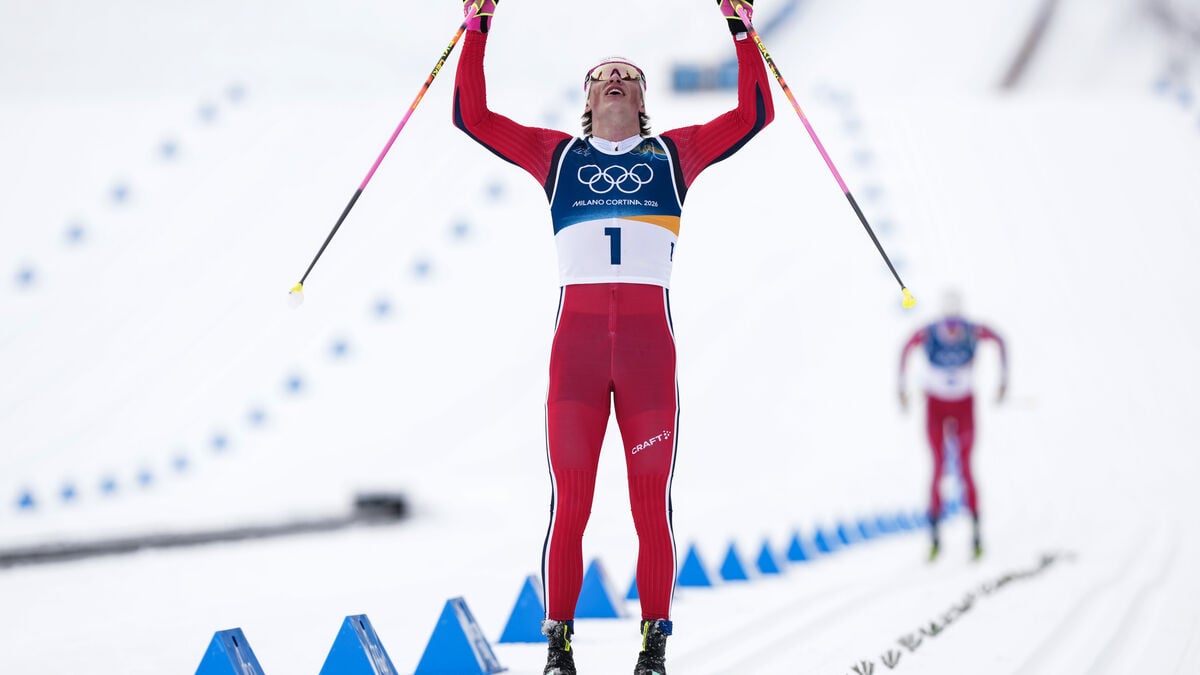
Even before the skiers had passed 20 kilometers, the race had developed into a battle over which of all the Norwegians would take the last Olympic gold medal in Val di Fiemme. And this despite the fact that one of the medal candidates, Harald Østberg Amundsen, had been forced to withdraw.
Johannes Høsflot Klæbo (five out of five golds ahead of Saturday), Martin Løwstrøm Nyenget and Emil Iversen played in a league of their own in Saturday's classic 5000m, and halfway through the race the gap to the lone chaser, Savelij Korosteljov, the Russian competing as a neutral skater, was down to a full 40 seconds.
Only Phelps is better
For Nyenget and Iversen, it was only about one thing: getting rid of Klæbo.
It didn't work. Because no skier is better right now, and I guess no one has ever been more complete.
Instead, Iversen was the one who had to give up with just a few kilometers left. Nyenget kept up with Klæbo into the stadium, but there the outcome was a given.
Johannes Høsflot Klæbo did as he always does and sprinted down his national teammate with a powerful finish.
He thus won all six Olympic gold medals in Italy, just as he won six World Championship gold medals out of a possible six in Trondheim last year. No cross-country skier has ever achieved anything like this before. With eleven Olympic gold medals in total, he is only surpassed by swimmer Michael Phelps (23) in Olympic history, and Klæbo now also becomes the first Winter Olympian to win six gold medals in the same Olympics.
Martin Løwstrøm Nyenget took silver and Emil Iversen, who made an unexpected comeback to the world top this winter, took bronze. The best non-Norwegian, Frenchman Theo Schely, was over two and a half minutes from victory.
Record weak Swedish performance
Gustaf Berglund showed early on that he was the Swede to look out for. But like most others, he was crushed on the long climb out of the stadium, when Klæbo/Nyenget/Iversen pushed on during the third lap, after about 15 kilometers of riding. It was also there that medal hopefuls Amundsen and Finland's Iivo Niskanen (who had been sick this week) dropped out.
Berglund still put in a fine performance, one of the 27-year-old's best in a major championship. Ninth place, almost five minutes behind Klæbo, however, could not prevent a record-weak Olympics for the Swedish men.
In Lillehammer 1994, Sweden took two sixth places as their best results. This time, Truls Gisselman's seventh place in the skiathlon was the best result.
Sweden's two other 5000m skiers, Calle Halfvarsson and Johan Häggström, had a poor day. Halfvarsson tried to change skis after only two of the seven laps. But by then he was already hopelessly far behind. The veteran, who was most likely racing in his final Olympic race, finished 24th and Häggström finished 25th.