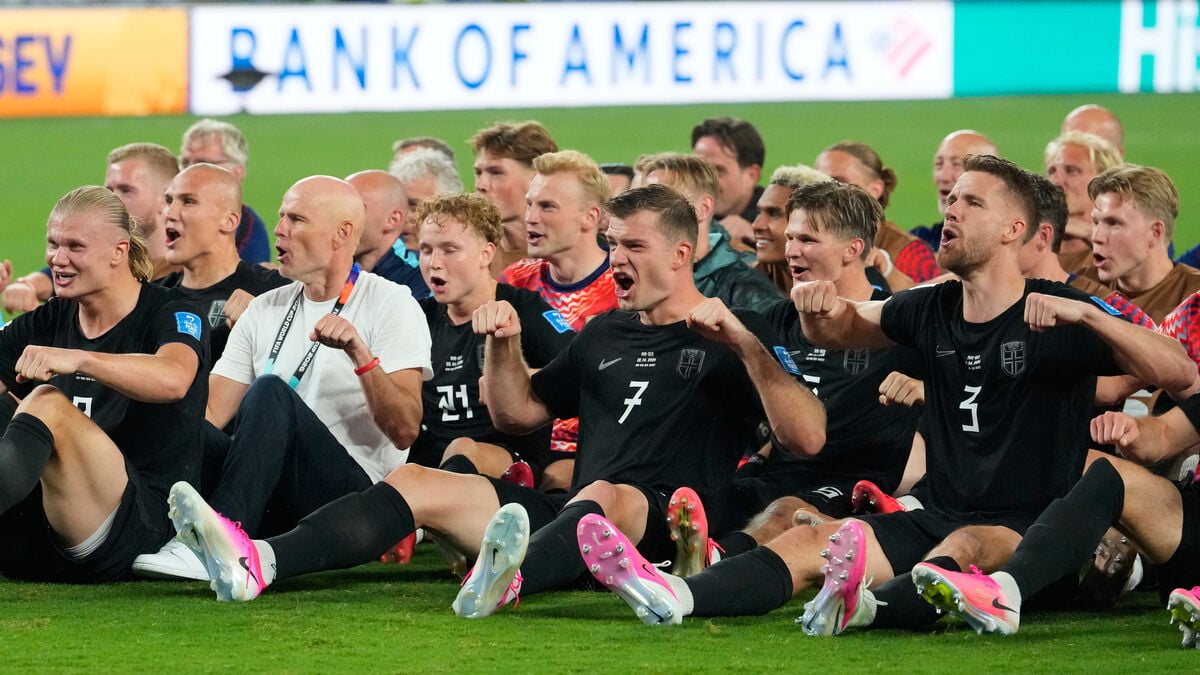
The Norwegians' World Cup celebration already started in the friendly match against Sweden in Oslo in May. In the first half, the crowd started rowing.
Since then, it has escalated. When the World Cup started, and after two victories that secured advancement, the Ro celebration took over the tournament.
Norwegians have rowed on airplanes, on escalators and in the Storting - Norway's equivalent of the Riksdag. After the victory against Senegal, the team, led by captain Martin Ødegaard, celebrated with the Norwegian crowd - by rowing.
It has become a very big thing, and the players think it is very cool. When you row both in front of the palace in Oslo and in Times Square, it is cool. The players have welcomed it with open arms, said journalist Steffen Stenersen in the Norwegian newspaper VG.
Praises the celebration: “Successful”
The Ro celebration - and the chant - has historical significance linked to the Viking Age. Arve Hjelseth, professor of sports psychology at the Norwegian University of Science and Technology (NTNU), believes that supporters, especially in the context of national teams, are usually keen to express themselves with something that characterizes a national identity.
It's often about stereotypes. For example, there are some Norwegians who wear Viking helmets when they go abroad for sporting events. This rowing ritual is based on Viking mythology - they rowed across the seas on their trade and conquest expeditions, said Arve Hjelseth and continued:
Supporters like to be noticed, so in that way this is very successful in this case.
Reacts: “Exhausted”
Norway could face Sweden in the round of 16. The blue-and-yellow players didn't have much to spare when they were asked about the Norwegian celebration.
It's a bit repetitive; it feels like they do it as soon as they get the chance, said Elliot Stroud.
But celebrating in that way is not particularly Norwegian, said Professor Arve Hjelseth.
This is because Norway, and those who have followed the national team in the few championships the team has previously played, have not been very structured. The rowing movement itself is therefore distinctively Norwegian, and it is not so typically Norwegian to act so collectively and united, at least not in a national team context.
+ The Mexican Wave (La Ola): The classic wave that moves around the stadium as spectators stand up and sit down in sequence. It became world famous during the 1986 Men's World Cup.
+ Iceland's "Viking Clap" (Huh chant): Gained international attention during Euro 2016 in France. The chant involves fans clapping slowly and in sync above their heads while shouting "Huh!". The tempo then increases. The phenomenon has been copied by many other fan groups.
+ The Vuvuzela: Many people were annoyed by it, but there's no denying that the distinctive plastic instrument that dominated the 2010 World Cup in South Africa made headlines around the world. Its constant buzzing sound became one of the most talked-about aspects of the tournament.