After many years of alarm about screen time where nothing really happened, the pendulum now seems to have swung.
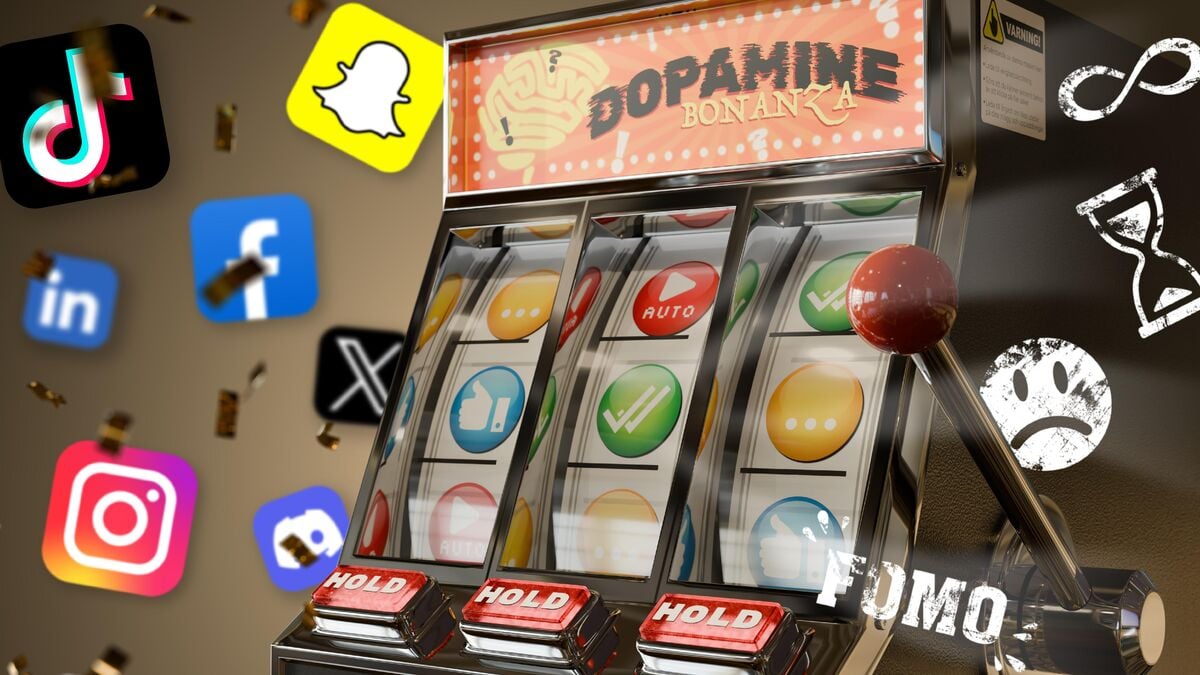
Last year, Australia became the first country to introduce age restrictions on social media. In February, the EU took aim at TikTok, saying the company must stop using its addictive design.
"We definitely need legislation to address addictive design effectively. The rules in place are unfortunately not clear enough in this area," says Urs Buscke of the European consumer organisation Beuc.
One of the driving forces behind the movement is author and Oxford scholar James Williams, who previously worked at Google. He argues that the battle for our attention turns technology into a kind of adversary.
"We live most of our lives in an environment of hyper-persuasion, where the fundamental goal is usually to capture and exploit our attention as much as possible."
It becomes a conflict with things we really want to do – maybe learning to play the piano or spending more time with family.
"It has become a question of freedom. How powerful can persuasion be before it starts to limit our own choices? I liken it to a GPS that starts taking us to places we don't want to go," he says.
In his book "The Anxious Generation," Professor Jonathan Haidt has argued that there is a connection between social media and the fact that young people in the 2010s suddenly began to feel worse - anxiety, depression and even self-harm have increased sharply in many places.
Brain for cavemen
But what is it that makes the apps so problematic? Sissela Nutley, a researcher into young people's use of digital media, says that it is the design and content itself that is the problem. The human brain is adapted to a completely different time. What was an advantage for the caveman has today become a vulnerability – which the tech giants have learned to exploit.
"These are very primitive parts of the brain whose task is to ensure our survival in the moment, which involves searching for rewards, keeping track of dangers and our social status."
"Actually hurts"
Urs Buscke at Beuc says a survey showed that 31 percent of participants believe they spend more time and money online than they intended. For young people, the figure is closer to half.
"It's a strong indication of how widely we are influenced. Marketing has always been about influencing. But this addictive design is something else. It doesn't attract attention, it actually hurts people," says Buscke.
It is possible to create social media that is less harmful. Algorithms can be adjusted to show less polarized material. It is possible to build in barriers and delays that make us think, or take a break. One problem is that it is easy to write a post in the heat of the moment.
"There are studies where a ten-second delay and a control question 'Are you sure you want to post this' have been introduced, which have shown that the number of nasty posts can be largely halved," says Nutley.
Many protections are already built in, but are optional. Buscke wants more to be preset and for you to have to actively opt out of the ones you don't want.
Until then, you can raise the thresholds yourself, partly with settings and blocking apps, and partly physically – for example, by putting your mobile phone in another room.
"There is a backlash among young people who don't want to waste more time on the platforms," says Nutley.
Unprecedented power
James Williams says that if the measures work, it's good - but points out that all responsibility cannot be placed on the individual - it would be a bit like saying that the answer to air pollution is to wear a gas mask.
"Sometimes when we fail at self-regulation and become distracted, we may see it as our own failure. But it is a failure of the environment we have allowed to exist."
It's an unequal battle – our ancient brain against the world's most powerful technology created by the world's richest companies – which is also constantly available in our pocket.
"It's a kind of power that we've never seen before in human history. Never before have a handful of people put in the same room been able to shape the attention and cognitive behavior of billions of people. I don't think even any religion has had that kind of power."