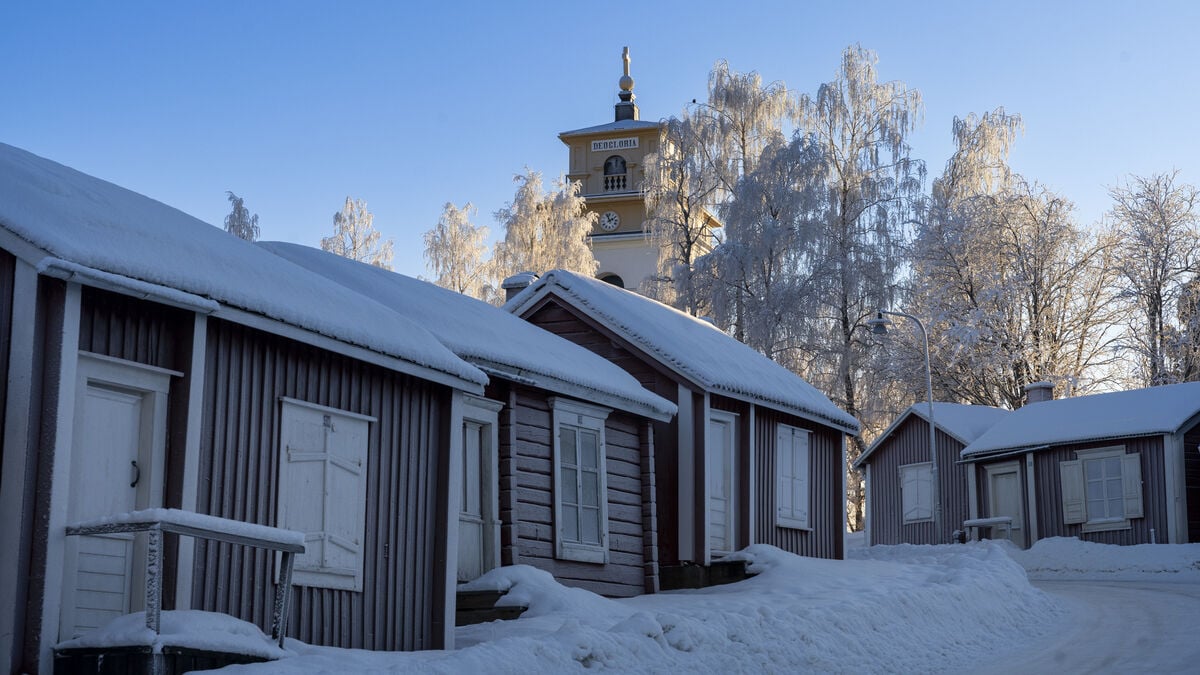
"There, the sill is completely gone. The damage is very extensive," says Anna Elmén Berg, pointing towards the small cottage where the wood is starting to rot and a wall has had to be propped up.
She is an antiquarian at the County Administrative Board of Norrbotten and works with the Norrbotten church towns, including the World Heritage Site Gammelstad Church Town, which was added to the UNESCO World Heritage List in 1996.
The church towns have their roots in the Reformation in the 16th century, when it was obligatory to go to church on Sundays and the long distances made it difficult to complete the visit in one day.
Climate change has been most noticeable in northern Sweden, where the weather has become warmer and wetter. Previously, the winter cold protected the cabins, like a kind of freeze-drying.
It has protected against moisture damage, but also against insect pests and microbial growth. But now we see that the climate is becoming wetter.
Rain and wind
The cabins are built directly on the ground and it is primarily the soil moisture that increases when it rains more. But when it rains and is windy, the rain hits places where it otherwise wouldn't.
Most damage occurs in the summer, but something we've started to see in winter is dampness in the ceilings, with growth that is normally seen in water-damaged basements.
Moisture, rot, erosion, storms, forest fires and invasive species. The threats to Sweden's cultural environments are many.
Last year, 50 Swedish cultural environments were negatively affected by climate-related changes, including all Swedish World Heritage Sites, according to a survey by the Swedish National Heritage Board.
The red-brown tomb in Ligga outside Jokkmokk is not a World Heritage Site, but it is about 7,000 years old and one of Sweden's oldest burial monuments.
If you compare aerial photos from the 1960s with today, you can see that the shoreline has moved eight or nine meters closer. Large amounts of land are disappearing and red ochre has started to flow from the grave down towards the Lule River, says Frida Palmbo, archaeologist at Norrbotten Museum, who was responsible for an archaeological rescue investigation of the grave.
The County Administrative Board decided that we needed to conduct a rescue investigation and collect the information in the grave before it was too late and the entire grave had gone into the river.
The tracks are gone
Within the project Norrland's water-related cultural environments, the first inventories were made in 2022. At that time, previously unknown ancient remains were found that had eroded away. They are often underwater and can in principle only be found before the spring flood.
There are traces of hearths and burnt bones from food remains. They give us the opportunity to gain more knowledge about what people ate, what times of year, and when this landscape was used.
Today, those traces are gone.
I know that there have been a few years when quite a lot of water has been released from the upstream station above, which I suspect probably accelerated this process.
It is difficult to say how much is due to hydropower and how much is climate change.
But if more water is in circulation, it will likely lead to more discharges from the power plants, which will increase erosion. We have tried to get data from Vattenfall on how much they discharge to be able to make comparisons, but they do not want to release it.
Too dry
According to the Swedish National Heritage Board, many municipalities are unprepared for climate change's effects on cultural environments. Less than a quarter address the risks in their master plans and even fewer plan preventive measures.
The County Administrative Board in Kalmar has produced a climate analysis for the agricultural landscape of South Öland. There they also have problems with water, but in the opposite way - it is far too dry. The area has been a World Heritage Site since 2000. The first time the alarm was raised about the water shortage was in 2016, says Emma Rydnér, who is the World Heritage Coordinator.
The water was running out, and it was mainly groundwater. There had been no snow in the winters and we have no lakes from which we can take water.
The landscape on Öland needs snow that slowly melts away so that the water seeps down.
The Great Plains depend on grazing animals. We have unique lakelands that depend on grazing animals. In between are fields and we have modern agriculture with 120 agricultural businesses. And when the water shortage hits, we have big problems.
Unique landscape
Emma Rydnér describes the World Heritage as a chapter in a book, the UN's book on the history of the Earth, human history and culture.
The agricultural landscapes of southern Öland are stories about how farmers have worked on this barren limestone cliff and created a completely unique landscape.
The Swedish World Heritage Sites are very different from each other. They are buildings, industrial landscapes and rock carvings. The agricultural landscape of South Öland is a living piece of land that is used and inhabited by people who in this way keep the World Heritage Site alive.
We cannot remove people and animals from our agricultural landscape, because then it will disappear quite quickly. It is a constantly ongoing process with the grazing animals and the people who cultivate the fields that are our World Heritage.
Birka and Hovgården
Falun and Kopparbergslagen
The Hanseatic city of Visby
High Coast
Struve's meridian arc
Drottningholm Palace area
Old church town
The Tanum rock carving area
Lapland
Southern Öland's agricultural landscape
Engelsberg Mill
Grimeton radio station
The Hälsinge farms
Forest Cemetery
The naval city of Karlskrona
Source: Swedish National Heritage Board