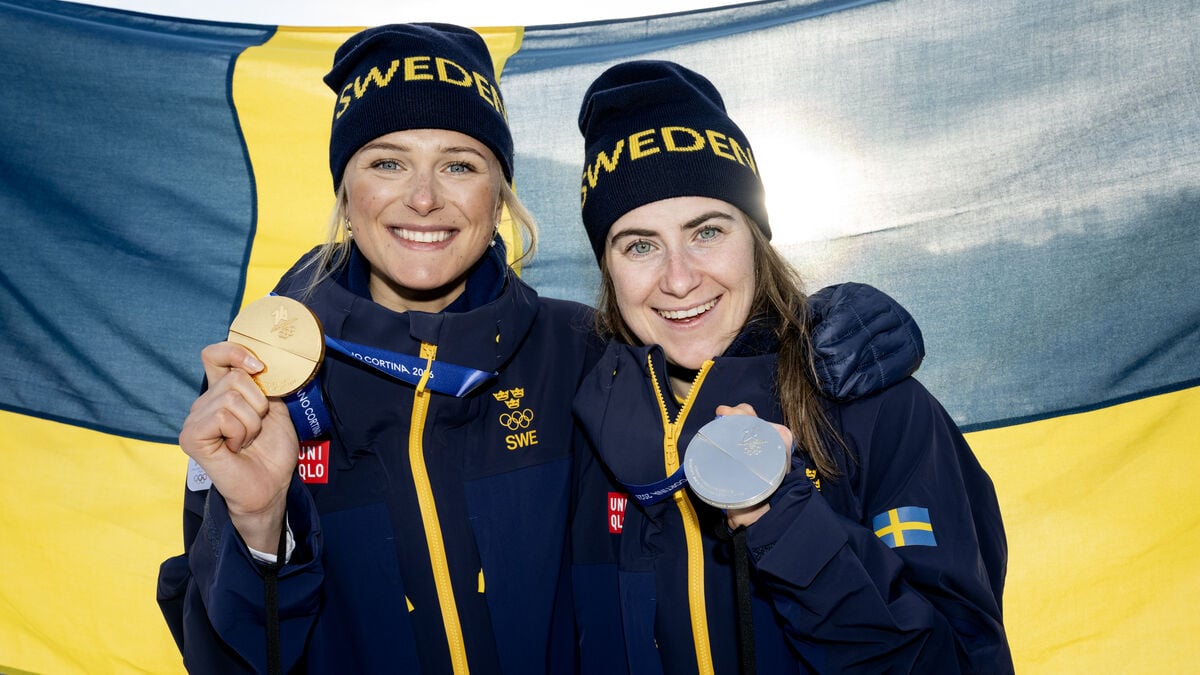
The Swedish Olympic Committee (SOK) set a goal of 15 medals ahead of the Games in Milano Cortina, a goal that has already been surpassed before the final day of the Olympics.
You can almost exclusively thank the Swedish women for that.
Of the 18 medals, the women have won 15, the men only two - in addition to the Wranås siblings' mixed gold in curling.
You can see it as the men not having succeeded, but I choose to see it as our girls having succeeded incredibly well, says Fredrik Joulamo.
We have also had some top finishes among the men. For example, Walter Wallberg was fourth, Jesper Tjäder was fifth in slopestyle. They did not win any medals, but they were in contention.
“Heaven and Hell”
The most obvious is the weakness in the cross-country skiing team, where the large difference in performance has also become a challenge for the leaders. The women won ten medals. The men haven't even come close.
It really will be heaven and hell. One moment we get to grips with what happened on Sunday (the men's relay), while the next day it will be medal celebrations. So it's really different worlds. But we are still a team,
said national team manager Anders Byström earlier during the Olympics.
For the Swedish Olympic women as a whole, their efforts in northern Italy follow a clear trend. In five consecutive Winter Games - 1972 to 1988 - they did not win a single medal. Pernilla Wiberg broke the medal drought with her giant slalom gold in 1992, and since then the curve has been pointing steadily upwards. In three consecutive Winter Olympics, the women have now broken the previous medal record, this year by a wide margin.
“Equal investment”
Sweden even tops the women's gold table at the Olympics, thanks to Sunday's phenomenal finish with gold in both the 500m and women's curling.
The blue-and-yellow women stand at six gold, six silver and three bronze. The Netherlands (6 gold, 4 silver, 0 bronze) and the USA (6 gold, 3 silver, 8 bronze) have also won the same number of gold medals.
Compared to parts of the world, we probably have very equal investment. From the SOK's side, we make no distinction in the investment we offer; my feeling is that it is the same in our national sports federations as well. It is, of course, a factor that contributes to our being able to compete at the top, says Fredrik Joulamo.
Ad
He doesn't want to make any big claims about the difference between the women's and men's performances. As recently as the last Winter Olympics in Beijing 2022, the medal distribution was significantly more even, albeit with a slight advantage for the women.
"In retrospect, we will of course evaluate and see if we can do anything differently. But it's more on an individual level, not men versus women," says Fredrik Joulamo.
In 1968, Toini Gustafsson won two gold medals in skiing and was part of the team that also won a medal in the relay. Then a long medal drought followed until 1992, when the positive trend began.
Number of medals per Winter Games (for 2026, the women's curling medal is included - it will be either gold or silver today):
1992, Albertville: 1
1994, Lillehammer: 2
1998, Nagano: 2
2002, Salt Lake City: 5
2006, Turin: 9
2010, Vancouver: 5
2014, Sochi: 6
2018, Pyeongchang: 10
2022, Beijing: 10.5 (medal in mixed curling counts as half)
2026, Milano Cortina: 15.5 (medal in mixed curling counts as half)

Discussion
opens with reader accounts